Summary
This update and revision of the international guideline for urticaria was developed in accordance with the methods recommended by Cochrane and the Grading of Recommendations Assessment, Development and Evaluation (GRADE) working group. It is an initiative of the Global Allergy and Asthma Excellence Network (GA2LEN) and its Urticaria and Angioedema Centers of Reference and Excellence (UCAREs and ACAREs), with the participation of 210 delegates from 107 national and international societies, from 59 countries. The consensus conference was held on December 6th, 2024. This guideline was acknowledged and accepted by the European Union of Medical Specialists (UEMS). Urticaria is a frequent, mast cell‐driven disease, defined by a rapid appearance of wheals, angioedema, or both. The lifetime prevalence of acute urticaria is estimated to be approximately 20%. Chronic urticaria, categorized as either chronic spontaneous urticaria or chronic inducible urticaria, is disabling, impairs quality of life, and affects performance at work and school, however, novel therapies are available. This updated version of the international guideline for urticaria covers the definition and classification of urticaria and outlines expert‐guided and evidence‐based diagnostic and therapeutic approaches for the different subtypes of urticaria.
Keywords: angioedema, consensus, evidence‐based, hives, itch, mast cell, urticaria, wheals
angioedema activity score
ACAREAngioedema Center of Reference and Excellence
ACEangiotensin‐converting enzyme
AECTangioedema control test
AE‐QoLangioedema quality of life questionnaire
AGREEAppraisal of Guidelines Research and Evaluation
AOSDAdult‐onset Still's disease
APAAACIAsia Pacific Association of Allergy, Asthma and Clinical Immunology
APSTAutologous Plasma Skin Test
ARIAallergic rhinitis and its impact on asthma
ASSTautologous serum skin test
BATbasophil activation test
BHRAbasophil histamine release assay
BSACIBritish Society for Allergy & Clinical Immunology
C1INHC1 esterase inhibitor
C4C4 Complement Protein
CAPScryopyrin‐associated periodic symptoms
CholUAScholinergic urticaria activity score
CIndUchronic inducible urticaria
CNScentral nervous system
COIconflict of interest
COX‐2cyclooxygenase‐2 enzyme
CRPC‐reactive protein
CSUchronic spontaneous urticaria
CSUaiTIchronic spontaneous urticaria autoimmunity Type I or autoallergic CSU
CSUaiTIIbchronic spontaneous urticaria autoimmunity Type IIb
CSUucCSU due to an unknown cause
CUchronic urticaria
CU‐Q2oLChronic urticaria quality of life questionnaire
CYPcytochrome P
DPUdelayed pressure urticaria
EAACIEuropean Academy of Allergology and Clinical Immunology
EDFEuropean Dermatology Forum
EDHMEosinophilic Dermatosis of Hematologic Malignancy
ESRerythrocyte sedimentation rate
EtDevidence‐to‐decision
FCASFamilial Cold Autoinflammatory Syndrome
FDA[The United States] Food and Drug Administration
GA2CIGulf Academy of Allergy and Clinical Immunology
GA2LENGlobal Asthma and Allergy Excellence Network
GRADEGrading of Recommendations Assessment, Development and Evaluation
HAEhereditary angioedema
HEShypereosinophilic syndromes
HIDShyper‐IgD syndrome
IgE/Gimmunoglobulin E/G
IL‐4/13interleukin 4/13
IVIG (also IGIV)intravenous immunoglobulins
MCASmast cell activation syndrome
MRGPRX2Mas‐related G‐protein coupled receptor member X2
MWSMuckle‐Wells‐Syndrome
NOMIDNeonatal Onset Multisystem Inflammatory Disease
N‐PFnon‐personal financial interest
NSAIDnonsteroidal anti‐inflammatory drugs
OASoral allergy syndrome
PAFplatelet activating factor
PETpositron emission tomography
PFpersonal financial interest
PICOPatient/Problem/Population, Intervention, Comparison/Control/Comparator, Outcome (a technique used in evidence‐based medicine)
PN‐Fpersonal nonfinancial interest
PROMpatient‐reported outcome measure
QoLquality of life
REMrapid eye movement
sJIAsystemic‐onset juvenile idiopathic arthritis
TNFtumor necrosis factor
TPOthyroid peroxidase
TRAPStumor necrosis factor receptor alpha‐associated periodic syndrome
UASurticaria activity score
UCAREurticaria center of reference and excellence
UCTurticaria control test
UEMSEuropean Union of Medical Specialists
UVultraviolet
WHOWorld Health Organization
1. Introduction
The guideline is an initiative of the Global Allergy and Asthma Excellence Network (GA2LEN) and its Urticaria and Angioedema Centers of Reference and Excellence (UCAREs and ACAREs), the European Dermatology Forum (EDF), the Asia Pacific Association of Allergy, Asthma and Clinical Immunology (APAAACI), the American Academy of Dermatology (AAD), the British Society for Allergy & Clinical Immunology (BSACI), and the Gulf Academy of Allergy and Clinical Immunology (GA2CI), providing funding for the development of the guideline, which is an update and revision of the International EAACI/GA2LEN/EuroGuiDerm/APAAACI guideline on urticaria published in 2022 [1]. There was no funding from other sources, except that several of the supporting societies have provided travel funding for their delegates.
The present update and revision of the guideline was undertaken by a panel of 213 urticaria experts from 59 countries, nominated as delegates by 107 participating national and/or international medical or scientific societies and patient organizations (Table 1). All the aforementioned societies endorse this guideline. The update and revision of this guideline is based on evidence and expert consensus and was developed following the methods recommended by Cochrane and the Grading of Recommendations Assessment, Development and Evaluation (GRADE) working group. The work of the expert panel was supported by a team of EuroGuiDerm methodologists led by PD Dr. Ricardo Werner (Table 2) and included the contributions of the participants of the hybrid consensus conference, held on December 6th 2024, in Berlin, Germany.
Members of the expert panel.
| Title | First name | Last name | Country | Nominating society | Affiliations | Role |
|---|---|---|---|---|---|---|
| Dr. | Zainab | Abdul Hameed Ansari | Oman | Gulf Academy of Allergy and Clinical Immunology | Clinical Immunology & Allergy, Internal Medicine, Royal Hospital, Oman | Co‐author |
| Dr. | Amir Hamzah | Abdul Latiff | Malaysia | Malaysian Society of Allergy and Immunology | Pantai Hospital Kuala Lumpur, Allergy & Immunology Centre | Co‐author |
| Prof. | Mohamed | Abuzakouk | United Arab Emirates | Gulf Academy of Allergy and Clinical Immunology | Cleveland Clinic Abu Dhabi, Allergy and Immunology | Co‐author |
| Dr. | Maria Socorro | Agcaoili‐De Jesus | Philippines | Philippine Society of Allergy, Asthma & Immunology | University of the Philippines‐Philippine General Hospital, Division of Allergy and Immunology, Department of Medicine | Co‐author |
| Dr. | Rosana Câmara | Agondi | Brazil | Brazilian Association of Allergy and Clinical Immunology | Hospital das Clínicas da Universidade de São Paulo, Clinical Immunology and Allergy Division—Internal Medicine Department | Co‐author |
| Prof. | Mona | Al‐Ahmad | Kuwait | Kuwait Society of Allergy and Clinical Immunology | College of Medicine, Kuwait University, Kuwait, and Al‐Rashed Allergy Center, Ministry of Health, Kuwait | Co‐author |
| Prof. | Abdullah A. | Alangari | Saudi Arabia | Saudi Allergy Asthma and Immunology Society | Allergy and Immunology Unit, Department of Pediatrics, College of Medicine, King Saud University | Co‐author |
| Dr. | Hamad | Alhameli | United Arab Emirates | Gulf Academy of Allergy and Clinical Immunology | Cleveland Clinic Abu Dhabi, Allergy and Clinical immunology | Co‐author |
| Dr. | Cesar Daniel | Alonso Bello | México | Colegio mexicano de immunología clínica y alergia | Hospital Juárez de México, Allergy and Immunology | Co‐author |
| Dr. | Saad | Alshareef | Saudi Arabia | Gulf Academy of Allergy and Clinical Immunology | Allergy Immunology, King Faisal Specialist Hospital and Research Center | Co‐author |
| Dr. | Salem | Al‐Tamemi | Oman | Gulf Academy of Allergy and Clinical Immunology | Sultan Qaboos University Hospital, Child Health; Omani Society of Allergy & Clinical Immunology | Co‐author |
| Dr. | Sabine | Altrichter | Austria | Austrian society for Allergology and Immunology | Kepler University Hospital, Department of Dermatology and Venerology | Co‐author |
| M.D. MSc. | João Luís | Alves Marcelino | Portugal | Portuguese Society for Allergology and Clinical Immunology | Immunology and Allergology Department, Hospital de São Bernardo, ULS Arrábida, Portugal | Co‐author |
| Dr. | Humaid A. | Al Wahshi | Oman | Oman Society of Rheumatology (OSR) | Royal Hospital, Oman | Co‐author |
| Dr. | Susan | Aquilina | Malta | Maltese Association of Dermatology and Venereology | Department of Dermatology, Mater Dei Hospital, Malta | Co‐author |
| Dr. | Miriam | Araújo | Portugal | Sociedade Portuguesa de Alergologia e Imunologia Clinica | Serviço de Imunoalergologia do Hospital Dona Estefânia, CHULC E.P.E | Co‐author |
| Dr. | Rand | Arnaout | Saudi Arabia | Gulf Academy of Allergy and Clinical Immunology | King Faisal Specialist Hospital and Research Center, Medicine | Co‐author |
| Dr. | Riccardo | Asero | Italy | Associazione Allergologi Immunologi Italiani Territoriali e Ospedalieri | Clinica San Carlo, Ambulatorio di Allergologia | Co‐author |
| Prof. | Barbara | Ballmer‐Weber | Switzerland | Swiss Society of Allergy and Clinical Immunology | Department of Dermatology, University Hospital Zurich and Clinic for Dermatology and Allergology Kantonsspital St. Gallen | Co‐author |
| Dr. | Christine | Bangert | Austria | Austrian Society of Dermatology and Venereology | Medical University of Vienna, Department of Dermatology | Co‐author |
| Prof. | Andrea | Bauer | Germany | Arbeitsgemeinschaft für Berufs‐ und Umweltdermatologie e.V. | University Hospital Carl Gustav Carus, Department of Dermatology | Co‐author |
| Dr. | Moshe | Ben‐Shoshan | Canada | Canadian Society of Allergy and Clinical Immunology | Montreal Children's Hospital allergy clinic, Pediatrics, Division of Allergy Immunology and Dermatology | Co‐author |
| Dr. | Jonathan | Bernstein | USA | UCARE | University of Cincinnati Department of Internal Medicine, Division of Rheumatology, Allergy and Immunology, Advanced Allergy Services LLC and Bernstein Clinical Research Center LLC | Co‐author |
| Prof. | Carsten | Bindslev‐Jensen | Denmark | Danish Society of Allergology (DSA) | Allergy Center—ORCA, Department of Dermatology and Allergy Center—ORCA | Co‐author |
| Prof. | Mojca | Bizjak | Slovenia | Slovenian Association of Allergology & Clinical Immunology, Association of Slovenian Dermatovenereologists | University Clinic of Respiratory and Allergic Diseases Golnik, Division of Allergy; Faculty of Medicine, University of Ljubljana, Slovenia; Faculty of Medicine, University of Maribor, Slovenia | Co‐author |
| Dr. | Isabelle | Boccon‐Gibod | France | Société Française d'Allergologie (SFA) | National Reference Center for Angiœdema CREAK, Internal medicine and Clinical Immunology | Co‐author |
| Dr. | Hanna | Bonnekoh | Germany | Autoinflammation Network e.V. | Institute of Allergology, Charité—Universitätsmedizin Berlin, Corporate Member of Freie Universität Berlin and Humboldt‐Universität zu Berlin, Berlin, Germany; Fraunhofer Institute for Translational Medicine and Pharmacology ITMP, Immunology and Allergology, Berlin, Germany | Co‐author |
| Prof. | Laurence | Bouillet | France | CREAK‐Centre de reference for bradykinin‐mediated angioedema | CREAK, Service de médecine interne, CHUGA | Co‐author |
| Prof. | Knut | Brockow | Germany | German Dermatological Society | Department of Dermatology and Allergy Biederstein, Faculty of Medicine and Health, Technical University of Munich | Co‐author |
| Prof. | Zenon | Brzoza | Poland | Polish Society of Allergology | University of Opole, Department of Internal Diseases, Allergology, Endocrinology, and Gastroenterology | Co‐author |
| Dr. | Maja | Bulatović Ćalasan | The Netherlands | Dutch Society of Allergology and Clinical Immunology | University Medical Center Utrecht, Rheumatology and Clinical Immunology | Co‐author |
| Dr. | Adeeb | Bulkhi | Saudi Arabia | Saudi Allergy Asthma and Immunology Society | Department of Internal Medicine, College of Medicine, Umm Al‐Qura University, Makkah, Saudi Arabia | Co‐author |
| Dr. | Thomas | Buttgereit | Germany | ACARE | Institute of Allergology, Charité—Universitätsmedizin Berlin, Corporate Member of Freie Universität Berlin and Humboldt‐Universität zu Berlin, Berlin, Germany; Fraunhofer Institute for Translational Medicine and Pharmacology ITMP, Immunology and Allergology, Berlin, Germany | Co‐author |
| Prof. | Anette | Bygum | Denmark | Danish Dermatological Society | Clinical Institute, University of Southern Denmark | Co‐author |
| Dr. | Teresa | Caballero | Spain | The Spanish Society of Allergology and Clinical Immunology | Allergy Department, Hospital Universitario La Paz, IdiPAZ, CIBERER | Co‐author |
| Dr. | Oscar | Calderon | Peru | Sociedad Peruana de Alergia, Asma e Inmunología | Clinica Sanna el Golf, San Isidro, Allergy Unit | Co‐author |
| Prof. | Regis | Campos | Brazil | Brazilian Association of Allergy and Clinical Immunology | Complexo Hospitalar Universitário, Universidade Federal da Bahia, Internal Medicine | Co‐author |
| Dr. | Mauro | Cancian | Italy | Italian Network for Hereditary and Aquired Angioedema | Departmental Allergy Unit, Department of Systems Medicine | Co‐author |
| Ms. | Emily | Carne | United Kingdom | All Wales Allergy Network | Allergy Service for Wales | Co‐author |
| Prof. | Mary Anne | Castor | Philippines | Philippine Society of Allergy, Athma & Immunology | Division of Allergy and Immunology, Department of Pediatrics, University of the Philippines Manila ‐ Philippine General Hospital | Co‐author |
| Dr. | Inmaculada | Cerecedo | United Arab Emirates | Gulf Academy of Allergy and Clinical Immunology | Cleveland Clinic Abu Dhabi, Allergy and Clinical Immunology, Respiratoy Institute | Co‐author |
| Dr. | Tubanur | Çetinarslan | Turkey | Dermatovenereology Association of Türkiye | Manisa Celal Bayar University, Dermatology and Venereology | Co‐author |
| Prof. | Ivan | Cherrez‐Ojeda | Ecuador | Sociedad Ecuatoriana de Alergia, Asma e Inmunología Centro Sur Occidental | Espiritu Santo University; Institute of Allergology, Charité‐Universitätsmedizin Berlin, Corporate Member of Freie Universität Berlin and Humboldt University; Respiralab Research Center | Co‐author |
| Dr. | Nana | Chkhikvadze | Georgia | European Academy of Allergy and Clinical Immunology | Allergy and Immunology, Center of Allergy and Immunology, Tbilisi, Georgia | Co‐author |
| Prof. | Herberto Jose | Chong‐Neto | Brazil | Brazilian Society of Pediatrics | Serviço de Alergia e Imunologia, Complexo Hospital de Clínicas, Universidade Federal do Paraná, Pediatrics | Co‐author |
| Dr. | Karen | Choo | Singapore | Allergy and Clinical Immunology Society, Singapore | Urticaria Clinic, Singapore General Hospital, Department of Dermatology | Co‐author |
| Prof. | George | Christoff | Bulgaria | Bulgarian Alliance of CLinical and Translational Allergy | Medical Center Excelsior Ltd. | Co‐author |
| Prof. | Chia‐Yu | Chu | Taiwan | Taiwanese Dermatological Association | Immunology Clinic, Department of Dermatology, National Taiwan University Hospital | Co‐author |
| Prof. | Niall | Conlon | Ireland | Irish Association of Allergy and Immunology | St. James's Hospital, Department of Clinical and Diagnostic Immunology | Co‐author |
| Dr. | Célia | Costa | Portugal | Sociedade Portuguesa de Alergologia e Imunologia Clinica | Serviço de Imunoalergologia, Unidade Local de Saúde Santa Maria (ULSSM), Lisboa, Portugal | Co‐author |
| Prof. | Timothy | Craig | USA | The American College of Allergy, Asthma and Immunology | Pediatrics, Ob/Gyn and Biomedical sciences, Penn State University, Hershey, PA, USA; Senior Advisor Vinmec International Hospital, Times City, Hanoi Vietnam | Co‐author |
| Prof. | Paulo Ricardo | Criado | Brazil | Brazilian Society of Dermatology | Alergoskin Alergia e Dermatologia SS Ltda, and Centro Universitário Faculdade de Medicina do ABC, Dermatology | Co‐author |
| Dr. | Inna | Danilycheva | Russia | Russian Association of Allergologists and Clinical Immunologists | NRC Institute of Immunology FMBA of Russia, Allegology | Co‐author |
| Prof. Dr. | Razvigor | Darlenski | Bulgaria | European Dermatology Forum | Excelsior Med Center/Acibadem Cityclinic Tokuda hospital (inpatients), Department of dermatology and venereology | Co‐author |
| Dr. | Erika | De Arruda Chaves | Peru | Sociedad Peruana de Alergia Asma e Immunologia | Clinica Anglo Americana, Allergy and Inmunology | Co‐author |
| Prof. | Laurence | de Montjoye | Belgium | Belgian Urticaria Working Group/Royal Belgian Society of Dermatology and Venereology | Dermatology Department, Cliniques Universitaires Saint‐Luc, Université catholique de Louvain | Co‐author |
| Prof. | Marie‐Sylvie | Doutre | France | The French Society of Dermatology | Bordeaux University Hospital, Dermatology | Co‐author |
| Dr. | Aurélie | Du‐Thanh | France | The French Society of Dermatology | CHU de Montpellier, Dermatology | Co‐author |
| Prof. | Didier | Ebo | Belgium | Koninklijke Artsenvereniging van Antwerpen V.Z.W. Royal Medical Association of Antwerp | Antwerp University Hospital, Immunology Allergology Rheumatology | Co‐author |
| Dr. | Shuayb | Elkhalifa | United Arab Emirates | Gulf Academy of Allergy and Clinical Immunology | Allergy and Immunology Division, Cleveland Clinic Abu Dhabi, Abu Dhabi, United Arab Emirates; Faculty of Biology, Medicine and Health, Centre for Musculoskeletal Research, The University of Manchester, Manchester, United Kingdom | Co‐author |
| Dr. | Sarina | Elmariah | USA | American Academy of Dermatology |
Clinical Dermatology Department of Dermatology, University of California, San Francisco, USA | Co‐author |
| Dr. | Tariq | El‐Shanawany | Wales | British Society for Allergy and Clinical Immunology | University Hospital of Wales, Department of Immunology and Allergy | Co‐author |
| Dr. | Luis Felipe | Ensina | Brazil | Brazilian Association of Allergy and Clinical Immunology | Federal University of São Paulo, Division of Allergy, Immunology and Rheumatology—Department of Pediatrics | Co‐author |
| Prof. | Ragıp | Ertaş | Turkey | Turkish Society of Dermatology | Health Sciences University, Kayseri Faculty of Medicine, Kayseri City Hospital, Department of Dermatology, Urticaria Center of Reference and Excellence Clinic. | Co‐author |
| Prof. | Roberta | Fachini Jardim Criado | Brazil | Rede Urticária Brasil | Ucare Faculdade De Medicina Do Abc (Abc Medical School), Department of Dermatology | Co‐author |
| Prof. | Marta | Ferrer | Spain | The Spanish Society of Allergology and Clinical Immunology | Clinica Universidad de Navarra, Allergy | Co‐author |
| Dr. | Silvia | Ferrucci | Italy | Società italiana di Dermatologia Allergologica, Professionale e Ambientale | Dermatology unit. Fondazione IRCCS Ca′ Granda Ospedale Maggiore Policlinico of Milan. Italy | Co‐author |
| Dr. | Jie Shen (Jason) | Fok | Australia | Australasian Society of Clinical Immunology and Allergy | Immunology/Allergy Clinic, Box Hill Hospital, Department of Respiratory Medicine | Co‐author |
| Dr. | Daria | Fomina | Russia | Russian Association of Allergologists and Clinical Immunologists |
Moscow City Research and Practical Center of Allergology and Immunology, City Clinical Hospital 52, Russia; 2. Dept. of Clinical Immunology and Allergology, I.M. Sechenov First Moscow State Medical University (Sechenov University), Moscow, Russian Federation | Co‐author |
| Prof. | Luz | Fonacier | USA | American College of Allergy, Asthma and Immunology | NYU Grossman Long Island School of Medicine, Allergy and Immunology | Co‐author |
| Dr. | Ghada E. | Fouda | Egypt | UCARE | Food and Drug Allergy Center, Allergy and Immunology, Cairo, Egypt | Co‐author |
| Ms. | Isadora | Francescantonio | Brazil | Associação dos Magistrados Brasileiros/Brazilian Society of Allergy and Immunology | Ymune, Allergy and Immunology | Co‐author |
| Dr. | Atsushi | Fukunaga | Japan | The Japanese Society of Allergology | Osaka Medical and Pharmaceutical University, Department of Dermatology | Co‐author |
| Dr. | Cesar Alberto | Galvan Calle | Peru | Peruvian Immunology Society | Emedic Salud, San Isidro, Lima | Co‐author |
| Dr. | Elizabeth | Garcia | Colombia | Asociación Colombiana de Alergia, Asma e Inmunología | Fundación Santa fe de Bogotá‐ Faculty of medicine Universidad de los Andes‐ UNIMEQ ORL | Co‐author |
| Dr. | Krisztián | Gáspár | Hungary | Hungarian Dermatological Society | University of Debrecen, Faculty of Medicine, Department of Dermatology | Co‐author |
| Prof. | Asli | Gelincik | Turkey | Turkish National Society of Allergy and Clinical Immunology | Istanbul Faculty of Medicine Istanbul University, Immunology and Allergic Diseases | Co‐author |
| Prof. | Songmei | Geng | China | Chinese Dermatologist Association | Department of Dermatology, The Second Affiliated Hospital, School of Medicine, Xi'an Jiaotong University, Xi'an, China | Co‐author |
| Prof. | Ana Maria | Giménez‐Arnau | Spain | Academia Española De Dermatologia y Venereologia | Hospital del Mar Research Institute. Universitat Pompeu Fabra, Barcelona, Spain | Co‐author |
| Prof. | Kiran | Godse | India | Indian Association of Dermatologists, Venereologists and Leprologists | Dr. D Y Patil Medical College and Hospital | Co‐author |
| Prof. | Margarida | Gonçalo | Portugal | Sociedade Portuguesa de Dermatologia e Venereologia | Dermatology, University Hospital, Coimbra Local health Unit and Faculty of Medicine, University of Coimbra | Co‐author |
| Prof. | Maia | Gotua | Georgia | Georgian Academy of Allergy, Asthma, and Clinical Immunology | Center of Allergy and Immunology, Tbilisi, Georgia, UCARE; David Tvildiani Medical University, Tbilisi, Georgia | Co‐author |
| Prof. | Clive | Grattan | United Kingdom | British Society for Allergy & Clinical Immunology | St John's Institute of Dermatology, Guy's Hospital, London, UK | |
| Prof. | Martine | Grosber | Belgium | Belgian Urticaria Working Group/Royal Belgian Society of Dermatology and Venereology | Department of Dermatology, Vrije Universiteit Brussel (VUB), Universitair Ziekenhuis Brussel (UZ Brussel) | Co‐author |
| Prof. | Guillermo | Guidos Fogelbach | México | Colegio mexicano de immunología clínica y alergia | Instituto Politécnico Nacional, SEPI/ENMH | Co‐author |
| Prof. | Mar | Guilarte | Spain | Spanish Allergology and Clinical Immunology Society | Hospital Universitari Vall d'Hebron; Universitat Autònoma de Barcelona. Departmemnt of Allergy. | Co‐author |
| Ms. | Roxane | Guillod | Switzerland | aha! Allergiezentrum Schweiz | aha! Allergiezentrum Schweiz | Co‐author |
| Prof. | Eckard | Hamelmann | Germany | Deutsche Gesellschaft für Allergologie und klinische Immunologie e.V. | Evangelisches Klinikum Bethel, Universitätsklinikum OWL, Universität Bielefeld, Pediatrics | Co‐author |
| Dr. | Jason | Hawkes | USA | The American Academy of Dermatology | Oregon Medical Research Center, Portland, Oregon | Co‐author |
| Dr. | Koremasa | Hayama | Japan | The Japanese Dermatological Association | Nihon University Itabashi Hospital Center for Allergy | Co‐author |
| Prof. | Michihiro | Hide | Japan | The Japanese Society of Allergology | Hiroshima University Hospital, and Hiroshima City Hiroshima Citizens Hospital; Dermatology | Co‐author |
| Prof. | Wolfram | Hoetzenecker | Austria | Österreichische Gesellschaft für Allergologie & Immunologie | University Hospital Linz, Johannes Kepler University, Department of Dermatology | Co‐author |
| Prof. | Naoko | Inomata | Japan | The Japanese Dermatological Association | Showa University School of Medicine, Dept. of Dermatology | Co‐author |
| Prof. | Hye‐Ryun | Kang | Republic of Korea | Korean Academy of Asthma, Allergy and Clinical Immunology | Seoul National University Hospital, Division of Allergy and Clinical Immunology, ACARE | Co‐author |
| Dr. | Allen | Kaplan | USA | GA2LEN | Medical University of South Carolina, Medicine | Co‐author |
| Prof. | Alexander | Kapp | Germany | Deutsche Akademie für Allergologie und Umweltmedizin e.V. | Hannover Medical School, Dermatology & Allergy | Co‐author |
| Dr. | Marilyn | Karam | United Arab Emirates | Gulf Academy of Allergy and Clinical Immunology | American University of Beirut Medical Center, Allergy and Immunology department, Lebanon | Co‐author |
| Prof. | Alicja | Kasperska‐Zajac | Poland | Polish Society of Allergology | Department of Clinical Allergology and Urticaria of Medical University of Silesia, Poland | Co‐author |
| Prof. | Constance H. | Katelaris | Australia | Australasian Society of Clinical Immunology and Allergy | Immunology/Allergy Unit, Campbelltown Hospital and Western Sydney University Sydney Australia | Co‐author |
| Prof. | Aharon | Kessel | Israel | Israel Association of Allergy and Clinical Immunology | Bnai Zion Medical Center, Division of Allergy and Clinical Immunology, Division of Allergy and Clinical Immunology | Co‐author |
| Prof. | Maryam | Khoshkhui | Iran | Iranian Society of Asthma and Allergy | Allergy Research Center, Mashhad University of Medical Sciences, Mashhad, Iran | Co‐author |
| Prof. | Brian | Kim | USA | International Forum for the Study of Itch | Icahn School of Medicine at Mount Sinai Hospital, Kimberaly and Eric J. Waldman Department of Dermatology | Co‐author |
| Prof. | Tamar | Kinaciyan | Austria | Österreichische Gesellschaft für Dermatologie und Venerologie | Department of Dermatology, Medical University of Vienna, Vienna, Austria | Co‐author |
| Prof. | Emek | Kocatürk | Turkey | Turkish Society of Dermatology | Bahçeşehir University, Dermatology | Co‐author |
| Dr. | Marta | Kolacinska‐Flont | Poland | Polish Society of Allergology | Department of Internal Medicine, Asthma and Allergy, Medical University of Lodz, Poland | Co‐author |
| Dr. | Pavel | Kolkhir | Germany | Urticaria Network e.V. | Institute of Allergology, Charité—Universitätsmedizin Berlin, Corporate Member of Freie Universität Berlin and Humboldt‐Universität zu Berlin, Berlin, Germany; Fraunhofer Institute for Translational Medicine and Pharmacology ITMP, Immunology and Allergology, Berlin, Germany | Co‐author |
| Dr. | George N. | Konstantinou | Greece | The Hellenic Society of Allergology & Clinical Immunology | 424 General Military Training Hospital, Department of Allergy and Clinical Immunology | Co‐author |
| Prof. | Mitja | Kosnik | Slovenia | Slovenian Association of Allergology & Clinical Immunology | University Clinic of Respiratory and Allergic Diseases, Golnik, Slovenia; Faculty of Medicine, University of Ljubljana, Slovenia | Co‐author |
| Prof. | Dorota | Krasowska | Poland | Polish Dermatological Society | Dermatology, Venereology and Pediatric Dermatology Clinic Medical University of Lublin, Poland, Department of Dermatology, Venereology and Pediatric Dermatology Medical University of Lublin, Poland | Co‐author |
| Prof. | Kanokvalai | Kulthanan | Thailand | Dermatological Society of Thailand | Siriraj UCARE, Department of Dermatology, Faculty of Medicine Siriraj Hospital | Co‐author |
| Prof. | Muthu Sendhil | Kumaran | India | Indian Association of Dermatologists, Venereologists and Leprologists | Urticaria Clinic, Department of Dermatology PGIMER Chandigarh | Co‐author |
| Dr. | Izabela | Kuprys‐Lipinska | Poland | Polish Society of Allergology | Department of Internal Medicine, Asthma and Allergy, Medical University of Lodz, Poland | Co‐author |
| Dr. | Moises | Labrador | Spain | Spanish Society of Allergology and Clinical Immunology | Hospital Vall d'Hebron, Barcelona, Spain. | Co‐author |
| Dr. | Jose Ignacio | Larco | Peru | Sociedad peruana de alergia asma e immunologia | Clinica San Felipe, Allergy Department | Co‐author |
| Dr. | Désirée | Larenas‐Linnemann | Mexico | Mexican College of Pediatricians Specialists in Clinical Immunology and Allergy | Centro de Excelencia en Asma y Alergia Larenas Hospital Médica Sur | Co‐author |
| Dr. | Elena | Latysheva | Russia | Russian Association of Allergologists and Clinical Immunologists | NRC Institute of Immunology FMBA, Russia | Co‐author |
| Prof. | Elisavet | Lazaridou | Greece | Hellenic Dermoscopy Society | 2nd Department of Dermatology, Papageorgiou General Hospital, Aristotle University of Thessaloniki | Co‐author |
| Prof. | Raquel | L. Orfali | Brazil | Brazilian Society of Dermatology | Department of Dermatology, Faculdade de Medicina FMUSP, Universidade de Sao Paulo, Sao Paulo, SP, BR; UCARE. | Co‐author |
| Prof. | Philip Hei | Li | China | Hong Kong Institute of Allergy | Department of Medicine, School of Clinical Medicine, The University of Hong Kong | Co‐author |
| Prof. | Hermenio | Lima | Canada | Dermatology Association of Ontario | Leader Research, Dermatology | Co‐author |
| Dr. | Undine | Lippert | Germany | North German Dermatological Society | University Medical Center Goettingen, Department of Dermatology, Venereology and Allergology | Co‐author |
| Prof. Dr. | Markus | Magerl | Germany | ACARE | Institute of Allergology, Charité—Universitätsmedizin Berlin, Corporate Member of Freie Universität Berlin and Humboldt‐Universität zu Berlin, Berlin, Germany; Fraunhofer Institute for Translational Medicine and Pharmacology ITMP, Immunology and Allergology, Berlin, Germany | Co‐author |
| Dr. | Michael | Makris | Greece | The Hellenic Society of Allergology & Clinical Immunology | Allergy Unit; 2nd Dpt of Dermatology and Venereology, National and Kapodistrian University of Athens, University General Hospital ‘Attikon’ | Co‐author |
| Prof. | Angelo Valerio | Marzano | Italy | Società Italiana di Dermatologia medica, chirurgica, estetica e di Malattie Sessualmente Trasmesse (SIDeMaST) | Dermatology Unit, Fondazione IRCCS Ca′ Granda Ospedale Maggiore Policlinico, Milan, Italy; Department of Pathophysiology and Transplantation, Università degli Studi di Milano, Milan, Italy | Co‐author |
| Dr. | Iris | Medina | Argentina | UCARE | Centro Medico Vitae, Allergy and Clinical Immunology | Co‐author |
| Prof. | Raisa | Meshkova | Russia | Russian Association of Allergologists and Clinical Immunologists | Raisa Meshkova Smolensk State Medical University, Raisa Meshkova Department of clinical immunology and allergology | Co‐author |
| Prof. | Martin | Metz | Germany | UCARE | Institute of Allergology, Charité—Universitätsmedizin Berlin, Corporate Member of Freie Universität Berlin and Humboldt‐Universität zu Berlin, Berlin, Germany; Fraunhofer Institute for Translational Medicine and Pharmacology ITMP, Immunology and Allergology, Berlin, Germany | Co‐author |
| Dr. | Daniel | Micallef | Malta | Maltese Association of Dermatology and Venereology | Mater Dei Hospital, Department of Dermatology | Co‐author |
| Dr. | Ramzy | Mohammed Ali | Qatar | Qatar Allergy & Immunology society & Gulf Academy of Allergy and Clinical Immunology | Adult Allergy & Immunology Division, Department of Medicine, Hamad Medical Corporation | Co‐author |
| Prof. | Charlotte | Mortz | Denmark | Danish Society of Allergology (DSA) | Department of Dermatology and Allergy Center, Odense University Hospital, Denmark | Co‐author |
| Dr. | Melba | Munoz | Germany | UCARE | Institute of Allergology, Charité—Universitätsmedizin Berlin, Corporate Member of Freie Universität Berlin and Humboldt‐Universität zu Berlin, Berlin, Germany; Fraunhofer Institute for Translational Medicine and Pharmacology ITMP, Immunology and Allergology, Berlin, Germany | Co‐author |
| Dr. | Hanneke | N.G. Oude Elberink | Netherlands | Dutch Society of Allergology and Clinical Immunology | University Medical Center Groningen | Co‐author |
| Prof. | Alla | Nakonechna | United Kingdom | British Society for Allergy and Clinical Immunology | Imperial College Healthcare NHS Trust, Chest and Allergy Clinic, London, United Kingdom | Co‐author |
| Dr. | Iman | Nasr | Oman | Oman Society of Allergy & Clinical Immunology | Clinical Immunology and Allergy, Royal Hospital, Oman | Co‐author |
| Dr. | Elena | Netchiporouk | Canada | UCARE | McGill University Health Centre, Dermatology | Co‐author |
| Prof. | Eustachio | Nettis | Italy |
Società Italiana di Allergologia, Asma e Immunologia Clinica | Operative Unit of Allergy and Clinical Immunology ‐ Regional Reference Center for Allergic and Immunological Diseases, Department of Precision and Regenerative Medicine and Ionian Area, University of Bari Aldo Moro, Bari, Italy | Co‐author |
| Dr. | Sandra | Nieto | Mexico | Asociación Mexicana de Angioedema Hereditario, A.C. | Instituto Nacional de Pediatria, Unidad de Genetica de la Nutricion | Co‐author |
| Dr. | Isabel | Ogueta C. | Chile | Chilean Society of Dermatology and Venereology, SOCHIDERM | Pontificia Universidad Católica de Chile, Department of Dermatology; DermaCDU, UCARE Center | Co‐author |
| Dr. | Tiia‐Linda | Okas | Estonia | Estonian Society of Dermatovenerologists | University of Tartu | Co‐author |
| Prof. | Esen | Özkaya | Turkey | Turkish Society of Dermatology | Istanbul Faculty of Medicine, Istanbul University, Istanbul, Turkey, Department of Dermatology and Venereology | Co‐author |
| Prof. | Claudio | Parisi | Argentina | UCARE | Hospital Italiano de Buenos Aires, Argentina | Co‐author |
| Prof. | Ruby | Pawankar | Japan | Asia Pacific Association of Allergy, Asthma and Clinical Immunology | Pediatric, Nippon Medical School | Co‐author |
| Dr. | Manuel P. | Pereira | Germany | UCARE | Institute of Allergology, Charité—Universitätsmedizin Berlin, Corporate Member of Freie Universität Berlin and Humboldt‐Universität zu Berlin, Berlin, Germany; Fraunhofer Institute for Translational Medicine and Pharmacology ITMP, Immunology and Allergology, Berlin, Germany | Co‐author |
| Prof. | Jonny | Peter | South Africa | Allergy Society of South Africa | Allergy and Immunology Unit, University of Cape Town Lung Institute, Division of Allergy and Clinical Immunology, University of Cape Town | Co‐author |
| Dr. | Elena | Petkova | Bulgaria | Bulgarian Society of Allergology | University Hospital “Alexandrovska”, Clinic of Allergology | Co‐author |
| Prof. | Paolo Daniele | Pigatto | Italy | Società Italiana di Dermatologia medica, chirurgica, estetica e di Malattie Sessualmente Trasmesse (SIDeMaST) | Department of Biomedical, Surgical and Dental Sciences, University of Milan, Milan, Italy; Clinical Dermatology, IRCCS Istituto Ortopedico Galeazzi, Milan, Italy | Co‐author |
| Dr. | Indrashis | Podder | India | Kolkata Derma Forum | College of Medicine and Sagore Dutta Hospital, Kolkata, India | Co‐author |
| Prof. | Todor | Popov | Bulgaria | Bulgarian Alliance of Clinical and Translational Allergy | University Hospital Sv. Ivan Rilski | Co‐author |
| Dr. | Grzegorz | Porebski | Poland | Polish Society of Allergology | Center of Clinical and Environmental Allergology, University Hospital in Krakow, Department of Clinical and Environmental Allergology, Jagiellonian University Medical College | Co‐author |
| Dr. | Polina | Pyatilova | Germany | Treasurer Urtikaria Network e.V. | Institute of Allergology, Charité—Universitätsmedizin Berlin, Corporate Member of Freie Universität Berlin and Humboldt‐Universität zu Berlin, Berlin, Germany; Fraunhofer Institute for Translational Medicine and Pharmacology ITMP, Immunology and Allergology, Berlin, Germany | Co‐author |
| Dr. | German Dario | Ramon | Argentina | GA2LEN | Instituto de Alergia e Inmunologia del sur, Alergia e Inmunologia | Co‐author |
| Prof. Dr. | Héctor Aurelio Ramón | Ratti Sisa | Paraguay | Sociedad Paraguaya de Alergia, Asma e Inmunologia | 1st Department of Internal Medicine, Uniclinic, UNA | Co‐author |
| Prof. | Marysia | Recto | Philippines | Philippine Society of Allergy, Athma & Immunology | Allergy and Immunology clinic, Division of allergy and immunology, Department of Pediatrics, University of the Philippines – PGH | Co‐author |
| Dr. | Krista | Ress | Estonia | Estonian Society for Immunology and Allergology | East Tallinn Central Hospital, Center of Allergology and Immunology | Co‐author |
| Dr. | Katie | Ridge | Ireland | To be added | St. James's Hospital, Dublin, Ireland, Clinical and diagnostic Immunology | Co‐author |
| Dr. | Marc | Riedl | USA | Western Society of Allergy, Asthma & Immunology | University of California, San Diego, Allergy & Immunology, Department of Medicine | Co‐author |
| Dr. | Carla | Ritchie | Argentina | Argentinean Association of Allergy & Clinical Immunology | Allergy department, Hospital Italiano de Buenos Aires | Co‐author |
| Prof. | Nelson | Rosario Filho | Brazil | Associação Brasileira de Alergia e Imunologia | Federal University of Parana, Allergy and Immunology | Co‐author |
| Dr. | Isabel | Rosmaninho | Portugal | Sociedade Portuguesa de Alergologia e Imunologia Clinica | Allergy Department, Centro Hospitalar Vila Nova De Gaia | Co‐author |
| Prof. | Michael | Rudenko | United Kingdom | British Society for Allergy and Clinical Immunology | London Allergy and Immunology Centre, Adult and Pediatric Allergy | Co‐author |
| Prof. | Maia | Rukhadze | Georgia | Asthma and Allergy Patient's Asscoiation of Georgia | Center of Allergy&Immunology, Tbilisi, Georgia, Geomedi University, Faculty of Medicine, Tbilisi, Georgia | Co‐author |
| Dr. | Krzysztof | Rutkowski | United Kingdom | British Society for Allergy and Clinical Immunology | Urticaria Clinic, St John's Institute of Dermatology, Guy's and St Thomas' Hospital | Co‐author |
| Prof. | Vito | Sabato | Belgium | Koninklijke Artsenvereniging van Antwerpen V.Z.W. Royal Medical Association of Antwerp | Antwerp University Hospital, Immunology Allergology Rheumatology | Co‐author |
| Prof. Dr. | Umit Murat | Sahiner | Turkey | Turkish National Society of Allergy and Clinical Immunology | Hacettepe University Faculty of Medicine Children's Hospital, Department of Pediatric Allergy | Co‐author |
| Dr. | Sarbjit | Saini | USA | UCARE | Johns Hopkins Asthma and Allergy Center, Medicine | Co‐author |
| Dr. | Fadhel | Saleh Al Sabbagh | Bahrain | Gulf Academy of Allergy and Clinical Immunology | Al Kindi Specialized Hospital W.L.L | Co‐author |
| Dr. | Andaç | Salman | Turkey | Society of Dermatology and Venereology (Turkiye) | Acıbadem Mehmet Ali Aydınlar University School of Medicine, Department of Dermatology | Co‐author |
| Dr. | Fulvio | Salvo | United Arab Emirates | Gulf Academy of Allergy and Clinical Immunology | Cleveland clinic Abu Dhabi, Allergy and Clinical Immunology | Co‐author |
| Dr. | Jorge | Sanchez | Colombia | Asociación Colombiana de Alergia, Asma e Inmunología | Group of Clinical and Experimental Allergy, Hospital “Alma Mater de Antioquia”, University of Antioquia | Co‐author |
| Dr. | Annalisa | Santucci | Italy | Italian Association of Allergists and Immunologists | Rimini Infermi Hospital, Allergy unit in internal department | Co‐author |
| Dr. | Sibylle | Schliemann | Germany | Arbeitsgemeinschaft für Berufs‐ und Umweltdermatologie e.V. | University Hospital Jena, Department of Dermatology | Co‐author |
| Prof. | Peter | Schmid‐Grendelmeier | Switzerland | CK‐CARE | Dept. of Dermatology, University Hospital of Zürich Medicine Campus Davos | Co‐author |
| Prof. | Bulent Enis | Sekerel | Turkey | Turkish National Society of Allergy and Clinical Immunology | Hacettepe University School of Medicine, Department of Pediatric Allergy and Asthma, Ankara, Turkey | Co‐author |
| Dr. | Faradiba | Serpa | Brazil | Brazilian Association of Allergy and Clinical Immunology | UCARE Hospital Santa Casa de Misericórdia de Vitória, Internal Medicine | Co‐author |
| Dr. | Farrukh | Sheikh | Pakistan | Society of Rhinology & Endoscopic Skull Base Surgery | Chughtai Medical Center, Lalik Chowk, DHA 2, Allergy & Immunology | Co‐author |
| Dr. | Javed | Sheikh | USA | California Society of Allergy, Asthma and Immunology | Kaiser Permanente Los Angeles Medical Center, Department of Allergy & Immunology | Co‐author |
| Dr. | Hiba | Shendi | United Arab Emirates | Gulf Academy of Allergy and Clinical Immunology | Sheikh Khalifa City Hospital, Abu Dhabi | Co‐author |
| Dr. | Frank | Siebenhaar | Germany | European Mast cell and Basophil Research Network | Institute of Allergology, Charité—Universitätsmedizin Berlin, Corporate Member of Freie Universität Berlin and Humboldt‐Universität zu Berlin, Berlin, Germany; Fraunhofer Institute for Translational Medicine and Pharmacology ITMP, Immunology and Allergology, Berlin, Germany | Co‐author |
| Prof. | Munkhbayarlakh | Sonomjamts | Mongolia | Mongolian Society of Allergology | Mongolia‐Japan Hospital of Mongolian National University of Medical Sciences, Department of Pulmonology and Allergology, School of Medicine | Co‐author |
| Prof. | Angele | Soria | France | The French Society of Dermatology | Hopital Tenon, APHP, Médecine Sorbonne Université, Service de dermatologie et allegologie | Co‐author |
| Prof. | Maria | Staevska | Bulgaria | Bulgarian Society of Allergology | Clinic of Allergology, University Hospital Alexandrovska, Department of Allergy, Medical University ‐ Sofia | Co‐author |
| Prof. | Petra | Staubach | Germany | Urticaria Network e.V. | University Medical Center Mainz, Department of Dermatology | Co‐author |
| Prof. | Luca | Stingeni | Italy | chirurgica, estetica e di Malattie Sessualmente Trasmesse (SIDeMaST) | Dermatology Section, Department of Medicine and Surgery, University of Perugia, Perugia, Italy | Co‐author |
| Dr. | Marcin | Stobiecki | Poland | Polish Society of Allergology | Jagiellonian University Medical College, Department of Clinical and Environmental Allergology | Co‐author |
| Prof. Dr. | Özlem | Su Küçük | Turkey | Anatolian Dermatology and Cosmetology Society | Department of Dermatology and Venerology, Faculty of Medicine at the Bezmialem Vakif University | Co‐author |
| Prof. | Gordon | Sussman | Canada | Canadian Society of Allergy and Clinical Immunology | Division of Clinical Immunology and Allergy, University of Toronto, Canada. | Co‐author |
| Prof. | Andrea | Szegedi | Hungary | Hungarian Dermatological Society | University of Debrecen, Faculty of Medicine, Department of Dermatology | Co‐author |
| Dr. | Shunsuke | Takahagi | Japan | The Japanese Dermatological Association | JA Hiroshima General Hospital, Department of Dermatology | Co‐author |
| Prof. | Akio | Tanaka | Japan | The Japanese Society of Allergology | Hiroshima University Hospital, Department of Dermatology | Co‐author |
| Dr. | Natasa | Teovska Mitrevska | North Macedonia | Macedonian Dermatovenereologic Society | Remedika General Hospital, Dermatology Department | Co‐author |
| Prof. | Simon Francis | Thomsen | Denmark | Danish Dermatological Society | Bispebjerg Hospital, Department of Dermatology | Co‐author |
| Prof. | Elias | Toubi | Israel | Israel Association of Allergy and Clinical Immunology | Allergy and Clinical Immunology | Co‐author |
| Dr. | Fragkiski | Tsatsou | Greece | Hellenic Dermoscopy Society | 2nd Department of Dermatology, Papageorgiou General Hospital, Aristotle University of Thessaloniki | Co‐author |
| Dr. | Murat | Turk | Turkey | Turkish National Society of Allergy and Clinical Immunology | Erciyes University School of Medicine, Division of Allergy and Clinical Immunology | Co‐author |
| Prof. | Zahava | Vadasz | Israel | Israel Association of Allergy and Clinical Immunology | Allergy and Clinical Immunology, Bnai‐Zion Medical Center, Haifa, Israel | Co‐author |
| Dr. | Anna | Valerieva | Bulgaria | Bulgarian Society of Allergology | Clinic of Allergology, Department of Allergology | Co‐author |
| Prof. | Solange | Valle | Brazil | Brazilian Association of Allergy and Clinical Immunology | Clementino Fraga Filho University Hospital, Federal University of Rio de Janeiro, Brazil, Internal Medicine | Co‐author |
| Dr. | Martijn | van Doorn | The Netherlands | De Nederlandse Vereniging voor Dermatologie en Venereologie | Erasmus MC, Department of Dermatology | Co‐author |
| Dr. | Beatriz | Veleiro Perez | Spain | The Spanish Society of Allergology and Clinical Immunology | Complexo Hospitalario Universitario A Coruña, Allergy Department | Co‐author |
| Dr. | Carolina Elisa | Vera Ayala | Germany | ACARE | Institute of Allergology, Charité—Universitätsmedizin Berlin, Corporate Member of Freie Universität Berlin and Humboldt‐Universität zu Berlin, Berlin, Germany; Fraunhofer Institute for Translational Medicine and Pharmacology ITMP, Immunology and Allergology, Berlin, Germany | Co‐author |
| Prof. | Christian | Vestergaard | Denmark | Danish Dermatological Society | Aarhus University Hospital, Department of Dermatology | Co‐author |
| Prof. | Celina | W. Maruta | Brazil | Brazilian Society of Dermatology | Department of Dermatology, Faculdade de Medicina FMUSP, Universidade de Sao Paulo, Sao Paulo, SP, BR; UCARE | Co‐author |
| Prof. | Bettina | Wedi | Germany | German Society for Allergology and Clinical Immunology | Hannover Medical School, Dept. of Dermatology & Allergy | Co‐author |
| Dr. | Evelyn Wen Yee | Yap | Malaysia | Dermatology Chapter, College of Physicians, Academy of Medicine of Malaysia | Hospital Pakar Sultanah Fatimah, Department of Dermatology | Co‐author |
| Prof. | Paraskevi | Xepapadaki | Greece | National and Kapodistrian University of Athens | 2nd Pediatric Clinic, National and Kapodistrian University of Athens, Allergy Department | Co‐author |
| Dr. | Yi‐Kui | Xiang | China | Chinese Association of Rehabilitation Dermatology | Shanghai Skin Disease Hospital, Tongji University School of Medicine | Co‐author |
| Prof. | Young‐Min | Ye | South Korea | Korean Academy of Asthma, Allergy and Clinical Immunology | Ajou University Medical Center, Allergy and Clinical Immunology | Co‐author |
| Dr. | Patrick FK | Yong | UK | British Society for Allergy and Clinical Immunology | Frimley Park Hospital, Clinical Immunology and Allergy Department | Co‐author |
| Prof. | Gil | Yosipovitch | USA | International Forum for the Study of Itch | Dr Philip Frost Department of Dermatology University of Miami Miller School of Medicine | Co‐author |
| Prof. | Anna | Zalewska‐Janowska | Poland | Polish Society of Allergology | Psychodermatology Dpt. Medical University of Lodz | Co‐author |
| Prof. Dr. | Zuotao | Zhao | China | China Dermatologist Association, Chinese Society of Dermatology | Department of Dermatology, Tianjin Institute of Integrative Dermatology, Tianjin Academy of Traditional Chinese Medicine Affiliated Hospital Tianjin, China | Co‐author |
| Prof. Dr. | Torsten | Zuberbier | Germany | Global Asthma & Allergy Excellence Network | Institute of Allergology, Charité—Universitätsmedizin Berlin, Corporate Member of Freie Universität Berlin and Humboldt‐Universität zu Berlin, Berlin, Germany; Fraunhofer Institute for Translational Medicine and Pharmacology ITMP, Immunology and Allergology, Berlin, Germany | Co‐author |
Members of the EuroGuiDerm guideline methodology group.
| Title | First name | Last name | Country | Organization | Role |
|---|---|---|---|---|---|
| Martin | Dittmann | Germany | Division of Evidence‐Based Medicine (dEBM), Charité – Universitätsmedizin Berlin | Information specialist, team support | |
| Ruben | Heuer | Germany | Division of Evidence‐Based Medicine (dEBM), Charité – Universitätsmedizin Berlin | Methodologist | |
| Dr. | Antonia | Pennitz | Germany | Division of Evidence‐Based Medicine (dEBM), Charité – Universitätsmedizin Berlin | Methodologist |
| Christoph | Zeyen | Germany | Division of Evidence‐Based Medicine (dEBM), Charité – Universitätsmedizin Berlin | Methodologist | |
| Dr. | Ricardo N. | Werner | Germany | Division of Evidence‐Based Medicine (dEBM), Charité – Universitätsmedizin Berlin | Senior methodologist, conference facilitator |
| Prof Dr. | Alexander | Nast | Germany | Division of Evidence‐Based Medicine (dEBM), Charité – Universitätsmedizin Berlin | Senior methodologist |
The aim of the guideline is to provide a definition and classification of urticaria, thereby facilitating the interpretation of data from different centers and areas of the world with regard to underlying causes, eliciting factors, comorbidities, the burden on patients and society, and the therapeutic responsiveness of subtypes of urticaria. Furthermore, the guideline provides recommendations for diagnostic and therapeutic approaches in common subtypes of urticaria. This is an international guideline, with consideration given to the global diversity of patients, physicians, medical systems, and access to diagnosis and treatment.
2. Methods
The detailed methods used in the development of this guideline have been published as a separate Methods Report, which is available on the EDF website alongside a separate Evidence Report that includes all evidence‐to‐decision frameworks (https://www.guidelines.edf.one/edf‐guidelines‐and‐consensus‐statements).
The guideline takes into account the Appraisal of Guidelines Research and Evaluation (AGREE II) Instrument [2] and the methods suggested by the GRADE working group. The literature review was conducted using the methods given in the Cochrane Handbook for Systematic Reviews of Interventions [3].
In summary, experts from 106 societies were nominated to be involved in the development of this update and revision of the guideline. All members of the expert panel received an invitation to submit a declaration of their conflicts of interest (COIs) online and to self‐declare their personal financial interests (PF), nonpersonal financial interests (N‐PF), and personal nonfinancial interests (PN‐F). An overview of the declarations of P‐F conflicts of interest is given in the Methods Report. Overall, 124 members of the expert panel (58.21%) declared that they had no PF COIs.
In the 2025 update of the guideline, five new questions pertaining to novel treatments were introduced as well as a question regarding the use of biomarkers to predict the disease course. Aside from these alterations, the same key questions were used as those developed for the version of the guideline published in 2021 [1]. Details on the processes used to develop these questions are available in the Methods Report of the current guideline. The key questions were translated into the PICO format, which specifies the intervention, comparison and outcome used to assess efficacy and safety, and are included in the header of each evidence‐to‐decision framework. Systematic searches for randomized‐ and clinical controlled trials were conducted in three databases on 09 February 2024.
The search identified a total of 1946 records. Two independent reviewers evaluated the literature and extracted eligible data. The removal of duplicates and title/abstract screening resulted in 258 records to be assessed as full texts for eligibility, of which 246 were excluded. A total of 12 records were determined to fulfill the inclusion criteria. A graphical breakdown of this process and a list of excluded full‐text publications with reasons for exclusion can be found in the separate Methods Report.
Wherever possible, we calculated effect measures with confidence intervals and performed meta‐analyses using Review Manager [4]. The quality of the evidence was then assessed following the GRADE approach [5]. Five criteria (risk of bias, inconsistency, indirectness, imprecision, and publication bias) were evaluated for each outcome resulting in an overall assessment of quality of evidence (Table 3). Effect measures, such as risk ratios, were used to express the size of an effect, while the quality rating indicates the confidence that can be attributed to a result.
Summary of the GRADE approach to assessing the quality of evidence by outcome in randomized controlled trials [7].
| Initial rating of quality of the body of evidence | Criteria that may decrease the quality rating | Criteria that may increase the quality rating | Quality of the body of evidence |
|---|---|---|---|
| RCT: High NRSI: Low |
|
|
High (++++): We are very confident that the true effect lies close to that of the estimate of effect Moderate (+++): We are moderately confident in the effect estimate: The true effect is likely to be close to the estimate of the effect, but there is a possibility that it is substantially different Low (++): Our confidence in the effect estimate is limited: The true effect may be substantially different from the estimate of the effect Very low (+): We have very little confidence in the effect estimate: The true effect is likely to be substantially different from the estimate of effect |
Abbreviations: NRSI, nonrandomized study of intervention (not included in this review as per inclusion criteria); RCT, randomized controlled trial.
Subsequently, evidence‐to‐decision frameworks were created to assist the expert panel in making judgments for specific comparisons regarding the magnitude of the desirable and undesirable effects, as the balance between these, and to provide an overview of the quality of the evidence. The evidence assessment yielded 12 new or updated GRADE evidence profiles and 12 new or updated evidence‐to‐decision frameworks. A summary of the evidence is provided in the separate Evidence Report. Recommendations for each of the evidence‐based key questions were subsequently drafted using standardized wording (Table 4).
Standardized wording and symbols for guideline recommendations.
| Strength of recommendation | Wording | Symbols | Implications |
|---|---|---|---|
| Strong recommendation for the use of an intervention | ‘We recommend …’ | ↑↑ | We believe that all or almost all informed people would make a choice in favor of using this intervention. Clinicians will not have to spend as much time on the process of decision‐making with the patient and may devote that time instead to overcoming barriers to implementation and adherence. In most clinical situations, the recommendation can be adopted as a policy |
| Weak recommendation for the use of an intervention | “We suggest …” | ↑ | We believe that most informed people would make a choice in favor of using this intervention, but a substantial number would not. Clinicians and other health care providers will need to devote more time to the process of shared decision‐making. Policy makers will have to involve many stakeholders and policy making will require substantial debate |
| No recommendation with respect to an intervention | “We cannot make a recommendation with respect to…” | 0 | Currently, a recommendation in favor of or against using this intervention cannot be made due to certain circumstances (e.g., unclear or balanced benefit–risk ratio, no data available) |
| Weak recommendation against the use of an intervention | “We suggest against…” | ↓ | We believe that most informed people would make a choice against using this intervention, but a substantial number would not |
| Strong recommendation against the use of an intervention | “We recommend against…” | ↓↓ | We believe that all or almost all informed people would make a choice against using this intervention. This recommendation can be adopted as a policy in most clinical situations |
Prior to the consensus conference, a discussion and prevoting process was conducted via an online survey to familiarize the expert panel with the draft recommendations and evidence‐to‐decision frameworks. The survey also sought to gather feedback on these recommendations, and subsequently to use this feedback to modify the recommendations or to draft a series of alternative recommendations, to be presented and voted upon during the consensus conference. All members of the expert panel were eligible for discussion and prevoting process (regardless of whether they had P‐F conflicts of interests). Of the 213 members of the expert panel, 127 completed the prevoting survey (response rate of 59.62%). The results were subsequently provided to the expert panel for review or integrated into the evidence‐to‐decision frameworks. All evidence‐to‐decision frameworks and draft recommendations were made available in advance to the participants of the consensus conference.
The consensus conference was held on December 6th 2024 in a hybrid format. The participants consisted of the members of the expert panel and a broader group of over 100 professionals, including physicians regularly involved in treating patients with urticaria, basic or clinical researchers in the field, and representatives of patient organizations and advocacy groups. The conference was also open to the participation of industrial stakeholders, who, however, were ineligible to vote on the recommendations. Voting took place online using the Vevox polling platform. To be eligible to vote, participants were required to submit a conflict of interest (COI) declaration. All participants, except those who had a relevant COI or are employed at a pharmaceutical company, were eligible to vote and were provided with a code to access the live polls. During the conference, the nominal group technique was used to facilitate discussion, modification, and the attainment of agreement on the different recommendations [6]. Each draft recommendation was presented alongside the relevant evidence or justification; this was followed by an open discussion, preliminary voting, or collection of suggestions for alternative wording, and then the final vote. In accordance with the EuroGuiDerm Guideline Manual, strong consensus was defined as more than 95% agreement, whereas consensus was defined as 75%–95% agreement. All recommendations were voted on by at least 96 participants and were passed with at least 75% agreement.
After the conference, the text of the previously published guideline [1] was amended by the guideline coordinators and the methodologist team, in line with the voting results and the discussion during the preconference rounds of online voting and the conference. The draft was subsequently reviewed internally by the expert panel and externally by the participating national and international societies.
In the guideline, the strength of the consensus reached for each recommendation is reported as shown in Table 5.
Definitions of strength of consensus according to EuroGuiDerm Guideline Manual.
| Strong consensus | Agreement of > 95% participants |
| Consensus | Agreement of > 75%–95% participants |
| Agreement of the majority | Agreement of > 50%–75% participants |
Each recommendation in the guideline is formatted as shown in Boxes 1, 2, 3. At the top of each box, the question of interest is given (e.g., “Should we … in chronic urticaria?”). In the row below the question of interest, the recommendation is stated using the standardized wording and symbols as shown in Table 4. In Box 1, for example, we can see that a strong recommendation is made (i.e., “We recommend…” and “↑↑” in dark green). Additionally, we can see, based on the information given in the right column of this row, that the eligible participants in the consensus conference agreed upon this recommendation and its wording with strong consensus (≥ 95% agreement), as well as that the recommendation is based on an expert consensus. If the recommendation is further supported by evidence from a systematic review of the literature, the phrase used here will read “Evidence‐ and consensus‐based (see Evidence Report)” instead of “Expert consensus”.
In the event of multiple recommendations addressing the same question of interest and each of these recommendations having been voted upon separately, these can be grouped together as shown in Box 2. In this case, the strength of consensus and the evidence are given for each recommendation individually.
Box 3 shows an example when two recommendations are given instead of one. However, in this case, because these were voted on jointly in the consensus conference, the information on the strength of consensus and the evidence is shown only once and applies to both recommendations.
3. Definition
3.1. Definition
Urticaria is a condition characterized by the development of wheals (hives), angioedema, or both. Urticaria needs to be differentiated from other medical conditions where wheals, angioedema, or both can occur as features of a spectrum of clinical conditions such as anaphylaxis, autoinflammatory syndromes, urticarial vasculitis, or bradykinin‐mediated angioedema including hereditary angioedema (HAE).
- A wheal has three typical features:
- a sharply circumscribed superficial central swelling of variable size and shape, almost invariably surrounded by reflex erythema,
- an itching or sometimes burning sensation,
- a fleeting nature, with the skin returning to its normal appearance, usually within 30 min to 24 h.
- Angioedema is characterized by:
- a sudden, pronounced erythematous or skin colored deep swelling in the lower dermis and subcutis or mucous membranes,
- tingling, burning, tightness, and sometimes pain rather than itch,
- a resolution slower than that of wheals (can take up to 72 h).
3.2. Classification of Urticaria Based on Its Duration and the Relevance of Eliciting Factors
The spectrum of clinical manifestations of different urticaria types and subtypes is extensive. Additionally, two or more different subtypes of urticaria can co‐exist in any patient. Urticaria is classified based on two main criteria: (i) its duration, as acute or chronic, and (ii) the role of definite triggers, categorized as inducible or spontaneous. Acute urticaria is defined as the occurrence of wheals, angioedema or both for 6 weeks or less. Chronic urticaria (CU) is defined as the occurrence of wheals, angioedema, or both for more than 6 weeks. CU can come with daily, or almost daily, signs and symptoms, or an intermittent/recurrent course. When the clinical course has no definite physical eliciting factor involved and shows a spontaneous course, it is described as chronic spontaneous urticaria (CSU). CSU episodes may recur after months or years of full remission [8].
Inducible urticaria is characterized by the presence of definite and subtype‐specific triggers leading to the development of wheals, angioedema, or both [9]. These triggers are definite because the symptoms always appear when the trigger at the individual threshold level is present and never when the trigger is absent. These triggers are specific because each subtype of inducible urticaria has its own relevant trigger, such as exposure to cold in cold urticaria, and this trigger is not relevant in other forms of inducible urticaria. Rare subtypes of inducible urticaria exist in which the combined presence of two or more specific triggers is required for the induction of the symptoms, such as in cold‐induced cholinergic urticaria [10]. In most types of chronic inducible urticaria (CIndU), the symptoms appear usually within 10 min after exposure to the trigger and resolve within 1–3 h after cessation of exposure [11]. Rare subtypes of all inducible urticarias exist and cannot be discussed in detail in this guideline. Some patients suffering from CSU experience trigger‐induced augmentation of wheals, angioedema, or both. Among others, these triggers include stress and infections. Some patients can present with more than one subtype of urticaria, which can also respond independently to treatment [12].
| How should urticaria be classified? | ||
| We recommend that urticaria is classified based on its duration as acute (≤ 6 weeks) or chronic (> 6 weeks) | ↑↑ |
Strong consensus1 Expert consensus |
| 1> 95% agreement | ||
| We recommend that urticaria is classified as spontaneous (no definite eliciting factor involved) or inducible (specific definite factor involved) | ↑↑ |
Strong consensus1 Expert consensus |
| 1> 95% agreement | ||
Table 6 shows the classification of CU subtypes for clinical use. This classification has been maintained from the previous version of the guideline by strong consensus (≥ 95%).
Recommended classification of chronic urticaria.
| Chronic Urticaria Subtypes | |
|---|---|
| Chronic Spontaneous Urticaria (CSU) | Chronic Inducible Urticaria (CIndU) |
| Spontaneous appearance of wheals, angioedema or both for > 6 weeks due to known a or unknown causes |
Symptomatic dermographism b Cold urticaria c Delayed pressure urticaria d Solar urticaria Heat urticaria e Vibratory angioedema f Cholinergic urticaria Contact urticaria Aquagenic urticaria |
Note: Chronic urticaria (CU) is classified as spontaneous (CSU) and inducible (CIndU). CSU comes as CSU with known cause and CSU with unknown cause. CIndU is further subclassified as symptomatic dermographism, cold urticaria, delayed pressure urticaria, solar urticaria, heat urticaria, and vibratory angioedema (collectively referred to as chronic physical urticaria), as well as cholinergic urticaria, contact urticaria, and aquagenic urticaria. CU patients can concomitantly show more than one form of CU including more than one form of CIndU and they often do.
For example, Type I autoimmunity (autoallergy) and type IIb autoimmunity, with mast cell‐activating autoantibodies.
Formerly called urticaria factitia or dermographic urticaria.
Also called cold contact urticaria or acquired cold urticaria.
Also called pressure urticaria.
Also called heat contact urticaria.
Also called Vibratory angioedema/urticaria.
| Should we maintain the current guideline classification of chronic urticaria? | ||
| We recommend that the current guideline classification of chronic urticaria should be maintained | ↑↑ |
Strong consensus1 Expert consensus |
| 1> 95% agreement | ||
Urticarial vasculitis, maculopapular cutaneous mastocytosis (formerly called urticaria pigmentosa), indolent systemic mastocytosis with involvement of the skin, mast cell activation syndrome (MCAS), auto‐inflammatory syndromes (e.g., cryopyrin‐associated periodic syndromes or Schnitzler's syndrome), nonmast cell mediator‐mediated angioedema (e.g., bradykinin‐mediated angioedema), and other diseases and syndromes that can manifest with urticaria‐like lesions and/or angioedema, are not considered to be types of urticaria due to their distinctly different pathophysiological mechanisms and/or clinical presentation (Table 7) [13, 14, 15, 16].
Differential diagnoses of urticaria.
|
|
|
|
|
|
|
|
|
| These differential diagnoses of urticaria are frequently misdiagnosed as urticaria because (1) they can present with wheals, angioedema, or both and/or (2) due to historical reasons. However, they are specific and distinct clinical entities |
3.3. Pathophysiological Aspects
Urticaria is predominantly a mast cell‐driven disease but the triggers that activate mast cells are heterogeneous, diverse, and vary from patient to patient [17, 18]. Other than the histamine receptor, there are other receptors on mast cells that are also involved, such as the Mas‐related G‐protein coupled receptor member X2 (MRGPRX2) [19, 20, 21]. In addition to mast cells, several other cells and mediators can contribute to the pathology of CSU. These include T cells (i.e., interaction via OX40/OX40L, T cell cytokines), B cells (autoantibody production), eosinophils (i.e., release of MRGPRX2 agonists), neutrophils or basophils, macrophages, sensory nerves (i.e., release of neuropeptides), and others [9, 22]. In more than 50% of CSU patients, the pathophysiology is driven by two main autoimmune mechanisms: Type I (autoallergy) involving IgE autoantibodies against autoallergens, and type IIb involving IgG autoantibodies; a subpopulation of patients with CSU has both types [23, 24, 25]. Also, a significant number of CSU patients show signs of type 2 inflammation‐driven comorbidities [26]. However, it remains unclear how many of the factors and their interaction among each other are actually involved in mast cell activation in urticaria.‐ Overall, the result of mast cell activation is the release of mediators such as histamine and platelet activation factor (PAF), among others, which are responsible for sensory nerve stimuli (pruritus), vasodilatation (erythema), and inflammatory cells chemoattraction.
Histologically, wheals are characterized by degranulated mast cells, with edema of the upper‐ and mid‐dermis, with dilatation and augmented permeability of the postcapillary venules as well as lymphatic vessels of the upper dermis. In angioedema, similar changes occur primarily in the lower dermis and the subcutis. The skin affected by wheals shows a mixed inflammatory perivascular infiltrate of variable intensity, consisting of T cells, eosinophils, neutrophils, basophils, macrophages, and other cells. In urticarial wheals, a distinct feature of urticarial vasculitis characterized by vessel‐wall necrosis is not seen [13, 14]. However, in some cases of CSU with long‐standing wheals, a slight overlap may be observed on histopathology [27]. The non‐lesional skin of CSU patients has been shown to exhibit an upregulation of adhesion molecules, infiltrating eosinophils, altered cytokine expression [28, 29], and sometimes a mild to moderate increase of mast cell numbers [17]. These findings underline the complex nature of urticaria pathogenesis, which has many features in addition to the release of histamine from dermal mast cells [30, 31, 32]. Some of these features of urticaria are also observed in a wide variety of inflammatory conditions and are thus not specific or of diagnostic value. A search for more specific histological biomarkers for different subtypes of urticaria, and for distinguishing urticaria from other conditions, is necessary [33]. There is emerging evidence that changes in the gut microbiome may play a role in the pathophysiology of urticaria [34, 35]. However, as with the chicken or the egg dilemma, it is not clear if these changes are the cause or the consequence of the disease. However, insights from airway allergic diseases suggest that microbiome‐modulating interventions can have beneficial effects on the disease, as seen in rhinoconjunctivitis treatment [36]. Exploration of the microbiome's role in urticaria and the use of probiotics could open new avenues for disease management and treatment strategies [37].
3.4. Burden of Disease
Urticaria is a frequent disease affecting up to 20% of the world population at some point during their lifetime, with over half of those patients reporting angioedema, and the global prevalence continues to increase [37, 38]. The burden of CU on patients, their family and friends, the health care system, and society is substantial [38]. Its debilitating symptoms—severe pruritus and wheals—disruption of daily activities, sleep, and emotional well‐being can create a cycle of frustration and decreased quality of life (QoL) often worsened by comorbidities such as anxiety and depression [39].
Available data indicates that urticaria significantly impacts both objective functioning and subjective well‐being [40, 41, 42]. Health status scores in CSU patients have been shown to be comparable to those reported by patients with rheumatoid arthritis or insulin‐treated diabetes [43]. Furthermore, both health status and subjective satisfaction in CSU patients are lower than in healthy individuals and in patients with respiratory allergies [44]. CU also imposes considerable costs on patients and society [45, 46, 47].
4. Diagnosis of Urticaria
A detailed medical history is essential in the diagnosis of urticaria [48, 49] and is the first step in the diagnostic workup of all urticaria patients. This clinical anamnesis should include concomitant and comorbid diseases. The second step is the physical examination of the patient. Since wheals and angioedema are transient and may not be present at the time of physical examination, it is important to review prior documentation, including patient‐provided photographs of wheals and/or angioedema [50]. In CU, the third step involves a basic diagnostic workup which includes a limited set of recommended diagnostic tests (see Table 8). Additional and individually selected diagnostic tests may be useful based on the outcome of the first three steps and depending on the urticaria type and subtype (Table 8; extended diagnostic program).
Recommended diagnostic tests in frequent urticaria subtypes.
| Types | Subtypes | Routine diagnostic tests (recommended for every patient) | Extended diagnostic program a (based on history)—For identification of underlying causes or eliciting factors and for ruling out possible differential diagnoses if indicated |
|---|---|---|---|
| Spontaneous urticaria | Acute spontaneous urticaria | None | None b |
| CSU |
Differential blood count. ESR and/or CRP IgG anti‐TPO and total IgE c | Avoidance of suspected triggers (e.g., drugs); Diagnostic tests for (in no preferred order): (i) infectious diseases (e.g., Helicobacter pylori ); (ii) functional autoantibodies (e.g., Autologous Serum Skin Test (ASST) and Autologous Plasma Skin Test (APST), basophil activation test); (iii) thyroid gland disorders (thyroid hormones and autoantibodies); (iv) allergy (skin tests and/or allergen avoidance test, e.g., avoidance diet); (v) concomitant CIndU d (vi) severe systemic diseases (e.g., tryptase); (vii) other (e.g., lesional skin biopsy or lab test to exclude hereditary angioedema); (viii) C4 (screening) and C1INH (antigen and function) testing in patients with angioedema only phenotype | |
| Inducible urticaria | Cold urticaria | Cold provocation and threshold test d , e | Differential blood count and ESR or CRP, rule out other diseases, especially infections [51] |
| Delayed pressure urticaria | Pressure test and threshold test d , e | None | |
| Heat urticaria | Heat provocation and threshold test d , e | None | |
| Solar urticaria | Provocation with UV and visible light of different wave lengths and threshold test e | Rule out other light‐induced dermatoses | |
| Symptomatic dermographism f | Elicit dermographism and threshold test d , e | Differential blood count, ESR or CRP | |
| Vibratory angioedema | Test with vibration e.g., Vortex‐mixer d | None | |
| Aquagenic urticaria | Provocation testing d | None | |
| Cholinergic urticaria | Provocation and threshold testing d | None | |
| Contact urticaria | Provocation testing d | None |
Abbreviations: CRP, C‐reactive protein; ESR, erythrocyte sedimentation rate.
Depending on suspected cause.
Unless strongly suggested by patient history, for example, allergy.
For patients in specialist care.
For details on provocation and threshold testing see [52].
All tests are done with different levels of the potential trigger to determine the threshold.
Symptomatic dermographism is characterized by wheals after shearing forces and has originally called dermographic urticaria.
It is imperative that the physician and patient have a clear understanding of the objectives of all diagnostic tests performed. It is of particular importance to find the balance between the necessary tests and the patient's wish to look for causative factors. It is also important to explain to the patient that CU is predominantly an autoimmune condition and that cases with positive results for IgE‐mediated food allergy do not necessarily indicate a causal relationship with urticaria, but may instead indicate a relevant comorbidity.
4.1. Diagnostic Workup in Acute Urticaria
Acute urticaria, because of its self‐limiting nature, usually does not require a diagnostic workup beyond a thorough medical history aimed at identifying possible trigger factors, such as recent infections at the time of onset (e.g., a common cold). The only exception to this is the suspicion of an acute urticaria due to a food allergy in sensitized patients, or drug hypersensitivity, especially for nonsteroidal anti‐inflammatory drugs (NSAIDs). In such cases, allergy tests, including provocation, can help to confirm a causative relation between the intake of such triggers and urticaria, as well as to find safe alternatives or tolerable doses in patients that use chronic NSAIDs due to other chronic medical conditions (i.e., coronary artery disease, rheumatoid arthritis). Patient education may also be useful to allow patients to avoid re‐exposure to the relevant causative factors. It is very important to differentiate acute urticaria from other conditions accompanied by wheals as a symptom, such as in acute anaphylaxis, where the symptoms do not persist for several days, unlike in acute urticaria. As with CU, other differential diagnoses need to be considered based on the patient's history.
| Should routine diagnostic measures be performed in acute urticaria? | ||
| We recommend against routine diagnostic measures in acute spontaneous urticaria. | ↓↓ |
Consensus1 Expert consensus |
| 1> 75% agreement | ||
4.2. Diagnostic Workup in CSU
In CSU, the diagnostic workup has seven major aims: (i) to confirm the diagnosis and exclude differential diagnoses, especially for angioedema‐only patients; (ii) to look for the underlying causes; (iii) to identify relevant conditions that modify disease activity; (iv) to check for comorbidities; (v) to identify the consequences of CSU; (vi) to assess predictors of the course of disease and response to treatment; and (vii) to monitor disease activity, impact, and control (Table 9) [49].
Aims of the diagnostic work up in patients with CSU [49].
| What to do in every CSU patient | |||
|---|---|---|---|
| History | Physical examination a | Basic tests b | UCT |
| Confirm | Rule out differential diagnoses | ||
| Cause | Look for indicators of CSUaiTI, CSUaiTIIb | ||
| Cofactors | Identify potential disease triggers, aggravators, and modifying factors | ||
| Comorbidities | For example, check for CIndU, related autoimmune conditions, mental health | ||
| Consequences | For example, evaluate sleep, mental health, sexual dysfunction, work, social performance | ||
| Components | Assess potential biomarkers or predictors of treatment response | ||
| Course | Monitor CSU activity, impact and control | ||
Abbreviations: CSU, chronic spontaneous urticaria; CSUaiTI, Type I autoimmune (autoallergic) CSU; CSUaiTIIb, Type IIb autoimmune CSU; UCT, urticaria control test.
Including review of patient photo documentation.
Differential blood count, CRP/Erythrocyte sedimentation rate; IgG‐anti‐TPO, total IgE for patients in specialist care.
In all CSU patients, the diagnostic workup should include a detailed medical history, physical examination (including review of pictures of wheals and/or angioedema), basic screening tests, and assessment of disease activity, impact, and control. To achieve this, the use of validated specific Patient Report Outcome Measures (PROMs) such as the Urticaria Activity Score over 7 days (UAS7), the Urticaria Control Test (UCT), and others, is very helpful. The basic tests include a differential blood count, CRP and/or ESR (to rule out severe systemic disease, as an indicator for parasitic disease, eosinophilic count, autoimmune disease such as systemic lupus), in all patients. In patients under specialist care, additional tests, such as total IgE and IgG‐anti‐TPO may be performed, as they indicate the likelihood of response to omalizumab [53]. Despite the established statistical association, the diagnostic performance and predictive accuracy of these tests remains limited [54]. Validated biomarkers assays are currently under development and are needed to better assist in decision‐making. Based on the results obtained by these measures, further diagnostic testing may be performed as outlined in Table 8.
4.2.1. Confirmation of CSU and Exclusion of Differential Diagnoses
Wheals or angioedema also occur in patients with diseases other than CSU (Figure 1). In patients who exclusively develop wheals (but not angioedema), urticarial vasculitis [14], and autoinflammatory disorders [55], such as Schnitzler syndrome or cryopyrin‐associated periodic syndromes (CAPS), need to be ruled out. On the other hand, in patients who suffer exclusively from recurrent angioedema (but not from wheals), differential diagnosis should include bradykinin‐mediated angioedema, including those induced by angiotensin‐converting enzyme (ACE)‐inhibitor or gliptins, or hereditary angioedema (HAE) (Figure 1). The differential diagnoses of CSU is primarily guided by the patient's medical history (Figure 1) and is supported by tests, see Table 8.
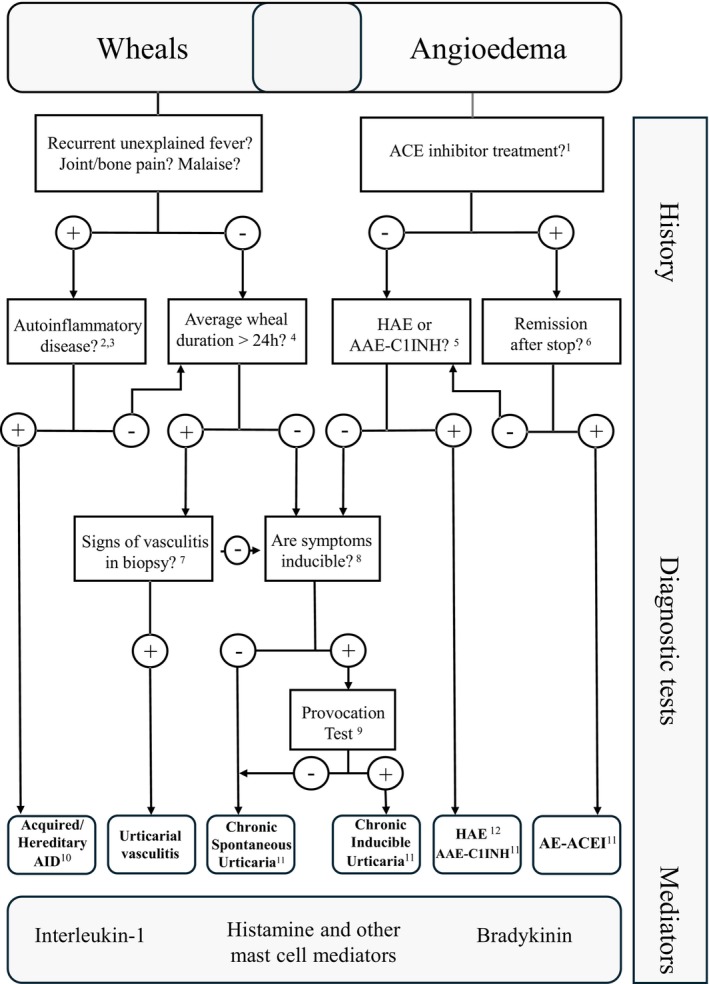
Diagnostic algorithm for patients presenting with wheals and/or angioedema. 1Apart from ACE inhibitors, angiotensin II type 1 receptor blockers (sartans), dipeptidyl peptidase IV inhibitors (gliptins) and neprilysin inhibitors have been described to induce angioedema when combined with ACE inhibitor but much less frequently. 2Patients should be asked for a detailed family history and age of disease onset. 3Test for elevated inflammation markers (C‐reactive protein, erythrocyte sedimentation rate), test for paraproteinemia in adults, look for signs of neutrophil‐rich infiltrates in skin biopsy; perform gene mutation analysis for hereditary periodic fever syndromes (e.g., Cryopyrin‐associated periodic syndrome), if strongly suspected. 4Patients should be asked: “For how long does each individual wheal last?” 5Test for Complement C4, C1‐INH levels and function; additionally test for C1q and C1‐INH antibodies, if AAE is suspected; do gene mutation analysis, if former tests are unremarkable but patient's history suggests hereditary angioedema. 6Remission should occur within a few days, in rare cases up to 6 months of ACE‐inhibitor discontinuation. 7Does the biopsy of lesional skin show damage of the small vessels in the papillary and reticular dermis and/or fibrinoid deposits in perivascular and interstitial locations suggestive of urticarial vasculitis? 8Patients should be asked: “Can you make your wheals appear? Can you bring out your wheals?” 9In patients with a history suggestive of inducible urticaria standardized provocation testing according to international consensus recommendations should be performed [40]. 10Acquired autoinflammatory syndromes include Schnitzler's syndrome as well as systemic‐onset juvenile idiopathic arthritis (sJIA) and adult‐onset Still's disease (AOSD); hereditary autoinflammatory syndromes include Cryopyrin‐associated periodic syndromes (CAPS) such as familial cold auto‐inflammatory syndromes (FCAS), Muckle‐Wells syndrome (MWS) and neonatal onset multisystem inflammatory disease (NOMID), more rarely hyper‐IgD syndrome (HIDS) and tumor necrosis factor receptor alpha‐associated periodic syndrome (TRAPS). 11In some rare cases recurrent angioedema is neither mast cell mediator‐mediated nor bradykinin‐mediated, and the underlying pathomechanisms remain unknown. These rare cases are referred to as “idiopathic angioedema” or “AE‐UNK” by some authors. 12Several subtypes HAE are known: HAE‐1: Hereditary angioedema due to C1‐Inhibitor deficiency; HAE‐2: Hereditary angioedema due to C1‐Inhibitor dysfunction; HAE nC1‐INH: Hereditary angioedema with normal C1‐Inhibitor levels, either due to a mutation in FXII (factor 12), ANGPT1 (angiopoietin‐1), PLG (plasminogen), KNG1 (kininogen), MYOF (myoferlin), HS3ST6 (heparan sulfate‐glucosamine 3‐O‐sulfotransferase 6), and CPN (carboxypeptidase N), or unknown. AAE‐C1INH, acquired angioedema due to C1‐inhibitor deficiency; AE, angioedema; AE‐ACEI, angiotensin converting enzyme inhibitor; AID, auto‐inflammatory disease; HAE, hereditary angioedema.
| Should differential diagnoses be considered in patients with chronic spontaneous urticaria? | ||
| We recommend that differential diagnoses be considered in all patients with signs or symptoms suggestive of chronic urticaria based on the guideline algorithm. | ↑↑ |
Strong consensus1 Expert consensus |
| 1100% agreement | ||
| What routine diagnostic measures should be performed in chronic spontaneous urticaria? | ||
|
We recommend limited investigations. Basic tests include differential blood count, CRP and/or ESR, and in specialized care total IgE and IgG anti‐TPO, and more biomarkers as appropriate. We recommend performing further diagnostic measures based on the patient history and examination, especially in patients with long standing and/or uncontrolled disease. | ↑↑ |
Consensus1 Expert consensus |
| 1> 70% agreement | ||
| Should routine diagnostic measures be performed in inducible urticaria? | ||
|
We recommend using provocation testing to diagnose chronic inducible urticaria. We recommend using provocation threshold measurements and the UCT to measure disease activity and control in patients with chronic inducible urticaria, respectively. | ↑↑ |
Strong consensus1 Expert consensus |
| 1> 95% agreement | ||
4.2.2. Identification of Underlying Causes
Although CSU pathogenesis is not yet fully understood, it is well established that its signs and symptoms are due to the activation of skin mast cells and the subsequent release and effects of their mediators. Acute urticaria frequently follows upper airways infections [56], including COVID‐19 [57], and some of these cases evolve into CSU [58, 59]. In rare instances, chronic (silent) infections may contribute to CSU, and very rarely, an underlying malignancy has been reported [60]. However, it is not known how these infections relate to the recently identified causes of CSU, namely autoimmunity Type I (CSUaiTI, or “autoallergic CSU”; with IgE autoantibodies to self‐antigens) and autoimmunity Type IIb (CSUaiTIIb; with mast cell‐directed activating IgG autoantibodies). In CSU due to an unknown cause (CSUuc), unidentified mechanisms likely contribute to mast cell degranulation. The patient's history and physical examination can provide clues on the underlying causes. Basic tests findings can provide further guidance, for example, CSUaiTIIb is often associated with elevated CRP and reduced eosinophil and basophil counts [61, 62]. Testing for IgG‐anti‐TPO and total IgE may also be more informative as CSUaiTIIb patients are more likely to have low or very low total IgE and elevated levels of IgG‐anti‐TPO IgG [53].
However, although a clinical association between these laboratory markers and urticaria endotypes has been demonstrated, their clinical usefulness remains limited because there are no studies evaluating their diagnostic accuracy. Currently, cutoff points can be suggested but cannot be recommended for definitive endotype classification [54]. More advanced tests, such as basophil activation testing for CSUaiTIIb can offer additional insights but are not routinely performed and should be guided by the patient's history, physical examination, and results of basic testing.
Other potential underlying causes include active thyroid disease, infections, cancer, inflammatory processes, food, and drugs, though these factors can be both causative as well as aggravating [48]. Intensive and costly general screening programs for causes of urticaria are not advised. Importantly, there may be considerable variations in the frequency of underlying causes in different parts of the world, and regional differences remain poorly researched and understood.
4.2.3. Identification of Relevant Conditions That Aggravate Disease Activity
Identifying conditions and factors that aggravate CSU activity, such as certain medications, food, stress, and infections, can help both physicians and patients to understand and potentially change the course of CSU.
Medications can lead to urticarial drug reactions with wheals occurring directly after intake, based on both, the IgE‐mediated reaction type (e.g., penicillin), or non‐IgE‐mediated mechanisms (e.g., NSAID). Non‐IgE‐mediated reactions to drugs can also augment the activity of preexisting CSU. NSAIDs are the most common drugs to do so in up to one‐fourth of patients, except for paracetamol (acetaminophen) and/or COX‐2 inhibitors which are considered to be safer options in patients with CSU. Physicians should therefore ask patients about the intake of NSAIDs, including on‐demand use, and advise patients with a history to NSAID‐induced urticaria to avoid these drugs (NSAID challenges may be considered to avoid unnecessary restrictions when clinical history is not clear). However, if low‐dose acetylsalicylic acid is needed as an antithrombotic treatment, it is not always necessary to abstain from using this drug. A four‐week transition to another antithrombotic agent can help to assess causality, and if symptoms persist, reintroduction can be considered. Routine NSAID challenge testing is not recommended when the clinical history clearly indicated a reaction. Some studies suggest that NSAID challenges may be useful to assess tolerance once the disease is well controlled or in remission, however further studies are needed before a recommendation can be made in this regard [63].
Food allergy is rarely a trigger of CSU but needs to be ruled out as differential diagnoses in repeated episodes of short‐term wheals. However, food allergies may also coexist with urticaria as a comorbidity, such as in oral allergy syndrome (OAS). Furthermore, nonallergic reactions to food can trigger CSU exacerbation, and physicians should ask patients about such patterns. Based on this information, diagnostic diets such as pseudoallergen‐ and histamine‐low diets may be considered in selected patients as individualized diagnostic tools. Diagnostic diets should be maintained only for a limited time to avoid side effects and safety risks; 2–3 weeks are usually recommended. Importantly, diagnostic diets should not delay effective treatment. Importantly, the overdiagnosis of “histamine intolerance” should be avoided, as can lead to unnecessary dietary restrictions and misuse of commercial supplements.
It is evident that stress can exacerbate CSU, with up to one‐third of CSU patients perceiving stress as an aggravating factor of their disease [64, 65]. Physicians should ask patients about the impact of stress on their disease and make them aware that stress‐reducing interventions can be helpful.
4.2.4. Identification of Comorbidities and Consequences of CSU
In CSU, the most common comorbidities are CIndUs, autoimmune diseases, metabolic syndrome, and allergies. Mental disorders, such as depression and anxiety, sexual dysfunction and sleep disturbance are also common consequences of CSU [66, 67]. Recent studies suggested an association between CSU and increased mortality, especially due to suicide, likely linked to its comorbidities [68]. Therefore, any findings from the patient's medical history, physical examination, or basic testing that suggest the presence of a comorbidity or consequence of CSU should prompt further investigations. These may include screening for specific diseases by questionnaires, provocation tests, further laboratory tests, or a referral to a specialist.
Several biomarkers have been identified as indicators of comorbidities, including other autoimmune conditions [69]. Table 10 lists several drugs used in the treatment of urticaria which have an effect on a comorbidity.
Drugs used in the treatment of urticaria which have an effect on a comorbidity.
| Comorbidity | Drug used in urticaria which has an effect on comorbidity |
|---|---|
| Asthma | Omalizumab, Dupilumab |
| Allergic rhinitis | H1‐antihistamine, Omalizumab |
| Atopic dermatitis | Dupilumab |
| Sinusitis/polyposis nasi | Omalizumab, Dupilumab |
| Food allergy | Omalizumab |
4.2.5. Identification of Predictors of the Course of Disease and Response to Treatment
In CSU, disease duration, disease activity, and response to treatment are linked to clinical characteristics and laboratory markers. While none of these are definite predictors, they can help physicians in counseling patients regarding disease severity, likely duration, and expected treatment outcomes.
For example, the presence of concomitant CIndU, high disease activity, elevated CRP and/or the presence of angioedema are indicative for a prolonged duration of CSU and suboptimal response to antihistamine treatment [70, 71, 72, 73].
4.2.6. Assessment of Disease Activity, Impact, and Control
Patients should be assessed for disease activity, impact, and control at all visits. Validated PROMs, such as the urticaria activity score (UAS, and the weekly urticaria activity score, that is, UAS7, calculated from it), the cholinergic urticaria activity score (CholUAS), the angioedema activity score (AAS), the chronic urticaria quality of life questionnaire (CU‐Q2oL), the angioedema quality of life questionnaire (AE‐QoL), the urticaria control test (UCT), and the angioedema control test (AECT), should be used for this purpose [74, 75]. These tools are available in a wide range of languages.
For daily practice, recording the UAS, either on a sheet of paper or in a digital application (i.e., the CRUSE control application [76]), for a period of 1 month, offers valuable insight into disease fluctuations. While the UAS7 and other tools such as the UCT provide a mean score, daily tracking of the UAS can help to discover aggravating factors, such as NSAID use.
In CSU patients with wheals, disease activity should be assessed using UAS7 in both clinical care and clinical trials (Table 11). The UAS7 is a unified and simple scoring system that was proposed in the last version of the guideline and has been validated [77, 78]. It captures the two key signs and symptoms of urticaria—wheals and pruritus—based on daily self‐assessments by the patient, making it a particularly valuable tool. Using UAS7 enables consistent comparison of results across different studies and centers. Given the fluctuating nature of urticaria, the most reliable way to assess overall disease activity is through daily symptom tracking over several days. The UAS7, calculated as the sum of daily scores over 7 consecutive days, should be routinely used to monitor disease activity and treatment response in patients with CSU. For CSU patients who develop angioedema, with or without wheals, the Angioedema Activity Score (AAS) should be used to assess disease activity (Table 11) [79]. CSU patients who experience wheals and angioedema should use the UAS7 and the AAS in combination.
The urticaria activity score (UAS) and Angioedema Activity Score (AAS) for assessing disease activity in CSU.
| Urticaria Activity Score (UAS) | ||
|---|---|---|
| Score | Wheals | Pruritus |
| 0 | None | None |
| 1 | Mild (< 20 wheals/24 h) | Mild (present but not annoying or troublesome) |
| 2 | Moderate (20–50 wheals/24 h) | Moderate (troublesome but does not interfere with normal daily activity or sleep) |
| 3 | Intense (> 50 wheals/24 h or large confluent areas of wheals) | Intense (severe pruritus, which is sufficiently troublesome to interfere with normal daily activity or sleep) |
| Angioedema Activity Score (AAS) | ||
| Score | Dimension | Answer options |
| — | Have you had a swelling episode in the last 24 h? | No, yes |
| 0–3 |
At what time(s) of day was this swelling episode(s) present? (please select all applicable times) | Midnight–8 a.m., 8 a.m.–4 p.m., 4 p.m.–midnight |
| 0–3 | How severe is/was the physical discomfort caused by this swelling episode(s) (e.g., pain, burning, itching?) | No discomfort, slight discomfort, moderate discomfort, severe discomfort |
| 0–3 | Are/were you able to perform your daily activities during this swelling episode(s)? | No restriction, slight restriction, severe restriction, no activities possible |
| 0–3 | Do/did you feel your appearance is/was adversely affected by this swelling episode(s)? | No, slightly, moderately, severely |
| 0–3 | How would you rate the overall severity of this swelling episode? | Negligible, mild, moderate, severe |
For the UAS7 the sum of the score (0–3 for wheals +0–3 for pruritis) for each day is summarized over 1 week (7 days) for a maximum of 42. For the AAS, scores are summed up to an AAS day sum score (0–15), 7 AAS day sum scores to an AAS week sum score (AAS7, 0–105), and 4 ASS week sum scores may be summed up to an AAS 4‐week sum score (AAS28, 0–420). Copyright for UAS: GA2LEN; copyright for AAS (UK version): MOXIE GmbH (www.moxie‐gmbh.de).
In addition to the assessment of disease activity, it is important to evaluate the impact of the disease on the quality of life, as well as to determine the level of disease control both in clinical practice and in trials.
The CU‐Q2oL should be used to determine QoL impairment in CSU patients with wheals. For CSU patients with angioedema, with or without wheals, the AE‐QoL should be used. In CSU patients with wheals and angioedema, the CU‐Q2oL and the AE‐QoL should be used.
It is also important to assess disease control in patients with CSU. The Urticaria Control Test (UCT) should be used to do this in CSU patients who develop wheals, with or without angioedema (Figure 2A). For CSU patients who develop angioedema only, the Angioedema Control Test (AECT) should be used (Figure 2B). In CSU patients who develop wheals and angioedema, both the UCT and the AECT should be used.
FIGURE 2
(A) The urticaria control test (UCT) and (B) The angioedema control test (AECT). Copyright: MOXIE GmbH, Berlin, Germany (www.moxie‐gmbh.de).
— figure not reproduced here; see the original article.The UCT was developed and validated to determine the level of disease control in all forms of CU (CSU and CIndU) [80, 81]. It is a simple four‐item tool with a clearly defined cut off for patients with “well‐controlled” vs. “poorly controlled” disease, and it is thus suited for the management of patients in routine clinical practice. Its recall period is 4 weeks. A 7‐day recall period UCT version is also available (UCT7) [82]. The UCT cutoff value for well‐controlled disease is 12 out of 16 possible points.
The AECT quantifies disease control in CSU patients with angioedema and patients with other forms of recurrent angioedema [74]. Like the UCT, the AECT is a retrospective PROM. Two versions of the AECT exist, one with a 4‐week recall period and one with a 3‐month recall period. The AECT consists, like the UCT, of only four questions. Its cut off for well controlled disease is 10 points. Both the UCT and the AECT are easy to administer and interpret. When completed, and the score is calculated, they can help to guide treatment decisions.
| Should patients with chronic urticaria be assessed for disease activity, impact, and control? | ||
| We recommend that patients with CU be assessed for disease activity, impact, and control at every visit. | ↑↑ |
Strong consensus1 Expert consensus |
| 1100% agreement | ||
| Which instruments should be used to assess and monitor disease activity in chronic spontaneous urticaria patients? | ||
| We recommend the use of the urticaria activity score, UAS7, and/or of the angioedema activity score, AAS, for assessing disease activity in patients with chronic spontaneous urticaria. | ↑↑ |
Strong consensus1 Expert consensus |
| 1100% agreement | ||
| Which instruments should be used to assess and monitor quality of life impairment in chronic spontaneous urticaria patients? | ||
| We recommend the use of the chronic urticaria quality of life questionnaire, CU‐Q2oL, and the angioedema quality of life questionnaire, AE‐QoL, for assessing quality of life impairment in patients with chronic spontaneous urticaria. | ↑↑ |
Strong consensus1 Expert consensus |
| 1> 95% agreement | ||
| Which instruments should be used to assess and monitor disease control in chronic spontaneous urticaria patients? | ||
| We recommend the use of the urticaria control test, UCT, and/or the angioedema control test, AECT, for assessing disease control in patients with CSU. | ↑↑ |
Strong consensus1 Expert consensus |
| 1> 95% agreement | ||
4.3. The Diagnostic Workup in CIndU
In patients with CIndU, the routine diagnostic workup should adhere to the consensus recommendations regarding the definition, diagnostic testing, and management of CIndUs [52]. Diagnostic efforts in CIndU focus on three main objectives: to exclude differential diagnoses, to identify the subtype of CIndU, and to determine trigger thresholds [52]. The last of these is important as it allows for assessing disease activity and response to treatment.
For most CIndU subtypes, there are validated tools available for provocation testing [52]. Examples include cold and heat urticaria, for which a Peltier element‐based provocation device (TempTest) is available [83], symptomatic dermographism for which dermographometers (Dermographic Tester, FricTest) [84, 85] have been developed, and delayed pressure urticaria tests (Dermographic Tester). In the case of cholinergic urticaria, a graded provocation test with office‐based methods, e.g., pulse‐controlled ergometry, is available [86, 87]. A new cholinergic urticaria activity score helps to identify everyday triggers [88]. Patients with contact urticaria [89] or aquagenic urticaria [90] should be assessed by appropriate cutaneous provocation tests.
Disease control in CIndU is assessed by provocation threshold testing and use of validated tools such as the UCT and AECT. PROMs for disease activity and impact are available, or being developed, for several CIndU subtypes [87, 91].
4.4. Diagnosis in Children
Urticaria can occur in individuals of all ages, including infants and young children. Recent reports indicate that, in children, the prevalence of CIndUs and CSU, as well as disease characteristics, underlying causes of CSU, and response to treatment, are very similar to those observed in adults [92, 93, 94, 95, 96, 97, 98, 99]. The diagnostic workup of CSU in children follows the same objectives as in adults. Differential diagnoses should be excluded with a special focus on cryopyrin‐associated periodic syndrome (CAPS), a rare autoinflammatory disease that presents with a urticaria‐like accompanied with fever that manifests in childhood [100].
If possible—depending on the age of the child, disease activity, impact and control should be assessed using assessment tools similar to those used in adults. While the UAS7 and UCT have been validated in children [101, 102], to date there are no other validated disease‐specific tools for children available. Triggers of exacerbation should be identified and, when indicated, investigating underlying causes—similar to those in adults—are important components of the diagnostic process. In children with CIndU, similar tests for provocation and the determination of trigger thresholds should be performed (as far as feasible given the child's age‐related ability to cooperate).
5. Management of Urticaria
5.1. Basic Considerations
- The goal of treatment is to treat the disease until it is gone, as efficiently and as safely as possible, aiming at a continuous complete control (consistently UAS = 0/UCT = 16) and a normalization of quality of life [103, 104].
- The therapeutic approach to CU should involve
- the search for, and if possible, elimination of underlying causes, which means healing the disease
- the avoidance of eliciting factors, reducing disease activity
- tolerance induction in some CIndUs, reducing disease activity
- the use of pharmacological treatment to prevent mast cell mediator release and/or the effects of mast cell mediators, reducing disease activity
- Treatment should follow the basic principles of treating as much as needed and as little as possible, taking into consideration that the activity of the disease may vary [105]. This implies stepping up or stepping down in the treatment algorithm according to the course of disease following the principle assess, act & adjust, and reassess (Figure 3). It is important to highlight that patients need good counseling regarding continuous treatment and using PROMs, especially about using the UAS.
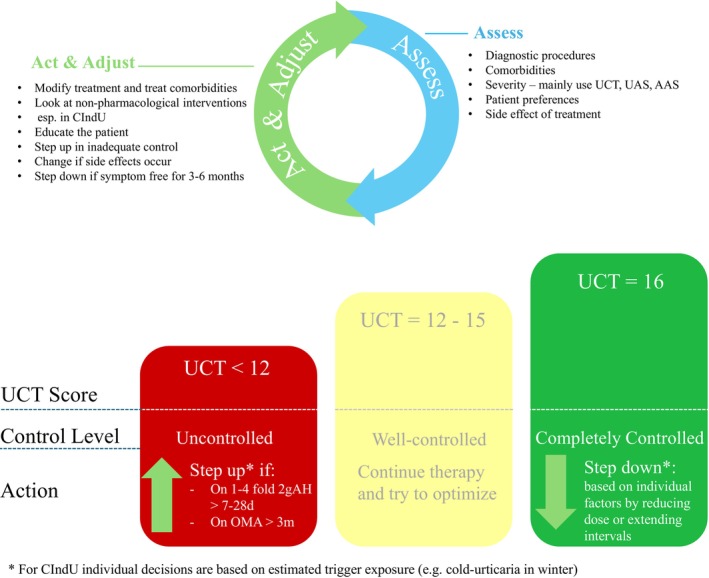
Chronic urticaria: management decisions and treatment adjustments. Apart from UCT, in some patients a monthly diary using the UAS and AAS can render better advice as this can discover short‐term exacerbations, especially although UCT states well controlled. In patients who are in the range of UCT 12–15, therefore a step up might also be required.
| Should treatment aim at complete symptom control in urticaria? | ||
| We recommend aiming at complete symptom control in urticaria, considering as much as possible the safety and the quality of life of each individual patient. | ↑↑ |
Strong consensus1 Expert consensus |
| 1> 95% agreement | ||
5.2. Identification and Elimination of Underlying Causes and Avoidance of Eliciting Factors
Although desirable, the elimination of underlying causes is currently not possible in most patients with urticaria. In the majority of patients, the underlying causes of CIndU and acute spontaneous urticaria remain unknown. Similarly, while several common underlying causes of CSU, such as Type I and Type IIb autoimmunity, have been identified, they are not curable at present. Although reduction of autoantibodies by plasmapheresis has demonstrated temporary benefit in some severely affected CSU patients [106], experience and evidence are limited and the costs of such a procedure are high.
In contrast, the avoidance of triggering factors, where possible, can be of benefit for patients with urticaria [107]. In CIndU, the avoidance of specific and definite triggers, such as cold in cold urticaria, can reduce disease activity. In CSU, the avoidance of individually relevant and unspecific triggers, for example stress or the intake of NSAIDs, can help to reduce disease exacerbations. It is crucial, however, to balance trigger avoidance with maintaining quality of life and participation in work and social activities, in patients with CIndU. For example, advising patients with cholinergic urticaria to completely avoid physical exercise or recommending that patients with solar urticaria avoid going outdoors should not be the aim of a patient‐centered management strategy.
5.2.1. Drugs
When drugs are suspected as contributors during the diagnostic workup, they should be omitted entirely or substituted by another class of agents if indispensable. Drugs causing hypersensitivity reactions (especially NSAIDs) cannot only elicit but can also aggravate preexisting CSU. Consequently, elimination in the latter case will only partially improve symptoms in some patients.
| Should patients with chronic spontaneous urticaria be advised to discontinue medication that is suspected to worsen the disease? | ||
| We recommend advising patients with chronic spontaneous urticaria to discontinue medication that is suspected to worsen the disease, e.g., NSAIDs. | ↑↑ |
Strong consensus1 Expert consensus |
| 1> 95% agreement | ||
5.2.2. Definite and Specific Triggers of CIndU
Avoidance or reduction of the specific triggers of CIndUs can help to reduce the occurrence of wheals and angioedema. However, this approach is usually not sufficient to control the disease and can impose a substantial burden on patients. Patients should be provided with information that helps them to recognize and minimize relevant trigger exposure. For example, patients with delayed pressure urticaria should be informed that pressure is defined as force per area and that simple measures, such as broadening of the handle of heavy bags, may be helpful in the prevention of symptoms. Similar considerations hold for cold urticaria where the impact of the wind chill factor in cold winds needs to be remembered. For solar urticaria, the exact identification of the range of eliciting wave lengths may be important for the appropriate selection of sunscreens or light bulbs with a UV‐A filter. However, in many patients, the threshold for the relevant physical trigger is low and total avoidance of symptoms is virtually impossible. For example, severe symptomatic dermographism is sometimes confused with CSU because seemingly spontaneous hives are observed where even loose‐fitting clothing rubs on the patient's skin, or unintentional scratching by the patient readily causes the development of wheals in that area.
5.2.3. Infections and Inflammatory Processes
In contrast to CIndU, CSU has been reported to be associated with a variety of inflammatory or infectious diseases, as well as vaccinations [58, 108]. This is regarded as significant in some instances, but studies show conflicting results and have methodological weaknesses. Infections that may contribute to CSU disease activity include those of the gastrointestinal tract such as an H. pylori infection, Lyme disease, and bacterial infections of the nasopharynx [109, 110, 111, 112, 113]. Even though the association with urticaria is not clear in the individual patient and a meta‐analysis shows overall low evidence for eradication therapy [109], H. pylori should be eliminated as an association with gastric cancer is suggested [114]. Furthermore it has been shown that the infection with H. pylori itself is not the trigger, but rather the resulting gastritis and urticaria will only subside if this is also sufficiently treated [110]. Bowel parasites, a rare possible cause of CSU in developed industrial countries, should be eliminated if indicated [109, 115, 116]. In the past, intestinal candidiasis was regarded as an important underlying cause of CSU [109], but more recent findings fail to support a significant causative role [117]. Apart from infectious diseases, chronic inflammatory processes due to other diseases have been identified to potentially trigger CSU. These can be secondary to infections. This holds true particularly for gastritis, reflux esophagitis, or the inflammation of the bile duct or gall bladder [118, 119]. Thus it could be shown that successful eradication of H. pylori is only having an impact on CSU if also the subsequent inflammation, that is, gastritis and esophagitis, is healed [110]. However, similar to infections, it is not easily possible to discern whether any of these are relevant causes of CSU, but should be treated regardless since many of them may be also associated with the development of malignancies.
5.2.4. Stress
Although the mechanisms of stress‐induced exacerbation are not well investigated, some evidence indicates that disease activity in patients with CSU can be linked to stress [65, 120]. Further studies are needed to characterize the prevalence and relevance of CSU exacerbation by stress as well as the underlying mechanisms. In a patient‐centered approach the discussion of stress and stress‐avoidance is part of the management [64].
5.2.5. Reduction of Functional Autoantibodies
Direct reduction of functional autoantibodies by plasmapheresis has been shown to be of temporary benefit in some, severely affected patients [106]. Due to limited experience and high costs, this therapy is suggested for autoantibody‐positive CSU patients who are unresponsive to all other forms of treatment. Autoantibodies and potentially activated T cells may also be reduced by immunosuppressive medication, such as cicloporin [121].
5.2.6. Food
IgE‐mediated food allergy is extremely rarely the underlying cause of CSU [119, 122]. If identified, the specific food allergens need to be omitted as much as possible, which leads to a remission within less than 24 h. In some CSU patients, pseudoallergic reactions (non‐IgE‐mediated hypersensitivity reactions) to naturally occurring food ingredients, and in some cases to food additives, have been observed [119, 122, 123, 124, 125, 126]. A pseudoallergen‐low diet, containing only low levels of natural as well as artificial food pseudoallergens, has been tested in different countries [127]. Also, a low histamine diet may improve symptoms in some patients [128]. Those diets have been criticized and have not been proven in well‐designed double‐blinded placebo‐controlled studies, which however are not possible as the diet needs to be monitored for 14 days. However, all open label studies have shown to be beneficial. This kind of treatment has the advantage that it does not involve costs for medications which is relevant in places without reimbursement, but it also requires cooperative patients and success rates may vary considerably due to regional differences in food and dietary habits. More research is necessary on the effects of natural and artificial ingredients of food on urticaria.
5.3. Inducing Tolerance
Inducing tolerance can be useful in some subtypes of CIndU. Examples are cold urticaria, cholinergic urticaria, and solar urticaria, where a rush therapy with UV‐A has been reported to be effective within 3 days [129]. However, tolerance induction is only lasting for a few days, thus a consistent daily exposure to the stimulus just at threshold level is required. Tolerance induction and maintenance are often not accepted by patients, for example, in the case of cold urticaria where daily cold baths/showers are needed to achieve this.
5.4. Symptomatic Pharmacological Treatment
The aim and the need for continued but adjusted treatment
The overall aim of the management in urticaria is to achieve complete control of symptoms and maintain effective and safe treatment until the disease is gone. This includes nonpharmacological measures like avoidance of triggers, as described above, in combination with pharmacological treatment using the minimal effective dose of the drug, or combination of drugs, that help the patient to maintain complete control. In order to constantly ensure the right level of treatment, patients need to be seen at regular intervals and adjustments are recommended based on the level of symptoms. For updosing, also the time of onset needs to be considered, for example, for treatment with an antihistamine, further improvement cannot be expected after 1–2 weeks of treatment as receptor saturation is complete after 1 week. For a stepdown, different options exist but costs are especially relevant for choosing which step to take first.
The targets
Current recommended and effective treatment options for urticaria aim to target mast cell mediators at the receptors on nerves and endothelia, mast cell releasability, or mast cell activation by autoimmune triggers among others. Novel treatments currently under development aim to better regulate Type 2 immunity, or silence mast cells via inhibitory receptors, or to reduce mast cell numbers. The overall goal of all these symptomatic treatments is to help patients to be free of signs and symptoms until their episode of urticaria shows complete symptom control under treatment and in the future, ideally to create a curative pharmacological approach. To achieve this, pharmacological treatment should be continuous, until no longer needed. Nonsedating 2nd generation H1‐antihistamines, for example, should be used daily, to prevent the occurrence of wheals and angioedema, rather than on demand. This has been so far supported by their safety profile (safety data are available for several years of continuous use and in pregnancy), the results of randomized controlled trials and real‐life studies [130, 131, 132], and their mechanism of action, that is, their inverse agonist effects on the H1 receptor, stabilizing its inactive state. Although continuous use of active treatment is also recommended, especially in very active and uncontrolled CIndU, some patients can benefit from short term prophylactic antihistamine treatment before a relevant trigger exposure. However, in patients with CIndU, an individualized decision should be made, based on the presence and predictability of triggers, as to whether 2nd generation H1‐antihistamines are taken regularly or as needed.
H 1 ‐antihistamine treatment
H1‐antihistamines have been available for the treatment of urticaria since the 1950s. The older 1st generation H1‐antihistamines have pronounced anticholinergic and sedative effects and many interactions with alcohol and other drugs such as analgesics, hypnotics, sedatives, and mood elevating drugs, have been described. They can also interfere with rapid eye movement (REM) sleep and impact learning and performance. Impairment is particularly prominent during multi‐tasking and performance of complex sensorimotor tasks, such as driving. In a GA2LEN position paper [133] it is strongly recommended not to use 1st generation H1‐antihistamines any longer in allergy for adults and especially not for children. This view is shared by the WHO ARIA guideline [134]. Based on strong evidence regarding potentially serious side‐effects of 1st generation H1‐antihistamines (lethal overdoses have been reported) [135], we recommend against their use for the routine management of CU as first‐line agents [136].
Modern 2nd generation H1‐antihistamines are minimally or nonsedating and free of anticholinergic effects [137]. However, two 2nd generation H1‐antihistamines, astemizole, and terfenadine, are shown to have cardiotoxic effects in patients treated with inhibitors of the cytochrome P450 (CYP) 3A4 isoenzyme, such as ketoconazole or erythromycin. Astemizole and terfenadine are no longer available in most countries, and we recommend that they are not used.
Most, but not all 2nd generation H1‐antihistamines have been tested specifically in urticaria, and evidence supports the use of bilastine, cetirizine, desloratadine, ebastine, fexofenadine, levocetirizine, loratadine, mizolastine, and rupatadine [132, 138, 139]. We recommend the use of a standard‐dosed modern 2nd generation H1‐antihistamines as the first‐line symptomatic treatment for urticaria. However, no recommendation can be made on which to choose because, to date, well‐designed clinical trials directly comparing the efficacy and safety of all modern 2nd generation H1‐antihistamines in urticaria are largely lacking. Considering treatment adjustments, it is important to know that the onset of action is quick and that doses, especially in CIndU, can be adjusted according to need, for example, outside temperature in cold urticaria and there is no tachyphylaxis. Even though rarely, some patients suffer urticaria exacerbations from using H1‐antihistamines and these patients are candidates to be treated with omalizumab [140].
Further information as well as a systematic presentation of the processed evidence underlying the treatment recommendation can be found in the evidence report (pp. 5–42).
| Should modern 2 nd generation H 1 ‐antihistamines be used as first‐line treatment of urticaria? | ||
| We recommend a 2nd generation H1‐antihistamine as first‐line treatment for all types of urticaria. | ↑↑ |
Strong consensus1 Evidence‐ and consensus‐based (see Evidence Report, pp. 5–20) |
| 1100% agreement | ||
| Is an increase in the dose to up to four‐fold of modern 2 nd generation H 1 ‐antihistamines useful and to be preferred over other treatments in urticaria? | ||
| We recommend updosing of a 2nd generation H1‐antihistamine up to 4‐fold in patients with chronic urticaria unresponsive to a standard‐dosed 2nd generation H1‐antihistamines as second‐line treatment before other treatments are considered. | ↑↑ |
Strong consensus1 Evidence‐ and consensus‐based (see Evidence Report, pp. 24‐27, 31‐39) |
| 1> 95% agreement | ||
| Should modern 2 nd generation H 1 ‐antihistamines be taken regularly or as needed? | ||
|
We suggest 2nd generation H1‐antihistamines to be taken regularly for the treatment of patients with chronic spontaneous urticaria. For the treatment of patients with chronic inducible urticaria, we suggest to decide based on the presence of triggers (e.g., time of the year in cold urticaria) whether 2nd generation H1‐antihistamines should be taken regularly or as needed. | ↑ |
Strong consensus1 Evidence‐ and consensus‐based (see Evidence Report, pp. 21–23) |
| 1> 95% agreement | ||
| Should different 2 nd generation H 1 ‐antihistamines be used at the same time? | ||
| We suggest against using different H1‐antihistamines at the same time (against an updosing of a single H1‐antihistamine if not legally restricted in country) | ↓ |
Consensus1 Evidence‐ and consensus‐based (see Evidence Report, pp. 28–30, 40–42) |
| 1> 95% agreement | ||
Several studies show the benefit of the use of a higher than standard dose 2nd generation H1‐antihistamines in urticaria patients [141, 142, 143] corroborating earlier studies with 1st generation H1‐antihistamines which have concluded the same result [144, 145]. Studies support the use of up to fourfold standard‐dosed bilastine, cetirizine, desloratadine, ebastine, fexofenadine, levocetirizine, mizolastine, and rupatadine [132, 138, 139, 141, 142, 146, 147, 148, 149, 150].
Further information as well as a systematic presentation of the processed evidence underlying the treatment recommendation can be found in the evidence report (p. 49).
| If there is no improvement, should higher than fourfold doses of 2 nd generation H 1 ‐antihistamines be used? | ||
| We recommend against using higher than 4‐fold standard dosed H1‐antihistamines in chronic urticaria | ↓↓ |
Strong consensus1 Evidence‐ and consensus‐based (see Evidence Report, p. 49) |
| 1> 95% agreement | ||
In summary, these studies suggest that some patients with urticaria, who show insufficient response to a licensed‐dose of 2nd generation H1‐antihistamine, benefit from updosing, which is preferred over mixing different 2nd generation H1‐antihistamines since their pharmacologic properties are different. The clinical advantage of updosing over multiple combinations of substances is also supported empirically in CU patients [150]. We, therefore, recommend to increase the dose up to fourfold, in such patients (Figure 4). Patients need to be informed that 2nd generation H1‐antihistamine updosing is off‐label and higher than fourfold is not recommended as it has not been tested. However, updosing has been suggested in the guidelines for urticaria since the year 2000, and so far, no serious adverse events have been reported, nor has a side effect ever been reported in the literature attributed to long‐term intake and potential accumulation. In a population‐based study in Taiwanese patients with new‐onset allergic rhinitis (2011–2017) using first and 2nd‐generation H1−antihistamines compared to non‐antihistamine users, showed that patients with allergic rhinitis on 1st‐ or 2nd‐generation H1‐antihistamines face an escalating dementia risk with increasing cumulative dosage [151]. It should be noted that the study's methodology is not sufficiently robust to challenge existing guideline recommendations. For example, the sample was heavily skewed towards patients taking antihistamines, which could have reduced the sensitivity in detecting any statistically significant increase in dementia risk among nonusers. In a later analysis of TriNetX data (presented at the GUF 2024 conference, data not published), the relationship was not confirmed. In addition, a separate study reported improved mental health outcomes associated with the use of first‐generation antihistamines [136].
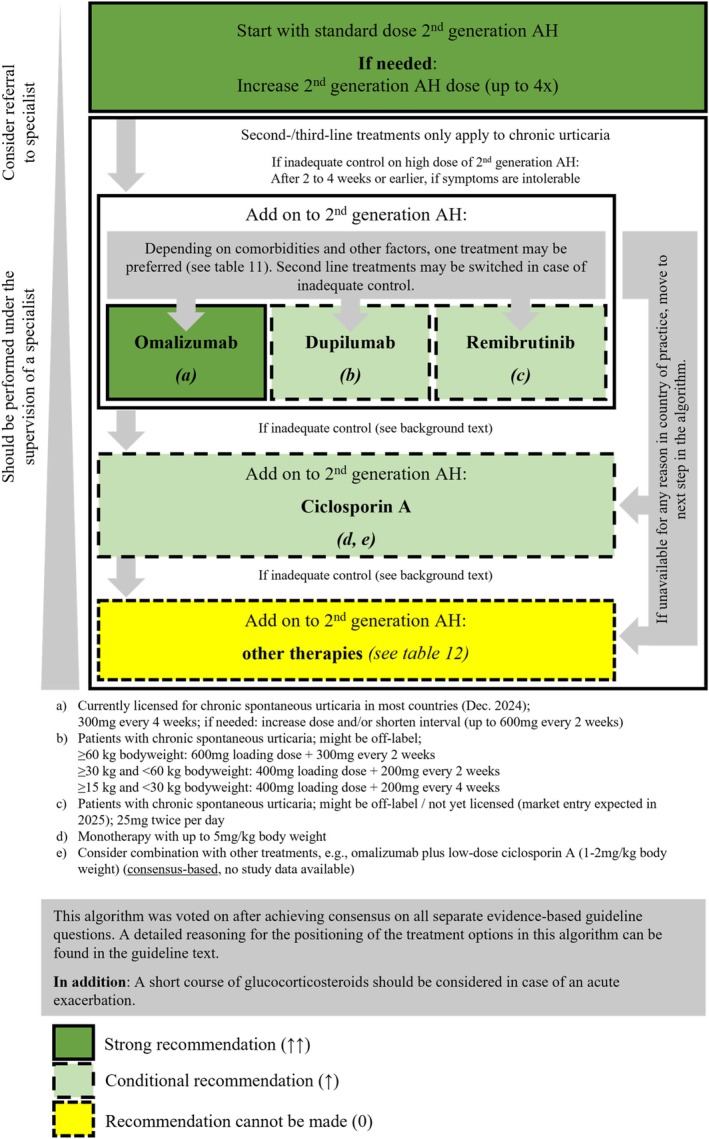
Recommended treatment algorithm for urticaria. This algorithm outlines the stepwise management approach for urticaria, developed in accordance with clinical evidence evaluated using the GRADE methodology. Each treatment recommendation in the management section (Section 5) was formally endorsed through expert voting, as indicated in the corresponding boxes. AH, antihistamine.
In conclusion, we regard the results of this study as a safety signal which needs further monitoring but does not alter our current evaluation of the benefit and risk potential of the use of second‐generation antihistamines in CSU.
Omalizumab treatment
Nearly worldwide, omalizumab (monoclonal anti‐IgE antibody) is the only other licensed treatment in urticaria. It is for patients who do not show sufficient benefit from treatment with a 2nd generation H1‐antihistamine, and therefore it is recommended as the next step in the algorithm. Omalizumab has been shown to be very effective and safe in the treatment of CSU [152, 153, 154, 155, 156, 157, 158, 159, 160]. Omalizumab has also been reported to be effective in CIndU [161, 162, 163, 164] including cholinergic urticaria [165], cold urticaria [166, 167], solar urticaria [168], heat urticaria [169], symptomatic dermographism [170, 171] as well as delayed pressure urticaria [172]. In CSU, omalizumab prevents wheal and angioedema development [173, 174], markedly improves quality of life [175, 176], is suitable for long‐term treatment, and effectively treats relapse after discontinuation [177, 178, 179]. The recommended initial dose in CSU is 300 mg every 4 weeks as add on to antihistamine treatment. Dosing is independent of total serum IgE and bodyweight [152].
Patients with urticaria who do not show sufficient benefit from treatment with omalizumab at the licensed dose of 300 mg every 4 weeks can be treated with omalizumab at higher doses, shorter intervals, or both. Studies support the use of omalizumab treatment at doses up to 600 mg and intervals of 2 weeks, in patients with insufficient response to standard dosed omalizumab [180, 181, 182, 183]. Patients need to be informed that omalizumab updosing is off‐label. But also, the prolongation of the interval is strictly off label.
When considering treatment adjustments, it is important to note that the onset of action is often slow. Doses, especially in CIndU, can be adjusted according to need, for example, the time of the year in cold urticaria, or in the case of symptom absence in CSU, a prolongation of the interval should be considered. After 3 months of complete control, the interval can be prolonged until long as first wheals reappear, as there is no tachyphylaxis nor have relevant levels of blocking antibodies been described.
Drug survival studies, or time to discontinuation, for omalizumab show that the main reason for discontinuation is due to well‐controlled disease and far less due to ineffectiveness or adverse effects [178, 181].
Further information as well as a systematic presentation of the processed evidence underlying the treatment recommendation can be found in the evidence report (pp. 49–60).
| Is omalizumab useful as add‐on treatment in patients unresponsive to high doses of H 1 ‐antihistamines? | ||
|
We recommend adding on omalizumab* for the treatment of patients with CU unresponsive to high doses of 2nd generation H1‐antihistamines. *Currently licensed for chronic spontaneous urticaria | ↑↑ |
Strong consensus1 Evidence‐ and consensus‐based (see Evidence Report, pp. 49–60) |
| 1> 95% agreement | ||
Dupilumab treatment
Several medications, already proven effective for other conditions, are currently studied for their potential benefits in treating antihistamine‐refractory CSU. This also pertains to the monoclonal anti‐IL4Rα antibody, dupilumab, that blocks the effect of IL‐4 and IL‐13. Results of Phase 3 studies show the efficacy of dupilumab as add‐on treatment, which is however, likely to be less pronounced than those observed with omalizumab [184]. Currently, urticaria‐specific long‐term safety data are lacking, but existent studies in various diseases reflect a generally favorable safety profile [185, 186, 187, 188, 189, 190, 191, 192, 193, 194]. Available data shows efficacy regardless of low baseline IgE levels for dupilumab, which is different compared to omalizumab where very low IgE values are often a reason for insufficient response [184]. Dupilumab can offer synergistic values to treat urticaria in conjunction with certain comorbidities such as asthma, chronic rhinosinusitis with nasal polyps, and atopic dermatitis. Dupilumab is approved for the treatment of urticaria in the USA, UAE, Brazil, and Japan where it is already licensed, and licensing in other countries is expected in 2025.
Further information as well as a systematic presentation of the processed evidence underlying the treatment recommendation can be found in the evidence report (pp. 61–63).
| Is dupilumab useful as add‐on treatment in patients unresponsive to high doses of H 1 ‐antihistamines? | ||
|
We suggest using dupilumab* as add‐on treatment for patients with CSU unresponsive to high doses of 2nd generation H1‐antihistamines. *might be off‐label | ↑ |
Consensus1 Evidence‐ and consensus‐based (see Evidence Report, pp. 61–63) |
| 1> 75% agreement | ||
Remibrutinib treatment
The clinical efficacy from Phases 2 and 3 studies of the Bruton's tyrosine kinase inhibitor, remibrutinib, as an add‐on treatment to H1‐antihistamines has recently been demonstrated for CSU and also suggests a favorable safety profile [195, 196, 197]. In September 2025 remibrutinib was approved by the FDA as an oral treatment for adult patients with CSU who remain symptomatic despite H1‐antihistamine treatment and does not require injections or lab monitoring [198]. Approval in other countries is expected soon. The use of remibrutinib can be considered in all patients with CSU and especially in patients who do not respond to both high‐dose antihistamine and omalizumab treatment. The available high‐quality data on its efficacy and the current and expected licensing, warrant the drug to be included in the treatment algorithm. Although other dosages have demonstrated benefits in a dose‐finding study, 25 mg twice daily will most likely be recommended as the treatment dose based on superior efficacy data [196].
Further information as well as a systematic presentation of the processed evidence underlying the treatment recommendation can be found in the evidence report (pp. 64–85).
| Is remibrutinib useful as add‐on treatment in patients unresponsive to high doses of H 1 ‐antihistamines? | ||
| We suggest using remibrutinib* as add‐on treatment for patients with CSU unresponsive to high doses of 2nd generation H1‐antihistamines. | ↑ |
Consensus1 Evidence‐ and consensus‐based (see Evidence Report, pp. 64–85) |
| 1> 75% agreement | ||
Ciclosporin treatment
Patients with CSU who do not show sufficient benefit from treatment with H1‐antihistamines, especially if they are also unresponsive to omalizumab, can alternatively be treated with ciclosporin 3–5 mg/kg per day. Ciclosporin is immunosuppressive and has a moderate and direct effect on mast cell mediator release [199, 200]. Efficacy of ciclosporin in combination with a modern 2nd generation H1‐antihistamine has been shown in placebo‐controlled trials [121, 201, 202] as well as open controlled trials in CSU [203], but this drug cannot be recommended as standard treatment due to a higher incidence of adverse effects, especially with long‐term use [201]. Ciclosporin is off‐label for urticaria and is recommended only for patients with severe disease refractory to any other licensed treatments. Ciclosporin can be especially effective in selected patients with CSUaiTIIb with low total IgE levels and other markers of autoimmunity [204]. Based on a small retrospective study with no control group, short courses of ciclosporin may induce long remissions in some CSU patients [205].
However, ciclosporin has a far better risk/benefit ratio compared to long‐term use of steroids. Some physicians also use tacrolimus which has a very similar mode of action with a better adverse event profile but there are no studies available which would allow for any recommendation here.
Further information as well as a systematic presentation of the processed evidence underlying the treatment recommendation can be found in the evidence report (pp. 94–96).
| Is ciclosporin useful as add‐on treatment in patients unresponsive to high doses of H 1 ‐antihistamine? | ||
|
We suggest using ciclosporin* for the treatment of patients with CU unresponsive to licensed treatments or if these are not available. *currently not licensed for CU | ↑ |
Consensus1 Evidence‐ and consensus‐based (see Evidence Report, pp. 94–96) |
| 1> 75% agreement | ||
Other symptomatic treatments
Some previous randomized clinical trials have assessed the use of leukotriene receptor antagonists. Studies are difficult to compare due to different populations studied, for example, inclusion of only aspirin and food additive intolerant patients or exclusion of patients with positive autologous serum skin test results. In general, the level of evidence for the efficacy of leukotriene receptor antagonists in urticaria is low, but the most so far for montelukast. A recent, systematic review and meta‐analysis found that adding leukotriene receptor antagonists to H1 antihistamines provides modest reductions in urticaria activity without significantly increasing overall adverse events, though the risk of neuropsychiatric effects remains uncertain [206]. Therefore, it is highly important to advert patients on the rare, but confirmed possible neuropsychiatric adverse events associated with montelukast [207], generally during the first days or weeks of treatment, due to which the drug has a black‐boxes warning by the FDA. At present, topical corticosteroids are frequently and successfully used in many allergic diseases, but are not useful in urticaria (with the possible exception of pressure urticaria on soles as alternative therapy with low evidence). If systemic corticosteroids are used, doses between 20–50 mg/day of prednisone equivalent are needed (dose is appropriate for adults and not children). Because such high doses will have side effects over the long term, we strongly recommend against the prolonged use of corticosteroids. Depending on the country it must be noted that steroids are also not licensed for CU (e.g., in Germany and Japan, prednisolone is only licensed for acute urticaria). For acute urticaria and acute exacerbations of CSU, a short course of oral corticosteroids, that is, treatment of a maximum of up to 10 days, may, however, be helpful to reduce disease duration/activity [208, 209]. Nevertheless, well‐designed randomized clinical trials are lacking.
Further information as well as a systematic presentation of the processed evidence underlying the treatment recommendation can be found in the evidence report (p. 103).
| Should oral corticosteroids be used as add‐on treatment in the treatment of urticaria? | ||
| We recommend against the long‐term use of systemic glucocorticosteroids or depot preparations in CU. | ↓↓ |
Strong consensus1 Evidence‐ and consensus‐based (see Evidence Report, p. 103) |
| We suggest considering a short course of rescue systemic glucocorticosteroids in patients with an acute exacerbation of CU. | ↑ | |
| 1> 95% agreement | ||
While H1 antihistamines at up to four‐fold the manufacturers' recommended dosages may control symptoms in a large proportion of patients with urticaria in general practice, alternative treatments are needed for the remaining unresponsive patients. It is strongly recommended to stick to the treatment algorithm, but it is acknowledged that omalizumab, dupilumab, and remibrutinib have restrictions due to their high cost, and that ciclosporin restricted due to its safety profile. Furthermore, licensing issues and economic cost must be considered with any intervention and alternative treatment options should be considered.
Since the severity of urticaria may fluctuate, and spontaneous remission may occur at any time, it is also recommended to re‐evaluate the necessity for continued or alternative drug treatment every three to 6 months. This is also reflected in Figure 3.
Almost all treatments not listed in the treatment algorithm (Figure 4) are based on clinical trials providing low levels of evidence. As an exception, moderate quality evidence exists for the monoclonal antibody benralizumab, which failed to show statistically significant efficacy in a classical trial of CU but may be considered in specific patients especially if certain comorbidities, such as eosinophilic asthma are present (Table 12) [210, 211].
Alternative treatment options.
| Although evidence from publications is low, clinical experience indicates that they may be useful in certain contexts. Interventions are listed in alphabetical order by frequency of use rather than efficacy | ||
|---|---|---|
| Intervention | Substance (class) | Possible indication |
| Widely used | ||
| Tricyclic antidepressant with potent H1‐ and H2‐antagonist activity | Doxepin a | CSU, Idiopathic cold‐induced urticaria |
| Diet | Pseudoallergen‐low diet b | CSU |
| H2‐antihistamine | Ranitidine c , famotidine, Lafutidine (available in Japan, South Korea, and India) | CSU |
| Immunosuppressive |
Methotrexate Mycophenolate mofetil |
CSU ± DPU d Autoimmune CSU |
| Leukotriene receptor antagonist | Montelukast | CSU, DPU |
| Sulphones |
Dapsone, Sulphasalazine |
CSU ± DPU CSU ± DPU |
| Infrequently used | ||
| Anabolic steroid | Danazol | Cholinergic urticaria |
| Anticoagulant | Warfarin | CSU |
| Antifibrinolytic | Tranexamic acid | CSU with angioedema |
| Immunomodulator |
IVIG Plasmapheresis |
Autoimmune CSU Autoimmune CSU |
| Miscellaneous |
Autologous blood/serum Hydroxychloroquine |
CSU CSU |
| Phototherapy | Narrow‐band UVB | Symptomatic dermographism |
| Psychotherapy | Psychotherapy | CSU |
| Rarely used | ||
| Anticoagulant | Heparin | CSU (elevated D‐Dimer) |
| Immunosuppressive |
Cyclophosphamide Rituximab |
Autoimmune CSU Autoimmune CSU |
| Miscellaneous |
Anakinra Anti‐TNF‐alpha Camostat mesilate Colchicine Miltefosine Mirtazapine PUVA Benralizumab e |
DPU CSU ± DPU CSU CSU CSU CSU CSU CSU ± eosinophilic asthma |
| Very rarely used | ||
| Immunosuppressive | Systemic Tacrolimus | CSU |
| Miscellaneous |
Vitamin D Interferon alpha |
CSU CSU |
Abbreviations: CSU, Chronic Spontaneous Urticaria; DPU, Delayed Pressure Urticaria; IVIG, Intravenous Immunoglobulin.
Has also H1 and H2‐antihistaminergic properties usually effective at a dose of 50–75 mg daily [26].
Does include low histamine diet as pseudoallergen‐free diet is also low in histamine. The evidence is controversial and different interpretations about what a pseudoallergen is or what foods contain them exist.
No longer available in most countries; alternative H2‐antihistamines are available including famotidine and nizatidine but evidence for their use in chronic urticaria varies.
Treatment can be considered especially if CSU and DPU are co‐existent in a patient.
Treatment can be considered especially if CSU and eosinophilic asthma are co‐existent in a patient.
H2‐antagonists, leukotriene antagonists, hydroxychloroquine, methotrexate, and dapsone, discussed in previous versions of this guideline as well as in national guidelines [212], are now perceived to have too little evidence to maintain them as recommendable in the algorithm, but they may still have relevance as they are very affordable in some more restricted health care systems. Sulfasalazine, interferon, plasmapheresis, phototherapy, intravenous immunoglobulins (IVIG/IGIV) and other treatment options have low‐quality evidence or just case series have been published (Table 12) [213]. Despite the lack of published evidence, all these drugs may be of value to individual patients in the appropriate clinical context [214]. This circumstance is already now reflected in available national guidelines that might justifiably deviate from the treatment algorithm outlined here, such as the current guideline for the diagnosis and management of urticaria in Indian settings [212]. This international guideline indeed encourages national adaptations but also recommends that deviations from the evidence proven treatment algorithm should be discussed with the patient as the above mentioned alternatives are not licensed for the treatment of urticaria.
Further information as well as a systematic presentation of the processed evidence underlying the treatment recommendation can be found in the evidence report (pp. 43–48).
| Are H 2 ‐antihistamines useful as add‐on treatment in patients unresponsive to low or high doses of H 1 ‐antihistamines? | ||
| We cannot make a recommendation for or against the combined use of H1‐ and H2‐antihistamines in patients with chronic urticaria. | 0 |
Consensus1 Evidence‐ and consensus‐based (see Evidence Report, pp. 43–48) |
| 1> 75% agreement | ||
Anti‐IL‐23 [215] and antagonists of tumor necrosis factor alpha (TNF‐alpha) [216] and IVIG [217, 218, 219] which have been successfully used in case reports, are recommended currently only to be used in specialized centers as a last option (i.e., anti‐TNF‐alpha for delayed pressure urticaria and IVIG for CSU) [220, 221].
For the treatment of CSU and symptomatic dermographism, UV‐B (narrow band‐UVB, TL01), UV‐A and PUVA treatment for 1–3 months can be added to antihistamine treatment [222, 223, 224] but caution should be taken regarding the carcinogenic properties of UV light treatment.
Some treatment alternatives formerly proposed have been shown to be ineffective in double‐blind, placebo‐controlled studies and should no longer be used as the certainty of the evidence is low. These include tranexamic acid and sodium cromoglycate in CSU [225, 226], nifedipine in symptomatic dermographism/urticaria factitia [227], and colchicine and indomethacin in delayed pressure urticaria [228, 229]. However, more research may be needed for patient subgroups, for example, a pilot study [230] of patients with elevated D‐dimer levels showed heparin and tranexamic acid therapy may be effective.
| Could any other treatment options be recommended for the treatment of urticaria? | ||
| We cannot make a recommendation with respect to further treatment options as standard therapies, but these may be considered in special cases with comorbidities or where financial, legal, or other limitations for the recommended algorithm treatment exist. | 0 |
Consensus1 Expert consensus |
| 1> 75% agreement | ||
5.5. Treatment of Special Populations
5.5.1. Children
Many clinicians use 1st generation H1‐antihistamines as their first choice treatment of children with urticaria assuming that their safety profile is better known than that of the modern 2nd generation H1‐antihistamines due to a longer experience with them, although 1st generation H1‐antihistamines have a proven detrimental effect on school performance [231]. Also, the use of modern 2nd generation H1‐antihistamines is not licensed for use in children less than 6 months of age in many countries. However, 1st generation H1‐antihistamines have an inferior safety profile compared with 2nd generation H1‐antihistamines, and are, therefore, not recommended as first line treatment in children with urticaria. Second‐generation H1‐antihistamines with proven efficacy and safety in the pediatric population include bilastine [226], cetirizine [227], desloratadine [228, 229], fexofenadine [230], levocetirizine [232], loratadine [227], and rupatadine [233].
The choice of which 2nd generation H1‐antihistamines to use in children with urticaria should take into consideration age and availability as not all are available as syrup or fast dissolving tablets, suitable for children. The lowest licensed age also differs from country to country. However, some are available already at infants' age. All further steps should be based on individual considerations and be taken carefully as updosing of antihistamines and further treatment options are not well studied in children. However, omalizumab is used for treating asthma (licensed from 6 years of age or older), dupilumab for treating atopic eczema (licensed from 6 months of age or older), and ciclosporin is also used in very young children in transplant medicine. In addition, a short course of corticosteroids as advised in the algorithm should be used only as a very restricted measure in children. Currently, omalizumab is the only approved biologic for anti‐histamine refractory CSU in patients aged older than 12 years, while dupilumab is undergoing trials in children ≥ 2 years with uncontrolled CSU (LIBERTY‐CSU CUPIDKids; https://clinicaltrials.gov/study/NCT05526521) [234].
| Should the same treatment algorithm be used in children? | ||
| We suggest using the same treatment algorithm with caution (e.g., according to licensing status, experience for use in children, weight‐ and age‐adjusted dosage) in children with chronic urticaria. | ↑ |
Strong consensus1 Expert consensus |
| 1> 95% agreement | ||
5.5.2. Pregnant and Lactating Women
The same considerations in principle apply to pregnant and lactating women. In general, use of any systemic treatment should generally be avoided in pregnant women, especially in the first trimester. On the other hand, pregnant women have the right to the best therapy possible. While the safety of treatment has not been systematically studied in pregnant women with urticaria, it should be pointed out that the possible negative effects of increased levels of histamine receptor binding occurring in urticaria have also not been studied in pregnancy, whereas emergency referrals due to urticaria exacerbations during pregnancy have been associated with preterm birth in the PREG‐CU study. Regarding treatment, no reports of birth defects in women having used modern 2nd generation H1‐antihistamines during pregnancy have been reported to date. However, only small sample size studies are available for cetirizine and one large meta‐analysis for loratadine [235, 236]. Furthermore, as several modern 2nd generation H1‐antihistamines are now prescription free and used widely in both allergic rhinitis and urticaria, it must be assumed that many women have used these drugs especially in the beginning of pregnancy, at least before the pregnancy was confirmed. Nevertheless, since the highest safety is mandatory in pregnancy, the suggestion for the use of modern 2nd generation H1‐antihistamines is to prefer loratadine with the possible extrapolation to desloratadine and cetirizine with a possible extrapolation to levocetirizine. All H1‐antihistamines are excreted in breast milk in low concentrations. Use of 2nd generation H1‐antihistamines is advised, as nursing infants occasionally develop sedation from the old 1st generation H1‐antihistamines transmitted in breast milk.
The increased dosage of modern 2nd generation H1‐antihistamines can only be carefully suggested in pregnancy since safety studies have not been done, and with loratadine it must be remembered that this drug is metabolized in the liver which is not the case for its metabolite desloratadine. 1st generation H1‐antihistamines should be avoided [133]. The use of omalizumab in pregnancy has been reported to be safe and to date there is no indication of teratogenicity [237, 238, 239, 240]. All further steps should be based on individual considerations, with a preference for medications that have a satisfactory risk‐to‐benefit ratio in pregnant women and neonates with regard to teratogenicity and embryotoxicity. For example, ciclosporin, although not teratogenic, is embryotoxic in animal models and is associated with preterm delivery and low birth weight in human infants. Whether the benefits of ciclosporin in CU are worth the risks in pregnant women will have to be determined on a case‐by‐case basis. However, all decisions should be re‐evaluated according to the current recommendations published by regulatory authorities.
| Should the same treatment algorithm be used in pregnant women and during lactation? | ||
| We suggest using the same treatment algorithm with caution both in pregnant and lactating women after risk‐benefit assessment. Drugs contraindicated or not suitable in pregnancy should not be used. | ↑ |
Strong consensus1 Expert consensus |
| 1> 95% agreement | ||
6. Need for Further Research
The panel and participants highlighted several key areas where additional research is needed. These include various aspects of urticaria such as its pathophysiology, epidemiology, and treatment approaches. An overview of the identified research gaps is provided in Table 13.
Areas of further research in urticaria.
|
Funding
This work was supported by the British Society for Allergy & Clinical Immunology (BSACI), Gulf Academy of Allergy and Clinical Immunology (GA2CI), Asia Pacific Association of Allergy, Asthma and Clinical Immunology (APAAACI), American Academy of Dermatology, Global Allergy and Asthma Excellence Network (GA²LEN), and European Dermatology Forum (EDF).
Disclosure
As this is an international guideline, no comment is given regarding the licensing of the drugs mentioned for the treatment of urticaria. It is in the duty of the treating physician to adhere to the relevant local regulations.
Conflicts of Interest
An overview of the declarations of personal–financial conflicts of interest of all authors/members of the expert panel is given in the Methods Report, which is available on the EDF website: https://www.guidelines.edf.one/edf‐guidelines‐and‐consensus‐statements.
Acknowledgments
The authors would like to thank the physicians and specialists who contributed to the development of this update of the guidelines through their active participation in the consensus process and discussion during the 7th International Consensus Meeting on Urticaria 2024. They would also like to thank the national and international societies for funding their delegates. We would like to express our immense gratitude to the late Prof. Dr. Marcus Maurer for his significant contributions to the development of this guideline update and for his monumental impact on advancing the understanding and treatment of urticaria.
GA2LEN‐UCARE‐Network (www.ga2len‐ucare.com).
Endorsing societies: ACAAI, The American College of Allergy, Asthma and Immunology; AEDV, Academia Española de Dermatologia y Venereologia; AMM, Academy of Medicine of Malaysia; aha, aha! Allergiezentrum Schweiz/Centre d'Allergie Suisse/Centro Allergie Svizzera; AWAN, All Wales Allergy Network; ACIS, Allergy and Clinical Immunology Society, Singapore; ALLSA, Allergy Society of South Africa; AAD, American Academy of Dermatology; ADKD, Anadolu Dermatoloji ve Kozmetoloji Derneği; ABD, Arbeitsgemeinschaft für Berufs‐ und Umweltdermatologie e.V.; APAAACI, Asia Pacific Association of Allergy, Asthma and Clinical Immunology; AMAEH, Asociación Mexicana de Angioedema Hereditario, A.C.; ASBAI, Associação Brasileira de Alergia e Imunologia; ACP, Association of Clinical Pathologists; ZSD, Association of Slovenian Dermatovenereologists; AAPAG, Asthma and Allergy Patient's Association of Georgia; ASCIA, Australasian Society of Clinical Immunology and Allergy; ÖGAI, Austrian Society for Allergology and Immunology; ÖGDV, Austrian Society of Dermatology and Venereology; ANEV, Autoinflammation Network e.V.; BUG, Belgian Urticaria Working Group; SBD, Brazilian Society of Dermatology; SBP, Brazilian Society of Pediatrics; BSACI, British Society for Allergy & Clinical Immunology; BACTA, Bulgarian Alliance of Clinical and Translational Allergy; BSA, Bulgarian Society of Allergology; CSAAI, California Society of Allergy, Asthma and Immunology; CSACI, Canadian Society of Allergy and Clinical Immunology; CREAK, Centre de reference for bradykinin‐mediated angioedema; SOCHIDERM, Chilean Society of Dermatology and Venereology; CARD, Chinese Association of Rehabilitation Dermatology; CDA, Chinese Dermatologist Association; CSD, Chinese Society of Dermatology; CMICA, Colegio mexicano de immunología clínica y alergia; DDS, Danish Dermatological Society; DSA, Danish Society of Allergology; NVDV, De Nederlandse Vereniging voor Dermatologie en Venereologie; DZHD, Deri ve Zührevi Hastaliklar Derneği; DST, Dermatological Society of Thailand; DAO, Dermatology Association of Ontario; DAAU, Deutsche Akademie für Allergologie und Umweltmedizin e.V.; DGAKI, German Society for Allergology and Clinical Immunology; DSAKI, Dutch Society of Allergology and Clinical Immunology; EDF, European Dermatology Forum; EIAS, Estonian Society for Immunology and Allergology; EMBRN, European Mast cell and Basophil Research Network; ENSAS, Estonian Society of Dermatovenerologists; ACARE, GA2LEN Angioedema Centers of Reference and Excellence; UCARE, GA2LEN Urticaria Centers of Reference and Excellence; GAAACI, Georgian Academy of Allergy, Asthma, and Clinical Immunology; GA2CI, Gulf Academy of Allergy and Clinical Immunology; GAACI, Georgian Association of Allergology & Clinical Immunology; DDG, German Dermatological Society; HDS, Hellenic Dermascopy Society; HSACI, Hellenic Society of Allergology and Clinical Immunology; HAE UK, Hereditary Angioedema; HKIA, Hong Kong Institute of Allergy; IADVL, Indian Association of Dermatologists, Venereologists and Leprologists; IFSI, International Forum for the Study of Itch; ISAA, Iranian Society of Asthma and Allergy; IAAI, Irish Association of Allergy and Immunology; IAACI, Israel Association of Allergy and Clinical Immunology; AAIITO, Association of Italian Hospital Allergists and Immunologists; ITACA, Italian Network for Hereditary and Acquired Angioedema; KDF, Kolkata Derma Forum; KARVA, Koninklijke Artsenvereniging van Antwerpen v.z.w.; KAAACI, Korean Academy of Asthma, Allergy and Clinical Immunology; KSACI, Kuwait Society of Allergy and Clinical Immunology; MDT, Macedonian Dermatovenerologic Society; MDT, Magyar Dermatológiai Társulat; MSAI, Malaysian Society of Allergy and Immunology; MADV, Maltese Association of Dermatology and Venereology; MSA, Mongolian Society of Allergology; COMPEDIA, Mexican College of Pediatricians Specialists in Clinical Immunology and Allergy; NKUA, National and Kapodistrian University of Athens; NVvAKI, Nederlandse Vereniging voor Allergologie en Klinische Immunologie; NDG, North German Dermatological Society; OSR, Oman Society of Rheumatology; OSACI, Omani Society of Allergy & Clinical Immunology; SPI, Peruvian Immunology Society; PSAAI, Philippine Society of Allergy, Asthma & Immunology; PDS, Polish Dermatological Society; PTA, Polish Society of Allergology; SPAIC, Sociedade Portuguesa de Alergologia e Imunologia Clínica; QAIS, Qatar Allergy & Immunology Society; Royal Belgian Society of Dermatology and Venereology; RUBRA, Rede Urticária Brasil; RAACI, Russian Association of Allergologists and Clinical Immunologists; SAAIS, Saudi Allergy Asthma and Immunology Society; SZD, Slovenian Association of Allergology & Clinical Immunology; SEAAISO, Sociedad Ecuatoriana de Alergia, Asma e Inmunología Centro Sur Occidental; SPAAI, Sociedad Peruana de Alergia, Asma e Inmunología; SPDV, Sociedade Portuguesa de Dermatologia e Venereologia; SIDAPA, Società Italiana di Dermatologia Allergologica, Professionale e Ambientale; SIDeMaST, Società Italiana di Dermatologia medica, chirurgica, estetica e di Malattie Sessualmente Trasmesse; SFA, Société francaise d'allergologie; SORESS, Society of Rhinology & Endoscopic Skull Base Surgery; SSAI, Swiss Society of Allergy and Clinical Immunology; SIAAIC, Società Italiana di Allergologia, Asma e Immunologia Clinica; TDA, Taiwanese Dermatological Association; SFD, The French Society of Dermatology; JDA, The Japanese Dermatological Association; JSA, The Japanese Society of Allergology; SEAIC, The Spanish Society of Allergology and Clinical Immunology; TNSACI, Turkish National Society of Allergy and Clinical Immunology; TDD, Türkiye Dermatoveneroloji Derneği; UNEV, Urticaria Network e.V.; WSAAI, Western Society of Allergy, Asthma & Immunology. Open Access funding enabled and organized by Projekt DEAL.
Data Availability Statement
Data sharing not applicable to this article as no datasets were generated or analyzed during the current study.
References
Associated Data
Data Availability Statement
Data sharing not applicable to this article as no datasets were generated or analyzed during the current study.
References
- Zuberbier T., Abdul Latiff A. H., Abuzakouk M., et al., “The International EAACI/GA(2)LEN/EuroGuiDerm/APAAACI Guideline for the Definition, Classification, Diagnosis, and Management of Urticaria,” Allergy 77, no. 3 (2022): 734–766.
- Consortium ANS , “The AGREE II Instrument,” (2009), accessed January 12, 2015, http://www.agreetrust.org .
- Higgins J. P. T. and Green S., “ Cochrane Handbook for Systematic Reviews of Interventions ,” Cochrane Collaboration (2011).
- “ Review Manager (RevMan) [Computer Program],” Version 5.3 Copenhagen, The Nordic Cochrane Centre: The Cochrane Collaboration (2014).
- Atkins D., Best D., Briss P. A., et al., “Grading Quality of Evidence and Strength of Recommendations,” BMJ 328, no. 7454 (2004): 1490.
- Jones J. and Hunter D., “Consensus Methods for Medical and Health Services Research,” BMJ 311, no. 7001 (1995): 376–380.
- Balshem H., Helfand M., Schunemann H. J., et al., “GRADE Guidelines: 3. Rating the Quality of Evidence,” Journal of Clinical Epidemiology 64, no. 4 (2011): 401–406.
- Sanchez J., Pite H., Gomez R. M., et al., “Chronic Spontaneous Urticaria Remission Definition and Therapy Stepping Down: World Allergy Organization Position Paper,” Journal of Allergy and Clinical Immunology 155, no. 3 (2025): 1050–1056.e1052.
- Kolkhir P., Gimenez‐Arnau A. M., Kulthanan K., Peter J., Metz M., and Maurer M., “Urticaria,” Nature Reviews. Disease Primers 8, no. 1 (2022): 61.
- Kaplan A. P. and Garofalo J., “Identification of a New Physically Induced Urticaria: Cold‐Induced Cholinergic Urticaria,” Journal of Allergy and Clinical Immunology 68, no. 6 (1981): 438–441.
- Maurer M., Bonnekoh H., Grekowitz E., et al., “An Algorithm for the Diagnosis and Treatment of Chronic Inducible Urticaria, 2024 Update,” Allergy 79, no. 9 (2024): 2573–2576.
- Ornek Ozdemir S., Kuteyla Can P., Degirmentepe E. N., Cure K., Singer R., and Kocaturk E., “A Comparative Analysis of Chronic Inducible Urticaria in 423 Patients: Clinical and Laboratory Features and Comorbid Conditions,” Journal of the European Academy of Dermatology and Venereology 38, no. 3 (2024): 513–520.
- Krause K., Bonnekoh H., Jelden‐Thurm J., et al., “Differential Diagnosis Between Urticarial Vasculitis and Chronic Spontaneous Urticaria: An International Delphi Survey,” Clinical and Translational Allergy 13, no. 10 (2023): e12305.
- Bonnekoh H., Jelden‐Thurm J., Allenova A., et al., “Urticarial Vasculitis Differs From Chronic Spontaneous Urticaria in Time to Diagnosis, Clinical Presentation, and Need for Anti‐Inflammatory Treatment: An International Prospective UCARE Study,” Journal of Allergy and Clinical Immunology. In Practice 11, no. 9 (2023): 2900–2910.e2921.
- Torre‐Castro J., Postigo C., Machan S., et al., “Urticarial Mycosis Fungoides: A Distinctive Presentation With Blood Involvement and a Peculiar Immunophenotype,” Journal of Cutaneous Pathology 51, no. 9 (2024): 649–653.
- Bonnekoh H., Munoz M., and Kolkhir P., “A 58‐Year‐Old Woman With Urticaria, Fever, and Joint Pain,” Journal of the American Medical Association 333, no. 8 (2025): 715–716.
- Church M. K., Kolkhir P., Metz M., and Maurer M., “The Role and Relevance of Mast Cells in Urticaria,” Immunological Reviews 282, no. 1 (2018): 232–247.
- Elieh‐Ali‐Komi D., Metz M., Kolkhir P., et al., “Chronic Urticaria and the Pathogenic Role of Mast Cells,” Allergology International 72, no. 3 (2023): 359–368.
- Maier P., Macht M., Beck S., et al., “MRGPRX2 Ligandome: Molecular Simulations Reveal Three Categories of Ligand‐Receptor Interactions,” Journal of Structural Biology 217, no. 2 (2025): 108193.
- Heidarzadeh‐Asl S., Maurer M., Kiani A., Atiakshin D., Stahl Skov P., and Elieh‐Ali‐Komi D., “Novel Insights on the Biology and Immunologic Effects of Histamine: A Road Map for Allergists and Mast Cell Biologists,” Journal of Allergy and Clinical Immunology 155 (2024): 1095–1114.
- Kuhn H., Kolkhir P., Babina M., et al., “Mas‐Related G Protein‐Coupled Receptor X2 and Its Activators in Dermatologic Allergies,” Journal of Allergy and Clinical Immunology 147, no. 2 (2021): 456–469.
- Larenas‐Linnemann D., “Biomarkers of Autoimmune Chronic Spontaneous Urticaria,” Current Allergy and Asthma Reports 23, no. 12 (2023): 655–664.
- Kolkhir P., Munoz M., Asero R., et al., “Autoimmune Chronic Spontaneous Urticaria,” Journal of Allergy and Clinical Immunology 149, no. 6 (2022): 1819–1831.
- Asero R., Marzano A. V., Ferrucci S., Lorini M., Carbonelli V., and Cugno M., “Co‐Occurrence of IgE and IgG Autoantibodies in Patients With Chronic Spontaneous Urticaria,” Clinical and Experimental Immunology 200, no. 3 (2020): 242–249.
- Xiang Y. K., Kolkhir P., Scheffel J., et al., “Most Patients With Autoimmune Chronic Spontaneous Urticaria Also Have Autoallergic Urticaria, but Not ViceVersa,” Journal of Allergy and Clinical Immunology. In Practice 11, no. 8 (2023): 2417–2425.e2411.
- Zuberbier T., Ensina L. F., Gimenez‐Arnau A., et al., “Chronic Urticaria: Unmet Needs, Emerging Drugs, and New Perspectives on Personalised Treatment,” Lancet 404, no. 10450 (2024): 393–404.
- Puhl V., Bonnekoh H., Scheffel J., et al., “A Novel Histopathological Scoring System to Distinguish Urticarial Vasculitis From Chronic Spontaneous Urticaria,” Clinical and Translational Allergy 11, no. 2 (2021): e12031.
- Kay A. B., Ying S., Ardelean E., et al., “Elevations in Vascular Markers and Eosinophils in Chronic Spontaneous Urticarial Weals With Low‐Level Persistence in Uninvolved Skin,” British Journal of Dermatology 171, no. 3 (2014): 505–511.
- Kay A. B., Ying S., Ardelean E., et al., “Calcitonin Gene‐Related Peptide and Vascular Endothelial Growth Factor Are Expressed in Lesional but Not Uninvolved Skin in Chronic Spontaneous Urticaria,” Clinical and Experimental Allergy 44, no. 8 (2014): 1053–1060.
- Greaves M. W., “Chronic Urticaria,” New England Journal of Medicine 332, no. 26 (1995): 1767–1772.
- Hermes B., Prochazka A. K., Haas N., Jurgovsky K., Sticherling M., and Henz B. M., “Upregulation of TNF‐Alpha and IL‐3 Expression in Lesional and Uninvolved Skin in Different Types of Urticaria,” Journal of Allergy and Clinical Immunology 103, no. 2 Pt 1 (1999): 307–314.
- Kaplan A. P., “Clinical Practice. Chronic Urticaria and Angioedema,” New England Journal of Medicine 346, no. 3 (2002): 175–179.
- Maurer M., Weller K., Bindslev‐Jensen C., et al., “Unmet Clinical Needs in Chronic Spontaneous Urticaria. A GA(2)LEN Task Force Report,” Allergy 66, no. 3 (2011): 317–330.
- Podder I., Pesque D., Carron N., Gonzalez Torres P. I., Pujol R. M., and Gimenez‐Arnau A. M., “Gut Microbial Alteration in Chronic Spontaneous Urticaria Unresponsive to Second Generation Antihistamines and Its Correlation With Disease Characteristics‐ a Cross‐Sectional Case‐Control Study,” Clinical and Translational Allergy 15, no. 1 (2025): e70027.
- Zhu L., Jian X., Zhou B., et al., “Gut Microbiota Facilitate Chronic Spontaneous Urticaria,” Nature Communications 15, no. 1 (2024): 112.
- Bergmann K. C. and Zuberbier T., “Effect of the Multi‐Strain Probiotic SYN‐53 in the Management of Allergic Rhinoconjunctivitis,” Allergy 80, no. 8 (2025): 2158–2166.
- Can P. K., Kızıltaç U., Cüre K., Singer R., Degirmentepe E. N., and Kocaturk E., “Evaluation of the Effect of Adding Probiotic Supplementation in Patients With Chronic Spontaneous Urticaria,” Dermatologica Sinica 42, no. 4 (2024): 280–286.
- Tan S., Chen Z., and Lin T., “Global, Regional, and National Burden of Urticaria (1990–2021), Its Potential Risk Factors, and Projections to 2046,” BMC Public Health 25, no. 1 (2025): 2709.
- Baiardini I., Braido F., Bindslev‐Jensen C., et al., “Recommendations for Assessing Patient‐Reported Outcomes and Health‐Related Quality of Life in Patients With Urticaria: A GA(2) LEN Taskforce Position Paper,” Allergy 66, no. 7 (2011): 840–844.
- Maurer M., Abuzakouk M., Berard F., et al., “The Burden of Chronic Spontaneous Urticaria Is Substantial: Real‐World Evidence From ASSURE‐CSU,” Allergy 72, no. 12 (2017): 2005–2016.
- Maurer M., Staubach P., Raap U., Richter‐Huhn G., Baier‐Ebert M., and Chapman‐Rothe N., “ATTENTUS, a German Online Survey of Patients With Chronic Urticaria Highlighting the Burden of Disease, Unmet Needs and Real‐Life Clinical Practice,” British Journal of Dermatology 174, no. 4 (2016): 892–894.
- Maurer M., Staubach P., Raap U., et al., “H1‐Antihistamine‐Refractory Chronic Spontaneous Urticaria: It's Worse Than We Thought – First Results of the Multicenter Real‐Life AWARE Study,” Clinical and Experimental Allergy 47, no. 5 (2017): 684–692.
- Min J., Her Y., Moon K. W., et al., “Assessing Quality of Life in Patients With Chronic Urticaria Through Comparisons With Patients Having Other Common Chronic Diseases,” Journal of Allergy and Clinical Immunology. In Practice 11, no. 8 (2023): 2426–2431.e2422.
- Baiardini I., Giardini A., Pasquali M., et al., “Quality of Life and Patients' Satisfaction in Chronic Urticaria and Respiratory Allergy,” Allergy 58, no. 7 (2003): 621–623.
- Sanchez J., Alvarez L., Larco J. I., et al., “Cost‐Of‐Illness Analysis of Chronic Urticaria Clinical Management in Five Countries of Latin America,” Clinical and Translational Allergy 15, no. 1 (2025): e70016.
- Broder M. S., Raimundo K., Antonova E., and Chang E., “Resource Use and Costs in an Insured Population of Patients With Chronic Idiopathic/Spontaneous Urticaria,” American Journal of Clinical Dermatology 16, no. 4 (2015): 313–321.
- Graham J., McBride D., Stull D., et al., “Cost Utility of Omalizumab Compared With Standard of Care for the Treatment of Chronic Spontaneous Urticaria,” PharmacoEconomics 34, no. 8 (2016): 815–827.
- Urticaria and Angioedema (Springer Cham, 2021).
- Metz M., Altrichter S., Buttgereit T., et al., “The Diagnostic Workup in Chronic Spontaneous Urticaria‐What to Test and Why,” Journal of Allergy and Clinical Immunology. In Practice 9, no. 6 (2021): 2274–2283.
- Ali Z., Sorensen J. A., Zhang D. G., et al., “Smartphone Photographs of Chronic Urticaria Taken by Patients Are of Good Quality and Useful in the Clinic,” Dermatology 240, no. 3 (2024): 357–361.
- Maurer M., “Cold Urticaria,” in UpToDate, ed. Saini S. S. C. J. (Wolters Kluwer Health, 2014).
- Magerl M., Altrichter S., Borzova E., et al., “The Definition, Diagnostic Testing, and Management of Chronic Inducible Urticarias – The EAACI/GA(2) LEN/EDF/UNEV Consensus Recommendations 2016 Update and Revision,” Allergy 71, no. 6 (2016): 780–802.
- Kolkhir P., Kovalkova E., Chernov A., et al., “Autoimmune Chronic Spontaneous Urticaria Detection With IgG Anti‐TPO and Total IgE,” Journal of Allergy and Clinical Immunology. In Practice 9, no. 11 (2021): 4138–4146.e4138.
- Sanchez J., Lopez J. F., and Alvarez L., “Is Anti‐TPO IgG and Total IgE Clinically Useful for the Detection of Autoimmune Chronic Spontaneous Urticaria?,” Journal of Allergy and Clinical Immunology. In Practice 10, no. 5 (2022): 1392.
- Bonnekoh H., Krause K., and Kolkhir P., “Chronic Recurrent Wheals – If Not Chronic Spontaneous Urticaria, What Else?,” Allergologie Select 7 (2023): 8–16.
- Konstantinou G. N., Papadopoulos N. G., Tavladaki T., Tsekoura T., Tsilimigaki A., and Grattan C. E., “Childhood Acute Urticaria in Northern and Southern Europe Shows a Similar Epidemiological Pattern and Significant Meteorological Influences,” Pediatric Allergy and Immunology 22, no. 1 Pt 1 (2011): 36–42.
- Larenas‐Linnemann D., Luna‐Pech J., Navarrete‐Rodriguez E. M., et al., “Cutaneous Manifestations Related to COVID‐19 Immune Dysregulation in the Pediatric Age Group,” Current Allergy and Asthma Reports 21, no. 2 (2021): 13.
- Kocaturk E., Salameh P., Sarac E., et al., “Urticaria Exacerbations and Adverse Reactions in Patients With Chronic Urticaria Receiving COVID‐19 Vaccination: Results of the UCARE COVAC‐CU Study,” Journal of Allergy and Clinical Immunology 152, no. 5 (2023): 1095–1106.
- Oztas Kara R., Demir S., Sarac E., et al., “Features of Chronic Spontaneous Urticaria Induced by COVID‐19,” International Archives of Allergy and Immunology 184, no. 8 (2023): 792–796.
- Larenas‐Linnemann D., Saini S. S., Azamar‐Jacome A. A., and Maurer M., “Chronic Urticaria Can Be Caused by Cancer and Resolves With Its Cure,” Allergy 73, no. 7 (2018): 1562–1566.
- Kolkhir P., Church M. K., Altrichter S., et al., “Eosinopenia, in Chronic Spontaneous Urticaria, Is Associated With High Disease Activity, Autoimmunity, and Poor Response to Treatment,” Journal of Allergy and Clinical Immunology. In Practice 8, no. 1 (2020): 318–325.e315.
- Jiao Q., Lohse K., Rauber‐Ellinghaus M. M., et al., “Basophil and Eosinophil Recruitment to Skin Lesions Is Linked to Features of Autoimmune Chronic Spontaneous Urticaria Including Basopenia,” Journal of the European Academy of Dermatology and Venereology 39, no. 2 (2025): e155–e157.
- Sanchez J., Diez S., and Cardona R., “Clinical Control of CSU With Antihistamines Allows for Tolerance of NSAID‐Exacerbated Cutaneous Disease,” Journal of Allergy and Clinical Immunology. In Practice 8, no. 10 (2020): 3577–3583.e3571.
- Xiang Y.‐K., Türk M., Ojeda I. C., Elieh‐Ali‐Komi D., Salman A., and Kocatürk E., “Psychological Stress and Urticaria: Pathophysiologic and Therapeutic Updates,” Current Treatment Options in Allergy 11, no. 4 (2024): 194–210.
- Konstantinou G. N. and Konstantinou G. N., “Psychological Stress and Chronic Urticaria: A Neuro‐Immuno‐Cutaneous Crosstalk. A Systematic Review of the Existing Evidence,” Clinical Therapeutics 42, no. 5 (2020): 771–782.
- Cherrez‐Ojeda I., Maurer M., Felix M., et al., “Chronic Urticaria and Obstructive Sleep Apnea: Is There a Significant Association?,” World Allergy Organization Journal 14, no. 8 (2021): 100577.
- Rayner D. G., Gou D., Weiler L., et al., “Prevalence of Mental Health Symptoms in Chronic Urticaria: A Systematic Review and Meta‐Analysis,” Allergy 80, no. 8 (2025): 2392–2394.
- Kolkhir P., Bieber K., Hawro T., et al., “Mortality in Adult Patients With Chronic Spontaneous Urticaria: A Real‐World Cohort Study,” Journal of Allergy and Clinical Immunology 155, no. 4 (2024): 1290–1298.
- Pesque D., March‐Rodriguez A., Curto‐Barredo L., et al., “Autoimmune Diseases and Low Baseline IgE in Chronic Spontaneous Urticaria: A Clinical and Therapeutic Prospective Analysis in Real‐Life Clinical Practice,” Journal of Allergy and Clinical Immunology. In Practice 11, no. 12 (2023): 3763–3771.e3765.
- Curto‐Barredo L., Archilla L. R., Vives G. R., Pujol R. M., and Gimenez‐Arnau A. M., “Clinical Features of Chronic Spontaneous Urticaria That Predict Disease Prognosis and Refractoriness to Standard Treatment,” Acta Dermato‐Venereologica 98, no. 7 (2018): 641–647.
- Fok J. S., Kolkhir P., Church M. K., and Maurer M., “Predictors of Treatment Response in Chronic Spontaneous Urticaria,” Allergy 76, no. 10 (2021): 2965–2981.
- Sanchez J., Jaimes F., Garcia E., Zakzuk J., Cardona R., and Velasquez M., “Risk Calculator of the Clinical Response to Antihistamines in Chronic Urticaria: Development and Internal Validation,” PLoS One 19, no. 2 (2024): e0295791.
- Sanchez J., Caraballo A., Cherrez I., et al., “Prognostic Calculator of the Clinical Response to Antihistamines in Chronic Urticaria: External Validation,” Journal of Allergy and Clinical Immunology. In Practice 13, no. 9 (2025): 2361–2369.
- Maurer M., Eyerich K., Eyerich S., et al., “Urticaria: Collegium Internationale Allergologicum (CIA) Update 2020,” International Archives of Allergy and Immunology 181, no. 5 (2020): 321–333.
- Weller K., Zuberbier T., and Maurer M., “Clinically Relevant Outcome Measures for Assessing Disease Activity, Disease Control and Quality of Life Impairment in Patients With Chronic Spontaneous Urticaria and Recurrent Angioedema,” Current Opinion in Allergy and Clinical Immunology 15, no. 3 (2015): 220–226.
- Neisinger S., Sousa Pinto B., Ramanauskaite A., et al., “CRUSE((R)) – An Innovative Mobile Application for Patient Monitoring and Management in Chronic Spontaneous Urticaria,” Clinical and Translational Allergy 14, no. 1 (2024): e12328.
- Hawro T., Ohanyan T., Schoepke N., et al., “Comparison and Interpretability of the Available Urticaria Activity Scores,” Allergy 73, no. 1 (2018): 251–255.
- Mlynek A., Zalewska‐Janowska A., Martus P., Staubach P., Zuberbier T., and Maurer M., “How to Assess Disease Activity in Patients With Chronic Urticaria?,” Allergy 63, no. 6 (2008): 777–780.
- Weller K., Groffik A., Magerl M., et al., “Development, Validation, and Initial Results of the Angioedema Activity Score,” Allergy 68, no. 9 (2013): 1185–1192.
- Ohanyan T., Schoepke N., Bolukbasi B., et al., “Responsiveness and Minimal Important Difference of the Urticaria Control Test,” Journal of Allergy and Clinical Immunology 140, no. 6 (2017): 1710–1713.e1711.
- Weller K., Groffik A., Church M. K., et al., “Development and Validation of the Urticaria Control Test: A Patient‐Reported Outcome Instrument for Assessing Urticaria Control,” Journal of Allergy and Clinical Immunology 133, no. 5 (2014): 1365–1372.e1361‐1366.
- Buttgereit T., Salameh P., Sydorenko O., et al., “The 7‐Day Recall Period Version of the Urticaria Control Test‐UCT7,” Journal of Allergy and Clinical Immunology 152, no. 5 (2023): 1210–1217.e1214.
- Magerl M., Abajian M., Krause K., Altrichter S., Siebenhaar F., and Church M. K., “An Improved Peltier Effect‐Based Instrument for Critical Temperature Threshold Measurement in Cold‐ and Heat‐Induced Urticaria,” Journal of the European Academy of Dermatology and Venereology 29, no. 10 (2015): 2043–2045.
- Mlynek A., Vieira dos Santos R., Ardelean E., et al., “A Novel, Simple, Validated and Reproducible Instrument for Assessing Provocation Threshold Levels in Patients With Symptomatic Dermographism,” Clinical and Experimental Dermatology 38, no. 4 (2013): 360–366; quiz 366.
- Schoepke N., Abajian M., Church M. K., and Magerl M., “Validation of a Simplified Provocation Instrument for Diagnosis and Threshold Testing of Symptomatic Dermographism,” Clinical and Experimental Dermatology 40, no. 4 (2015): 399–403.
- Altrichter S., Salow J., Ardelean E., Church M. K., Werner A., and Maurer M., “Development of a Standardized Pulse‐Controlled Ergometry Test for Diagnosing and Investigating Cholinergic Urticaria,” Journal of Dermatological Science 75, no. 2 (2014): 88–93.
- Koch K., Weller K., Werner A., Maurer M., and Altrichter S., “Antihistamine Updosing Reduces Disease Activity in Patients With Difficult‐To‐Treat Cholinergic Urticaria,” Journal of Allergy and Clinical Immunology 138, no. 5 (2016): 1483–1485.e1489.
- Schnarkowski P., Salameh P., Grekowitz E., et al., “Validation of the Cholinergic Urticaria Activity Score (CholUAS),” Journal of Allergy and Clinical Immunology. In Practice 13, no. 1 (2025): 213–219.e213.
- Wakelin S. H., “Diagnostic Methods: Cutaneous Provocation Tests in Contact Urticaria Syndrome,” in Contact Urticaria Syndrome: Diagnosis and Management, ed. Giménez‐Arnau A. M. and Maibach H. I. (Springer International Publishing, 2018), 123–130.
- Abdi P., Diamond C., and Stuckless J. M., “Aquagenic Urticaria: Presentation, Diagnosis and Management,” BML Case Reports 17, no. 11 (2024): e260364.
- Ruft J., Asady A., Staubach P., et al., “Development and Validation of the Cholinergic Urticaria Quality‐Of‐Life Questionnaire (CholU‐QoL),” Clinical and Experimental Allergy 48, no. 4 (2018): 433–444.
- Azkur D., Civelek E., Toyran M., et al., “Clinical and Etiologic Evaluation of the Children With Chronic Urticaria,” Allergy and Asthma Proceedings 37, no. 6 (2016): 450–457.
- Balp M. M., Weller K., Carboni V., et al., “Prevalence and Clinical Characteristics of Chronic Spontaneous Urticaria in Pediatric Patients,” Pediatric Allergy and Immunology 29, no. 6 (2018): 630–636.
- Church M. K., Weller K., Stock P., and Maurer M., “Chronic Spontaneous Urticaria in Children: Itching for Insight,” Pediatric Allergy and Immunology 22, no. 1 Pt 1 (2011): 1–8.
- Fricke J., Avila G., Keller T., et al., “Prevalence of Chronic Urticaria in Children and Adults Across the Globe: Systematic Review With Meta‐Analysis,” Allergy 75, no. 2 (2020): 423–432.
- Lee S. J., Ha E. K., Jee H. M., et al., “Prevalence and Risk Factors of Urticaria With a Focus on Chronic Urticaria in Children,” Allergy, Asthma & Immunology Research 9, no. 3 (2017): 212–219.
- Maurer M., Church M. K., and Weller K., “Chronic Urticaria in Children: Still Itching for Insight,” JAMA Dermatology 153, no. 12 (2017): 1221–1222.
- Sackesen C., Sekerel B. E., Orhan F., Kocabas C. N., Tuncer A., and Adalioglu G., “The Etiology of Different Forms of Urticaria in Childhood,” Pediatric Dermatology 21, no. 2 (2004): 102–108.
- Staubach P., Mann C., Peveling‐Oberhag A., et al., “Epidemiology of Urticaria in German Children,” Journal der Deutschen Dermatologischen Gesellschaft 19, no. 7 (2021): 1013–1019.
- Kuemmerle‐Deschner J. B., Ozen S., Tyrrell P. N., et al., “Diagnostic Criteria for Cryopyrin‐Associated Periodic Syndrome (CAPS),” Annals of the Rheumatic Diseases 76, no. 6 (2017): 942–947.
- Gabrielli S., Mule P., Prosty C., et al., “Validation of UAS7 Among Children With Chronic Spontaneous Urticaria,” Journal of Allergy and Clinical Immunology. In Practice 10, no. 7 (2022): 1927–1929.e1921.
- Prosty C., Gabrielli S., Mule P., et al., “Validation of the Urticaria Control Test (UCT) in Children With Chronic Urticaria,” Journal of Allergy and Clinical Immunology. In Practice 10, no. 12 (2022): 3293–3298.e3292.
- Bernstein J. A., Gimenez‐Arnau A., Maurer M., et al., “ Why a Complete Response Is the Treatment Aim in Chronic Spontaneous Urticaria ,” (2023). 2077‐0383 (electronic) 2077‐0383.
- Kolkhir P., Laires P. A., Salameh P., et al., “The Benefit of Complete Response to Treatment in Patients With Chronic Spontaneous Urticaria‐CURE Results,” Journal of Allergy and Clinical Immunology. In Practice 11, no. 2 (2023): 610–620.e615.
- Turk M., Kocaturk E., Ertas R., et al., “A Global Perspective on Stepping Down Chronic Spontaneous Urticaria Treatment: Results of the Urticaria Centers of Reference and Excellence SDown‐CSU Study,” Clinical and Translational Allergy 14, no. 2 (2024): e12343.
- Grattan C. E., Francis D. M., Slater N. G., Barlow R. J., and Greaves M. W., “Plasmapheresis for Severe, Unremitting, Chronic Urticaria,” Lancet 339, no. 8801 (1992): 1078–1080.
- Kowalski M. L., Woessner K., and Sanak M., “Approaches to the Diagnosis and Management of Patients With a History of Nonsteroidal Anti‐Inflammatory Drug‐Related Urticaria and Angioedema,” Journal of Allergy and Clinical Immunology 136, no. 2 (2015): 245–251.
- Kocaturk E., Munoz M., Elieh‐Ali‐Komi D., et al., “How Infection and Vaccination Are Linked to Acute and Chronic Urticaria: A Special Focus on COVID‐19,” Viruses 15, no. 7 (2023): 1585.
- Shakouri A., Compalati E., Lang D. M., and Khan D. A., “Effectiveness of Helicobacter pylori Eradication in Chronic Urticaria: Evidence‐Based Analysis Using the Grading of Recommendations Assessment, Development, and Evaluation System,” Current Opinion in Allergy and Clinical Immunology 10, no. 4 (2010): 362–369.
- Zheleznov S., Urzhumtseva G., Petrova N., et al., “Gastritis Can Cause and Trigger Chronic Spontaneous Urticaria Independent of the Presence of Helicobacter pylori ,” International Archives of Allergy and Immunology 175, no. 4 (2018): 246–251.
- Michael M. and Gmitter T., “A Case of Disseminated Lyme Disease Presenting as Chronic Urticaria,” Cureus 11, no. 9 (2019): e5600.
- Teles C., Gaspar E., Goncalo M., and Santos L., “Normocomplementemic Urticarial Vasculitis Secondary to Lyme Disease: A Rare Association With Challenging Treatment,” Journal of the Royal College of Physicians of Edinburgh 53, no. 1 (2023): 27–29.
- Berger B. W., “Dermatologic Manifestations of Lyme Disease,” Reviews of Infectious Diseases 11, no. Suppl 6 (1989): S1475–S1481.
- Ishaq S. and Nunn L., “Helicobacter Pylori and Gastric Cancer: A State of the Art Review,” Gastroenterology and Hepatology From Bed to Bench 8, no. Suppl 1 (2015): S6–S14.
- Henz B. M., Zuberbier T., Grabbe J., and Monroe E., “Urticaria. Clinical, Diagnostic and Therapeutic Aspects,” in Causes of Urticaria (Springer, 1998).
- Konstantinou G. N. and Podder I., “Paradoxical Worsening of Chronic Spontaneous Urticaria Following Omalizumab Administration: The Missing Link,” Cureus 16, no. 5 (2024): e61453.
- Ergon M. C., Ilknur T., Yucesoy M., and Ozkan S., “ Candida spp. Colonization and Serum Anticandidal Antibody Levels in Patients With Chronic Urticaria,” Clinical and Experimental Dermatology 32, no. 6 (2007): 740–743.
- Bruno G., Bagalino A., and Graf U., “Exercise‐Induced Urticaria‐Angioedema Syndrome: A Role in Gastroesophageal Reflux,” in Proceedings of the International Symposium on Urticaria, ed. Vena G. A. and Puddu P. (Editrice CSH, Milan, 1998), 85–89.
- Zuberbier T., Chantraine‐Hess S., Hartmann K., and Czarnetzki B. M., “Pseudoallergen‐Free Diet in the Treatment of Chronic Urticaria. A Prospective Study,” Acta Dermato‐Venereologica 75, no. 6 (1995): 484–487.
- Varghese R., Rajappa M., Chandrashekar L., et al., “Association Among Stress, Hypocortisolism, Systemic Inflammation, and Disease Severity in Chronic Urticaria,” Annals of Allergy, Asthma & Immunology 116, no. 4 (2016): 344–348.e341.
- Grattan C. E., O'Donnell B. F., Francis D. M., et al., “Randomized Double‐Blind Study of Cyclosporin in Chronic ‘Idiopathic’ Urticaria,” British Journal of Dermatology 143, no. 2 (2000): 365–372.
- Juhlin L., “Recurrent Urticaria: Clinical Investigation of 330 Patients,” British Journal of Dermatology 104, no. 4 (1981): 369–381.
- Bunselmeyer B., Laubach H. J., Schiller M., Stanke M., Luger T. A., and Brehler R., “Incremental Build‐Up Food Challenge–A New Diagnostic Approach to Evaluate Pseudoallergic Reactions in Chronic Urticaria: A Pilot Study: Stepwise Food Challenge in Chronic Urticaria,” Clinical and Experimental Allergy 39, no. 1 (2009): 116–126.
- Nettis E., Colanardi M. C., Ferrannini A., and Tursi A., “Sodium Benzoate‐Induced Repeated Episodes of Acute Urticaria/Angio‐Oedema: Randomized Controlled Trial,” British Journal of Dermatology 151, no. 4 (2004): 898–902.
- Pfrommer C. B. R., Vieths S., Ehlers I., Henz B. M., and Zuberbiert T., “Characterization of Naturally Occurring Pseudoallergens Causing Chronic Urticaria,” Journal of Allergy and Clinical Immunology 97 (1996): 367.
- Pigatto P. D. and Valsecchi R. H., “Chronic Urticaria: A Mystery,” Allergy 55, no. 3 (2000): 306–308.
- Akoglu G., Atakan N., Cakir B., Kalayci O., and Hayran M., “Effects of Low Pseudoallergen Diet on Urticarial Activity and Leukotriene Levels in Chronic Urticaria,” Archives of Dermatological Research 304, no. 4 (2012): 257–262.
- Wagner N., Dirk D., Peveling‐Oberhag A., et al., “A Popular Myth ‐ Low‐Histamine Diet Improves Chronic Spontaneous Urticaria – Fact or Fiction?,” Journal of the European Academy of Dermatology and Venereology 31, no. 4 (2017): 650–655.
- Beissert S., Stander H., and Schwarz T., “UVA Rush Hardening for the Treatment of Solar Urticaria,” Journal of the American Academy of Dermatology 42, no. 6 (2000): 1030–1032.
- Grob J. J., Auquier P., Dreyfus I., and Ortonne J. P., “How to Prescribe Antihistamines for Chronic Idiopathic Urticaria: Desloratadine Daily vs PRN and Quality of Life,” Allergy 64, no. 4 (2009): 605–612.
- Weller K., Ardelean E., Scholz E., Martus P., Zuberbier T., and Maurer M., “Can On‐Demand Non‐Sedating Antihistamines Improve Urticaria Symptoms? A Double‐Blind, Randomized, Single‐Dose Study,” Acta Dermato‐Venereologica 93, no. 2 (2013): 168–174.
- Weller K., Gimenez‐Arnau A. M., Baron J., et al., “Efficacy and Safety of On‐Demand Versus Daily Rupatadine in Chronic Spontaneous Urticaria: A Randomized Trial,” Allergy 79, no. 1 (2024): 93–103 ‐undefined.
- Church M. K., Maurer M., Simons F. E., et al., “Risk of First‐Generation H(1)‐Antihistamines: A GA(2)LEN Position Paper,” Allergy 65, no. 4 (2010): 459–466.
- Bousquet J., Khaltaev N., Cruz A. A., et al., “Allergic Rhinitis and Its Impact on Asthma (ARIA) 2008 Update (In Collaboration With the World Health Organization, GA(2)LEN and AllerGen),” Allergy 63, no. Suppl 86 (2008): 8–160.
- Simons F. E. and Simons K. J., “H1 Antihistamines: Current Status and Future Directions,” World Allergy Organization Journal 1, no. 9 (2008): 145–155.
- Cherrez‐Ojeda I., Thomsen S. F., and Gimenez‐Arnau A., “Alexithymia Prevalence in Individuals With Chronic Urticaria and Its Association With Illness Severity and Therapeutic Profile,” British Journal of Dermatology 189, no. 6 (2023): 766–767.
- Kubo N., Senda M., Ohsumi Y., et al., “Brain Histamine H1 Receptor Occupancy of Loratadine Measured by Positron Emission Topography: Comparison of H1 Receptor Occupancy and Proportional Impairment Ratio,” Human Psychopharmacology 26, no. 2 (2011): 133–139.
- Sanchez J., Caraballo D., and Amaya D., “Evaluation of Guideline Line‐Care Approach to the Treatment of Chronic Inducible Urticaria,” Journal of Allergy and Clinical Immunology. In Practice 12, no. 8 (2024): 2166–2172.
- Sanchez J., Zakzuk J., and Cardona R., “Evaluation of a Guidelines‐Based Approach to the Treatment of Chronic Spontaneous Urticaria,” Journal of Allergy and Clinical Immunology. In Practice 6, no. 1 (2018): 177–182.e171.
- Deza G., Garcia‐Colmenero L., Curto‐Barredo L., Pujol R. M., and Gimenez‐Arnau A. M., “Management of Chronic Spontaneous Urticaria Exacerbated by Antihistamines: When Treatment Can Act as a Causal Agent Itself,” Acta Dermato‐Venereologica 96, no. 6 (2016): 838–839.
- Kontou‐Fili K., Paleologos G., and Herakleous M., “Suppression of Histamine‐Induced Skin Reactions by Loratadine and Cetirizine diHCl,” European Journal of Clinical Pharmacology 36, no. 6 (1989): 617–619.
- Zuberbier T., Munzberger C., Haustein U., et al., “Double‐Blind Crossover Study of High‐Dose Cetirizine in Cholinergic Urticaria,” Dermatology 193, no. 4 (1996): 324–327.
- Kontou‐Fili K., Maniatakou G., Demaka P., Gonianakis M., Palaiologos G., and Aroni K., “Therapeutic Effects of Cetirizine in Delayed Pressure Urticaria: Clinicopathologic Findings,” Journal of the American Academy of Dermatology 24, no. 6 Pt 2 (1991): 1090–1093.
- Wanderer A. A. and Ellis E. F., “Treatment of Cold Urticaria With Cyproheptadine,” Journal of Allergy and Clinical Immunology 48, no. 6 (1971): 366–371.
- Kaplan A. P., Gray L., Shaff R. E., Horakova Z., and Beaven M. A., “In Vivo Studies of Mediator Release in Cold Urticaria and Cholinergic Urticaria,” Journal of Allergy and Clinical Immunology 55, no. 6 (1975): 394–402.
- Staevska M., Popov T. A., Kralimarkova T., et al., “The Effectiveness of Levocetirizine and Desloratadine in up to 4 Times Conventional Doses in Difficult‐To‐Treat Urticaria,” Journal of Allergy and Clinical Immunology 125, no. 3 (2010): 676–682.
- Siebenhaar F., Degener F., Zuberbier T., Martus P., and Maurer M., “High‐Dose Desloratadine Decreases Wheal Volume and Improves Cold Provocation Thresholds Compared With Standard‐Dose Treatment in Patients With Acquired Cold Urticaria: A Randomized, Placebo‐Controlled, Crossover Study,” Journal of Allergy and Clinical Immunology 123, no. 3 (2009): 672–679.
- Gimenez‐Arnau A., Izquierdo I., and Maurer M., “The Use of a Responder Analysis to Identify Clinically Meaningful Differences in Chronic Urticaria Patients Following Placebo‐ Controlled Treatment With Rupatadine 10 and 20 Mg,” Journal of the European Academy of Dermatology and Venereology 23, no. 9 (2009): 1088–1091.
- Guillen‐Aguinaga S., Jauregui Presa I., Aguinaga‐Ontoso E., Guillen‐Grima F., and Ferrer M., “Updosing Nonsedating Antihistamines in Patients With Chronic Spontaneous Urticaria: A Systematic Review and Meta‐Analysis,” British Journal of Dermatology 175, no. 6 (2016): 1153–1165.
- Kim M.‐A., Choi J.‐H., Shin Y.‐S., Park H.‐S., and Ye Y.‐M., “Efficacy of Second‐Line Treatments in Chronic Urticaria Refractory to Standard Dose Antihistamines,” Allergy, Asthma & Immunology Research 15, no. 4 (2023): 496–511.
- Su C. H., Huang K. H., Yang Y., et al., “Cumulative Dose Effects of H1 Antihistamine Use on the Risk of Dementia in Patients With Allergic Rhinitis,” Journal of Allergy and Clinical Immunology. In Practice 12, no. 8 (2024): 2155–2165.
- Saini S., Rosen K. E., Hsieh H. J., et al., “A Randomized, Placebo‐Controlled, Dose‐Ranging Study of Single‐Dose Omalizumab in Patients With H1‐Antihistamine‐Refractory Chronic Idiopathic Urticaria,” Journal of Allergy and Clinical Immunology 128, no. 3 (2011): 567–573.e561.
- Maurer M., Altrichter S., Bieber T., et al., “Efficacy and Safety of Omalizumab in Patients With Chronic Urticaria Who Exhibit IgE Against Thyroperoxidase,” Journal of Allergy and Clinical Immunology 128, no. 1 (2011): 202–209.e205.
- Saini S. S., Bindslev‐Jensen C., Maurer M., et al., “Efficacy and Safety of Omalizumab in Patients With Chronic Idiopathic/Spontaneous Urticaria Who Remain Symptomatic on H1 Antihistamines: A Randomized, Placebo‐Controlled Study,” Journal of Investigative Dermatology 135, no. 3 (2015): 925 ‐undefined.
- Maurer M., Rosen K., Hsieh H. J., et al., “Omalizumab for the Treatment of Chronic Idiopathic or Spontaneous Urticaria,” New England Journal of Medicine 368, no. 10 (2013): 924–935.
- Kaplan A., Ledford D., Ashby M., et al., “Omalizumab in Patients With Symptomatic Chronic Idiopathic/Spontaneous Urticaria Despite Standard Combination Therapy,” Journal of Allergy and Clinical Immunology 132, no. 1 (2013): 101–109.
- Zhao Z. T., Ji C. M., Yu W. J., et al., “Omalizumab for the Treatment of Chronic Spontaneous Urticaria: A Meta‐Analysis of Randomized Clinical Trials,” Journal of Allergy and Clinical Immunology 137, no. 6 (2016): 1742–1750.e1744.
- Maurer M., Ensina L. F., Gimenez‐Arnau A. M., et al., “Efficacy and Safety of Ligelizumab in Adults and Adolescents With Chronic Spontaneous Urticaria: Results of Two Phase 3 Randomised Controlled Trials,” Lancet (London, England) 403, no. 10422 (2024): 147–159.
- Maurer M., Gimenez‐Arnau A. M., Sussman G., et al., “Ligelizumab for Chronic Spontaneous Urticaria,” New England Journal of Medicine 381, no. 14 (2019): 1321–1332.
- Yuan W., Hu S., Li M., et al., “Efficacy and Safety of Omalizumab in Chinese Patients With Anti‐Histamine Refractory Chronic Spontaneous Urticaria,” Dermatologic Therapy 35, no. 4 (2022): e15303 ‐undefined.
- Maurer M., Metz M., Brehler R., et al., “Omalizumab Treatment in Patients With Chronic Inducible Urticaria: A Systematic Review of Published Evidence,” Journal of Allergy and Clinical Immunology 141, no. 2 (2018): 638–649.
- Metz M., Altrichter S., Ardelean E., et al., “Anti‐Immunoglobulin E Treatment of Patients With Recalcitrant Physical Urticaria,” International Archives of Allergy and Immunology 154, no. 2 (2011): 177–180.
- Exposito‐Serrano V., Curto‐Barredo L., Aguilera Peiro P., et al., “Omalizumab for the Treatment of Chronic Inducible Urticaria in 80 Patients,” British Journal of Dermatology 184, no. 1 (2021): 167–168.
- Soegiharto R., Alizadeh Aghdam M., Sorensen J. A., et al., “Omalizumab Is Effective and Safe in Chronic Inducible Urticaria (CIndU): Real‐World Data From a Large Multi‐National UCARE Study,” Allergy 80 (2025): 489–499.
- Metz M., Bergmann P., Zuberbier T., and Maurer M., “Successful Treatment of Cholinergic Urticaria With Anti‐Immunoglobulin E Therapy,” Allergy 63, no. 2 (2008): 247–249.
- Boyce J. A., “Successful Treatment of Cold‐Induced Urticaria/Anaphylaxis With Anti‐IgE,” Journal of Allergy and Clinical Immunology 117, no. 6 (2006): 1415–1418.
- Metz M., Schutz A., Weller K., et al., “Omalizumab Is Effective in Cold Urticaria‐Results of a Randomized Placebo‐Controlled Trial,” Journal of Allergy and Clinical Immunology 140, no. 3 (2017): 864–867.e865.
- Guzelbey O., Ardelean E., Magerl M., Zuberbier T., Maurer M., and Metz M., “Successful Treatment of Solar Urticaria With Anti‐Immunoglobulin E Therapy,” Allergy 63, no. 11 (2008): 1563–1565.
- Bullerkotte U., Wieczorek D., Kapp A., and Wedi B., “Effective Treatment of Refractory Severe Heat Urticaria With Omalizumab,” Allergy 65, no. 7 (2010): 931–932.
- Krause K., Ardelean E., Kessler B., et al., “Antihistamine‐Resistant Urticaria Factitia Successfully Treated With Anti‐Immunoglobulin E Therapy,” Allergy 65, no. 11 (2010): 1494–1495.
- Maurer M., Schutz A., Weller K., et al., “Omalizumab Is Effective in Symptomatic Dermographism‐Results of a Randomized Placebo‐Controlled Trial,” Journal of Allergy and Clinical Immunology 140, no. 3 (2017): 870–873.e875.
- Bindslev‐Jensen C. and Skov P. S., “Efficacy of Omalizumab in Delayed Pressure Urticaria: A Case Report,” Allergy 65, no. 1 (2010): 138–139.
- Staubach P., Metz M., Chapman‐Rothe N., et al., “Effect of Omalizumab on Angioedema in H1 ‐Antihistamine‐Resistant Chronic Spontaneous Urticaria Patients: Results From X‐ACT, a Randomized Controlled Trial,” Allergy 71, no. 8 (2016): 1135–1144.
- Casale T. B., Trzaskoma B., Holden M., Bernstein J. A., and Maurer M., “Does Angioedema in Patients With Chronic Spontaneous Urticaria Impact Response to Omalizumab?,” World Allergy Organization Journal 17, no. 8 (2024): 100943.
- Finlay A. Y., Kaplan A. P., Beck L. A., et al., “Omalizumab Substantially Improves Dermatology‐Related Quality of Life in Patients With Chronic Spontaneous Urticaria,” Journal of the European Academy of Dermatology and Venereology 31, no. 10 (2017): 1715–1721.
- Maurer M., Sofen H., Ortiz B., Kianifard F., Gabriel S., and Bernstein J. A., “Positive Impact of Omalizumab on Angioedema and Quality of Life in Patients With Refractory Chronic Idiopathic/Spontaneous Urticaria: Analyses According to the Presence or Absence of Angioedema,” Journal of the European Academy of Dermatology and Venereology 31, no. 6 (2017): 1056–1063.
- Maurer M., Kaplan A., Rosen K., et al., “The XTEND‐CIU Study: Long‐Term Use of Omalizumab in Chronic Idiopathic Urticaria,” Journal of Allergy and Clinical Immunology 141, no. 3 (2018): 1138–1139.e1137.
- Soegiharto R., Alizadeh Aghdam M., Sorensen J. A., et al., “Multinational Drug Survival Study of Omalizumab in Patients With Chronic Urticaria and Potential Predictors for Discontinuation,” JAMA Dermatology 160, no. 9 (2024): 927–935.
- Metz M., Ohanyan T., Church M. K., and Maurer M., “Retreatment With Omalizumab Results in Rapid Remission in Chronic Spontaneous and Inducible Urticaria,” JAMA Dermatology 150, no. 3 (2014): 288–290.
- “Summary of Product Characteristics – Xolair (Omalizumab),” In: Novartis Europharm Limited; Date of Issue of Marketing Authorisation 25 Oct 2005.
- Metz M., Vadasz Z., Kocaturk E., and Gimenez‐Arnau A. M., “Omalizumab Updosing in Chronic Spontaneous Urticaria: An Overview of Real‐World Evidence,” Clinical Reviews in Allergy and Immunology 59, no. 1 (2020): 38–45.
- Curto‐Barredo L., Spertino J., Figueras‐Nart I., et al., “Omalizumab Updosing Allows Disease Activity Control in Patients With Refractory Chronic Spontaneous Urticaria,” British Journal of Dermatology 179, no. 1 (2018): 210–212.
- Kocaturk E., Deza G., Kiziltac K., and Gimenez‐Arnau A. M., “Omalizumab Updosing for Better Disease Control in Chronic Spontaneous Urticaria Patients,” International Archives of Allergy and Immunology 177, no. 4 (2018): 360–364.
- Maurer M., Casale T. B., Saini S. S., et al., “Dupilumab in Patients With Chronic Spontaneous Urticaria (LIBERTY‐CSU CUPID): Two Randomized, Double‐Blind, Placebo‐Controlled, Phase 3 Trials,” Journal of Allergy and Clinical Immunology 154, no. 1 (2024): 184–194.
- Bacharier L. B., Maspero J. F., Katelaris C. H., et al., “Dupilumab in Children With Uncontrolled Moderate‐To‐Severe Asthma,” New England Journal of Medicine 385, no. 24 (2021): 2230–2240.
- Bachert C., Mannent L., Naclerio R. M., et al., “Effect of Subcutaneous Dupilumab on Nasal Polyp Burden in Patients With Chronic Sinusitis and Nasal Polyposis: A Randomized Clinical Trial,” Journal of the American Medical Association 315, no. 5 (2016): 469–479.
- Blauvelt A., de Bruin‐Weller M., Gooderham M., et al., “Long‐Term Management of Moderate‐To‐Severe Atopic Dermatitis With Dupilumab and Concomitant Topical Corticosteroids (LIBERTY AD CHRONOS): A 1‐Year, Randomised, Double‐Blinded, Placebo‐Controlled, Phase 3 Trial,” Lancet 389, no. 10086 (2017): 2287–2303.
- Castro M., Corren J., Pavord I. D., et al., “Dupilumab Efficacy and Safety in Moderate‐To‐Severe Uncontrolled Asthma,” New England Journal of Medicine 378, no. 26 (2018): 2486–2496.
- Cork M. J., Thaci D., Eichenfield L. F., et al., “Dupilumab in Adolescents With Uncontrolled Moderate‐To‐Severe Atopic Dermatitis: Results From a Phase IIa Open‐Label Trial and Subsequent Phase III Open‐Label Extension,” British Journal of Dermatology 182, no. 1 (2020): 85–96.
- Hirano I., Dellon E. S., Hamilton J. D., et al., “Efficacy of Dupilumab in a Phase 2 Randomized Trial of Adults With Active Eosinophilic Esophagitis,” Gastroenterology 158, no. 1 (2020): 111–122.e110.
- Paller A. S., Bansal A., Simpson E. L., et al., “Clinically Meaningful Responses to Dupilumab in Adolescents With Uncontrolled Moderate‐To‐Severe Atopic Dermatitis: Post‐Hoc Analyses From a Randomized Clinical Trial,” American Journal of Clinical Dermatology 21, no. 1 (2020): 119–131.
- Paller A. S., Siegfried E. C., Thaci D., et al., “Efficacy and Safety of Dupilumab With Concomitant Topical Corticosteroids in Children 6 to 11 Years Old With Severe Atopic Dermatitis: A Randomized, Double‐Blinded, Placebo‐Controlled Phase 3 Trial,” Journal of the American Academy of Dermatology 83, no. 5 (2020): 1282–1293.
- Simpson E. L., Bieber T., Guttman‐Yassky E., et al., “Two Phase 3 Trials of Dupilumab Versus Placebo in Atopic Dermatitis,” New England Journal of Medicine 375, no. 24 (2016): 2335–2348.
- Simpson E. L., Paller A. S., Siegfried E. C., et al., “Efficacy and Safety of Dupilumab in Adolescents With Uncontrolled Moderate to Severe Atopic Dermatitis: A Phase 3 Randomized Clinical Trial,” JAMA Dermatology 156, no. 1 (2020): 44–56.
- Jain V., Gimenez‐Arnau A., Hayama K., et al., “Remibrutinib Demonstrates Favorable Safety Profile and Sustained Efficacy in Chronic Spontaneous Urticaria Over 52 Weeks,” Journal of Allergy and Clinical Immunology 153, no. 2 (2024): 479–486.e474.
- Maurer M., Berger W., Gimenez‐Arnau A., et al., “Remibrutinib, a Novel BTK Inhibitor, Demonstrates Promising Efficacy and Safety in Chronic Spontaneous Urticaria,” Journal of Allergy and Clinical Immunology 150, no. 6 (2022): 1498–1506.e1492‐undefined.
- Metz M., Gimenez‐Arnau A., Hide M., et al., “Remibrutinib in Chronic Spontaneous Urticaria,” New England Journal of Medicine 392, no. 10 (2025): 984–994.
- “Novartis Receives FDA Approval for Rhapsido (Remibrutinib), the Only Oral Targeted BTKi Treatment for Chronic Spontaneous Urticaria (CSU) [Press Release],” Internet, 30 September 2025 (2025).
- Stellato C., de Paulis A., Ciccarelli A., et al., “Anti‐Inflammatory Effect of Cyclosporin A on Human Skin Mast Cells,” Journal of Investigative Dermatology 98, no. 5 (1992): 800–804.
- Harrison C. A., Bastan R., Peirce M. J., Munday M. R., and Peachell P. T., “Role of Calcineurin in the Regulation of Human Lung Mast Cell and Basophil Function by Cyclosporine and FK506,” British Journal of Pharmacology 150, no. 4 (2007): 509–518.
- Vena G. A., Cassano N., Colombo D., Peruzzi E., Pigatto P., and Neo I. S. G., “Cyclosporine in Chronic Idiopathic Urticaria: A Double‐Blind, Randomized, Placebo‐Controlled Trial,” Journal of the American Academy of Dermatology 55, no. 4 (2006): 705–709.
- Kulthanan K., Chaweekulrat P., Komoltri C., et al., “Cyclosporine for Chronic Spontaneous Urticaria: A Meta‐Analysis and Systematic Review,” Journal of Allergy and Clinical Immunology. In Practice 6, no. 2 (2018): 586–599.
- Doshi D. R. and Weinberger M. M., “Experience With Cyclosporine in Children With Chronic Idiopathic Urticaria,” Pediatric Dermatology 26, no. 4 (2009): 409–413.
- Kolkhir P., Pogorelov D., and Kochergin N., “Chronic Spontaneous Urticaria Associated With Vitiligo and Thyroiditis (Autoimmune Polyglandular Syndrome IIIC): Case Series,” International Journal of Dermatology 56, no. 5 (2017): e89–e90.
- Alves F., Calado R., Relvas M., Gomes T., and Goncalo M., “Short Courses of Ciclosporin Can Induce Long Remissions in Chronic Spontaneous Urticaria,” Journal of the European Academy of Dermatology and Venereology 36, no. 8 (2022): e645–e646.
- Rayner D. G., Liu M., Chu A. W. L., et al., “Leukotriene Receptor Antagonists as Add‐On Therapy to Antihistamines for Urticaria: Systematic Review and Meta‐Analysis of Randomized Clinical Trials,” Journal of Allergy and Clinical Immunology 154, no. 4 (2024): 996–1007.
- Jordan A., Toennesen L. L., Eklof J., et al., “Psychiatric Adverse Effects of Montelukast‐A Nationwide Cohort Study,” Journal of Allergy and Clinical Immunology. In Practice 11, no. 7 (2023): 2096–2103.e2091.
- Zuberbier T., Ifflander J., Semmler C., and Henz B. M., “Acute Urticaria: Clinical Aspects and Therapeutic Responsiveness,” Acta Dermato‐Venereologica 76, no. 4 (1996): 295–297.
- Asero R. and Tedeschi A., “Usefulness of a Short Course of Oral Prednisone in Antihistamine‐Resistant Chronic Urticaria: A Retrospective Analysis,” Journal of Investigational Allergology & Clinical Immunology 20, no. 5 (2010): 386–390.
- Nct , “A Study to Investigate the Use of Benralizumab in Patients With Chronic Spontaneous Urticaria Who Are Symptomatic Despite the Use of Antihistamines (ARROYO),” (2020), https://clinicaltrialsgov/show/NCT04612725 .
- Altrichter S., Gimenez‐Arnau A. M., Bernstein J. A., et al., “Benralizumab Does Not Elicit Therapeutic Effect in Patients With Chronic Spontaneous Urticaria: Results From the Phase IIb Multinational Randomized Double‐Blind Placebo‐Controlled ARROYO Trial,” British Journal of Dermatology 191, no. 2 (2024): 187–199.
- Godse K., Patil A., De A., et al., “Diagnosis and Management of Urticaria in Indian Settings: Skin Allergy Research Society's Guideline‐2022,” Indian Journal of Dermatology 67, no. 6 (2022): 732–743.
- Zuberbier T., Asero R., Bindslev‐Jensen C., et al., “EAACI/GA(2)LEN/EDF/WAO Guideline: Management of Urticaria,” Allergy 64, no. 10 (2009): 1427–1443.
- Rutkowski K. and Grattan C. E. H., “How to Manage Chronic Urticaria ‘Beyond’ Guidelines: A Practical Algorithm,” Clinical and Experimental Allergy 47, no. 6 (2017): 710–718.
- Bonnekoh H., Kiefer L., Buttgereit T., et al., “Anti‐IL‐23 Treatment With Tildrakizumab Can Be Effective in Omalizumab‐Refractory Chronic Spontaneous Urticaria: A Case Series,” Journal of Allergy and Clinical Immunology. In Practice 11, no. 8 (2023): 2578–2580.e2571.
- Magerl M., Philipp S., Manasterski M., Friedrich M., and Maurer M., “Successful Treatment of Delayed Pressure Urticaria With Anti‐TNF‐Alpha,” Journal of Allergy and Clinical Immunology 119, no. 3 (2007): 752–754.
- O'Donnell B. F., Barr R. M., Black A. K., et al., “Intravenous Immunoglobulin in Autoimmune Chronic Urticaria,” British Journal of Dermatology 138, no. 1 (1998): 101–106.
- Dawn G., Urcelay M., Ah‐Weng A., O'Neill S. M., and Douglas W. S., “Effect of High‐Dose Intravenous Immunoglobulin in Delayed Pressure Urticaria,” British Journal of Dermatology 149, no. 4 (2003): 836–840.
- Pereira C., Tavares B., Carrapatoso I., et al., “Low‐Dose Intravenous Gammaglobulin in the Treatment of Severe Autoimmune Urticaria,” European Annals of Allergy and Clinical Immunology 39, no. 7 (2007): 237–242.
- Bangsgaard N., Skov L., and Zachariae C., “Treatment of Refractory Chronic Spontaneous Urticaria With Adalimumab,” Acta Dermato‐Venereologica 97, no. 4 (2017): 524–525.
- Sand F. L. and Thomsen S. F., “TNF‐Alpha Inhibitors for Chronic Urticaria: Experience in 20 Patients,” Journal of Allergy 2013 (2013): 130905.
- Hannuksela M. and Kokkonen E. L., “Ultraviolet Light Therapy in Chronic Urticaria,” Acta Dermato‐Venereologica 65, no. 5 (1985): 449–450.
- Borzova E., Rutherford A., Konstantinou G. N., Leslie K. S., and Grattan C. E., “Narrowband Ultraviolet B Phototherapy Is Beneficial in Antihistamine‐Resistant Symptomatic Dermographism: A Pilot Study,” Journal of the American Academy of Dermatology 59, no. 5 (2008): 752–757.
- Engin B., Ozdemir M., Balevi A., and Mevlitoglu I., “Treatment of Chronic Urticaria With Narrowband Ultraviolet B Phototherapy: A Randomized Controlled Trial,” Acta Dermato‐Venereologica 88, no. 3 (2008): 247–251.
- Thormann J., Laurberg G., and Zachariae H., “Oral Sodium Cromoglycate in Chronic Urticaria,” Allergy 35, no. 2 (1980): 139–141.
- Laurberg G., “Tranexamic Acid (Cyklokapron) in Chronic Urticaria: A Double‐Blind Study,” Acta Dermato‐Venereologica 57, no. 4 (1977): 369–370.
- Lawlor F., Ormerod A. D., and Greaves M. W., “Calcium Antagonist in the Treatment of Symptomatic Dermographism. Low‐Dose and High‐Dose Studies With Nifedipine,” Dermatologica 177, no. 5 (1988): 287–291.
- Lawlor F., Black A. K., Ward A. M., Morris R., and Greaves M. W., “Delayed Pressure Urticaria, Objective Evaluation of a Variable Disease Using a Dermographometer and Assessment of Treatment Using Colchicine,” British Journal of Dermatology 120, no. 3 (1989): 403–408.
- Dover J. S., Black A. K., Ward A. M., and Greaves M. W., “Delayed Pressure Urticaria. Clinical Features, Laboratory Investigations, and Response to Therapy of 44 Patients,” Journal of the American Academy of Dermatology 18, no. 6 (1988): 1289–1298.
- Asero R., Tedeschi A., and Cugno M., “Heparin and Tranexamic Acid Therapy May Be Effective in Treatment‐Resistant Chronic Urticaria With Elevated d‐Dimer: A Pilot Study,” International Archives of Allergy and Immunology 152, no. 4 (2010): 384–389.
- Walker S., Khan‐Wasti S., Fletcher M., Cullinan P., Harris J., and Sheikh A., “Seasonal Allergic Rhinitis Is Associated With a Detrimental Effect on Examination Performance in United Kingdom Teenagers: Case‐Control Study,” Journal of Allergy and Clinical Immunology 120, no. 2 (2007): 381–387.
- Pampura A. N., Papadopoulos N. G., Spicak V., and Kurzawa R., “Evidence for Clinical Safety, Efficacy, and Parent and Physician Perceptions of Levocetirizine for the Treatment of Children With Allergic Disease,” International Archives of Allergy and Immunology 155, no. 4 (2011): 367–378.
- Potter P., Mitha E., Barkai L., et al., “Rupatadine Is Effective in the Treatment of Chronic Spontaneous Urticaria in Children Aged 2–11 Years,” Pediatric Allergy and Immunology 27, no. 1 (2016): 55–61.
- “Press Release: Dupixent Phase 3 Study Confirms Significant Improvements in Itch and Hives for Patients With CSU [Press Release],” (2024).
- Schwarz E. B., Moretti M. E., Nayak S., and Koren G., “Risk of Hypospadias in Offspring of Women Using Loratadine During Pregnancy: A Systematic Review and Meta‐Analysis,” Drug Safety 31, no. 9 (2008): 775–788.
- Weber‐Schoendorfer C. and Schaefer C., “The Safety of Cetirizine During Pregnancy. A Prospective Observational Cohort Study,” Reproductive Toxicology 26, no. 1 (2008): 19–23.
- Namazy J., Cabana M. D., Scheuerle A. E., et al., “The Xolair Pregnancy Registry (EXPECT): The Safety of Omalizumab Use During Pregnancy,” Journal of Allergy and Clinical Immunology 135, no. 2 (2015): 407–412.
- Gonzalez‐Medina M., Curto‐Barredo L., Labrador‐Horrillo M., and Gimenez‐Arnau A., “Omalizumab Use During Pregnancy for Chronic Spontaneous Urticaria (CSU): Report of Two Cases,” Journal of the European Academy of Dermatology and Venereology 31, no. 5 (2017): e245–e246.
- Ghazanfar M. N. and Thomsen S. F., “Successful and Safe Treatment of Chronic Spontaneous Urticaria With Omalizumab in a Woman During Two Consecutive Pregnancies,” Case Reports in Medicine 2015 (2015): 368053.
- Ensina L. F., Cusato‐Ensina A. P., Camelo‐Nunes I. C., and Sole D., “Omalizumab as Third‐Line Therapy for Urticaria During Pregnancy,” Journal of Investigational Allergology & Clinical Immunology 27, no. 5 (2017): 326–327.
Conditions covered
Reproduced for free educational use under the licence shown above. WhiteCoat Pro is not affiliated with or endorsed by the authors, the publisher or the issuing organisation. Always check the original document for the current version.