Summary
Background
Lynch syndrome is the most common genetic predisposition for hereditary cancer but remains underdiagnosed. Large prospective observational studies have recently increased understanding of the effectiveness of colonoscopic surveillance and the heterogeneity of cancer risk between genotypes. The need for gene‐ and gender‐specific guidelines has been acknowledged.
Methods
The European Hereditary Tumour Group (EHTG) and European Society of Coloproctology (ESCP) developed a multidisciplinary working group consisting of surgeons, clinical and molecular geneticists, pathologists, epidemiologists, gastroenterologists, and patient representation to conduct a graded evidence review. The previous Mallorca guideline format was used to revise the clinical guidance. Consensus for the guidance statements was acquired by three Delphi voting rounds.
Results
Recommendations for clinical and molecular identification of Lynch syndrome, surgical and endoscopic management of Lynch syndrome‐associated colorectal cancer, and preventive measures for cancer were produced. The emphasis was on surgical and gastroenterological aspects of the cancer spectrum. Manchester consensus guidelines for gynaecological management were endorsed. Executive and layperson summaries were provided.
Conclusion
The recommendations from the EHTG and ESCP for identification of patients with Lynch syndrome, colorectal surveillance, surgical management of colorectal cancer, lifestyle and chemoprevention in Lynch syndrome that reached a consensus (at least 80 per cent) are presented.
Definitions used in these guidelines
- Consensus: at least 80 per cent agreement
- Majority: 50–79 per cent agreement
- Subtotal colectomy: anastomosis is ileosigmoidal
- Total colectomy: anastomosis is ileorectal
- Extended surgery: refers either to subtotal colectomy with ileosigmoidal anastomosis or total colectomy with ileorectal anastomosis, when used to replace an operation that would be oncological standard practice for a sporadic colorectal cancer, because of a pathogenic germline variant
- Amsterdam criteria: these criteria were introduced for uniform classification based on family history and require at least three affected members on the same side of the family in two or more generations, with one being a first‐degree relative of the other two and at least one individual diagnosed before 50 years of age. The Amsterdam I criteria apply to families with three or more colorectal cancers, and the Amsterdam II criteria also include extracolonic tumours: endometrial cancer, cancer of the upper urinary tract and cancer of the small bowel
- Carrier: a person with a germline path_MMR variant
- Lynch syndrome (LS): the dominantly inherited cancer syndrome caused by the presence of a pathogenic mismatch repair gene variant
- Revised Bethesda guidelines: guidance developed for testing colorectal tumours for microsatellite instability (MSI), when: colorectal or uterine cancer is diagnosed in a patient who is less than 50 years of age; synchronous, metachronous colorectal, or other hereditary non‐polyposis colorectal cancer (HNPCC)‐associated tumours (regardless of age) are present; colorectal cancer with MSI‐high is diagnosed in a patient who is aged less than 60 years; colorectal cancer is diagnosed in one or more first‐degree relatives with an HNPCC‐related tumour, with one of the cancers being diagnosed under age 50 years; colorectal cancer is diagnosed in two or more first‐ or second‐degree relatives with HNPCC‐related tumours, regardless of age
- Path_MMR: the pathogenic (disease‐causing) variants of the specified mismatch repair (MMR) gene associated with cancer, including all structural or epigenetic variants of these
Executive summary of recommendations
Recommendations for the identification of patients with Lynch syndrome (LS), colorectal surveillance, surgical management of colorectal cancer, lifestyle and chemoprevention that reached a consensus (at least 80 per cent) by a combined expert working group from the European Hereditary Tumour Group (EHTG; former Mallorca Group) and the European Society of Coloproctology (ESCP) are presented in Table 1. In addition, there was agreement to endorse the Manchester consensus statement for gynaecological cancer in LS1. The summary of recommendations for healthcare professionals is as follows.
Recommendations that achieved consensus based on GRADE
| Strength of recommendation | % of voters agreeing | |
|---|---|---|
| Identification of LS | ||
| Amsterdam criteria and/or revised Bethesda criteria are not sufficient to guide tumour testing owing to low sensitivity in detection of patients with LS | Strong* | 86 |
| All colorectal cancers should be tested by MMR (MLH1, MSH2, MSH6, PMS2) immunohistochemistry or MSI testing (followed by possible MLH1 hypermethylation testing) to screen for LS | Strong* | 91 |
| Immunohistochemistry performed on preoperative colorectal cancer biopsies is at least as accurate as that performed on resection specimens | Strong* | 81 |
| Colorectal surveillance | ||
| For path_MLH1, path_MSH2 and path_MSH6 carriers, 2‐ or 3‐yearly colonoscopic surveillance is recommended‡ | Strong* | 75 |
| For path_PMS2 carriers, colonoscopic surveillance should be performed to reduce mortality and incidence of colorectal cancer | Strong* | 82 |
| For path_PMS2 carriers, 5‐yearly surveillance may be considered | Weak† | 80 |
| For patients with LS with a history of CRC and segmental colectomy, biennial colonoscopies should be performed | Strong* | 88 |
| For patients with LS with a history of CRC and segmental colectomy, biennial rectosigmoidoscopies should be performed | Strong* | 88 |
| There is no evidence at the moment to support different surveillance colonoscopy intervals for men and women | Strong* | 100 |
| Chromoendoscopy is equivalent to high‐definition white‐light endoscopy in specialist centres. It may be an adjunct to be considered in the absence of high‐definition endoscopy or in centres with lower adenoma detection rates | Weak† | 92 |
| If bowel preparation is not entirely adequate, a repeat procedure at 1 year is recommended. If the bowel preparation is completely inadequate or the examination incomplete, an immediate repeat colorectal surveillance procedure should be requested (within next 6 weeks) | Weak, based on very low‐quality evidence (expertopinion) | 85 |
| Age at onset of surveillance colonoscopy should be stratified according to genotype | Strong* | 100 |
| For path_MLH1 or path_MSH2 carriers, surveillance colonoscopies should be initiated at the age of 25 years | Moderate† | 94 |
| For path_MSH6 or path_PMS2 carriers, surveillance colonoscopies should be initiated at the age of 35 years | Moderate† | 93 |
| Age at onset of surveillance should not be stratified by gender | Moderate* | 88 |
| Surgical management of colorectal cancer | ||
| For a path_MLH1 or path_MSH2 carrier with a first colonic cancer, extended surgery with ileosigmoidal/ileorectal anastomosis is preferable to standard resection to reduce the risk of metachronous CRC | Strong* | 82 |
| For a path_MSH6 or path_PMS2 carrier with a first colonic cancer, standard/segmental colonic resection should be offered | Weak* | 80 |
| For a path_MMR carrier with a metachronous colonic cancer, the surgical treatment can be extended surgery with ileorectal/ileosigmoidal anastomosis. | Weak, based on very low‐quality evidence | 93 |
| A decision on extended colorectal surgery for CRC should not be based on dMMR immunohistochemistry (loss of MLH1, MSH2, MSH6 or PMS2) and BRAF staining/MLH1 hypermethylation from the preoperative endoscopic biopsy only | Strong* | 94 |
| For a path_MMR carrier, the surgical treatment of a primary rectal cancer (occurring as the first colorectal cancer) should be standard resection (anterior resection or APR) | Strong* | 92 |
| In a young path_MMR carrier with a rectal cancer and a synchronous neoplasia or a personal preference, extended surgery can be considered | Weak, based on very low‐quality evidence | 86 |
| Ileoanal pouch surgery (in agreement with ECCO guidelines for pouch surgery in ulcerative colitis) should be performed in highly specialized colorectal surgical units | Moderate† | 92 |
| For endoscopically non‐removable polyps with advanced histology, an oncological approach is recommended, as for gene‐specific treatment for carcinoma | Strong* | 93 |
| Prophylactic colorectal surgery in the absence of neoplastic lesions in the colorectum is not recommended for path_MMR carriers based on their pathogenic variant‐related risk only | Strong* | 97 |
| Lifestyle and chemoprevention | ||
| Path_MMR carriers should be advised that smoking increases the risk of colorectal cancer | Weak† | 100 |
| Path_MMR carriers should be advised that obesity increases the risk of colorectal cancer | Weak† | 100 |
| Path_MMR carriers should be advised that physical activity reduces the risk of colorectal cancer | Weak† | 90 |
| Path_MMR carriers should be advised that alcohol consumption increases the risk of colorectal cancer | Weak† | 82 |
| Path_MMR carriers should be advised that there is a high probability that daily aspirin will reduce cancer risk | Weak# | 90 |
| Patients with path_MMR should be advised that there is a high probability that daily aspirin will reduce their cancer risk | Weak* | 100 |
| The recommended aspirin dose should be a minimum of 75–100 mg daily. This dose should be increased for people with above‐average body mass | Weak† | 93 |
*Based on moderate‐quality evidence; †based on low‐quality evidence. ‡Consensus not reached between 2‐ and 3‐year interval. GRADE, Grading of Recommendations, Assessment, Development and Evaluation; LS, Lynch syndrome; MMR, mismatch repair; MSI, microsatellite instability; CRC, colorectal cancer; dMMR, deficient mismatch repair; APR, abdominoperineal resection; ECCO, European CanCer Organisation.
Overview of chromoendoscopy studies in Lynch syndrome
| Reference | Study outcomes |
|---|---|
| Brown et al.24 | CE yielded more people with at least one neoplastic lesion (OR 1·53, 95 per cent c.i. 1·31 to 1·79). However, the authors felt the evidence base was too small |
| Kamiński et al.25 | The study strongly recommended the routine use of high‐definition pancolonic CE in patients with known or suspected LS (conventional CE, NBI, i‐SCAN), but acknowledged the low‐quality evidence |
|
Lecomte et al.26 | A small series reported that CE improved the adenoma detection rate in tandem colonoscopy studies |
| Stoffel et al.27 | Patients underwent white‐light colonoscopy and were then randomized to CE versus intensive inspection (withdrawal time of at least 20 min). CE was superior to standard white‐light examination but not significantly different from intensive inspection |
| Rahmi et al.28 | Patients underwent tandem colonoscopy with white light then CE. CE was superior, identifying 32 of 78 patients with one or more adenomas versus 18 of 78 (P < 0·001) and an additional adenoma in 24 of 78 (31%). |
| van Rijn et al.29 | A 20% adenoma miss rate in average‐risk cohorts was reported in a systematic review of tandem white‐light/CE studies |
| East et al.30 | The authors reported a significantly increased adenoma detection rate with NBI. However, there was no randomization of the order in which NBI and white‐light colonoscopy were undertaken in this study, which is a major methodological criticism |
| Bisschops et al.31 | An increased adenoma detection rate was reported with the use of i‐SCAN versus high‐definition white‐light colonoscopy in 61 patients with LS. Patients were randomized to i‐SCAN or white light first |
| Hüneburg et al.32 | In a comparison of white light with CE and virtual chromoendoscopy, CE was found to be significantly better than NBI and standard white‐light colonoscopy |
| Rondagh et al.33 | Findings in patients with and without LS were compared. LS adenomas were more likely to be non‐polypoid (43 versus 17%; OR 3·6, P < 0·001). This was particularly so for those in the proximal colon (58 versus 16%; OR 6·93, P < 0·001). Advanced histology was more likely to be found in non‐polypoid adenomas in patients with LS than those without (4 of 5 versus 5 of 12). Serrated lesions were more likely to be non‐polypoid in LS (49 versus 20%; OR 3·57, P < 0·001) |
CE, chromoendoscopy; OR, odds ratio; NBI, narrow‐band imaging; i‐SCAN, postprocessing software filter technology; LS, Lynch syndrome.
General information
- LS is caused by inherited malfunction in one of the four MMR genes named MLH1, MSH2, MSH6 and PMS2. The malfunctioning variants are referred to as path_MLH1, path_MSH2, path_MSH6 and path_PMS2. People carrying inherited path_MMR or inherited epigenetically silenced variants of these genes are referred to as carriers.
- Carriers have an increased risk of developing colorectal, endometrial, ovarian, urinary tract, prostate and other cancers, depending on which gene is malfunctioning. Therefore, consideration to the responsible gene and gender should be given where a pathogenic variant has been identified.
- The average risk for cancer stratified by gene, organ, gender and age is available at http://www.PLSD.eu. This resource allows personalized genetic counselling to support decision‐making.
- The guidelines presented here are designed to empower patients and clinicians to enable informed and individualized decision‐making; the authors recognize that there is no universal approach to the care of those who carry path_MMR and have LS, and therefore personalized care is critical.
Identification of carriers
- All colorectal and endometrial cancer should be tested for evidence of MMR deficiency to screen for LS. If not limited by resources, all those with colorectal or endometrial cancer can undergo direct germline testing for path_MMR.
- The established clinical criteria may be used for selecting people without cancer to be genetically tested.
Surveillance for colorectal cancer
- Colonoscopy is recommended every 2 or 3 years for path_MLH1, path_MSH2 and path_MSH6 carriers, unless they have had colorectal cancer before, after which biennial colonoscopy is recommended.
- Path_PMS2 carriers may be considered for 5‐yearly colonoscopy.
- Colonoscopy surveillance is recommended starting at age 25 years for path_MLH1 and path_MSH2 carriers, and at age 35 years for path_MSH6 and path_PMS2 carriers.
- The recommended surveillance for colorectal cancer does not differ between men and women.
Surveillance, management and prevention of gynaecological cancer
- The Manchester International Consensus Group1 recommendations for the surveillance, management and prevention of gynaecological cancers in LS are endorsed.
Surgical management of colorectal cancer
- Extended surgery is recommended for path_MLH1 and path_MSH2 carriers at the time of first diagnosis of a colonic cancer.
- Removing part of the colon or rectum in the absence of cancer or endoscopically non‐removable polyps is not generally recommended for path_MSH6 and path_PMS2 carriers.
Lifestyle and chemoprevention
- Smoking and obesity increase the risk of colorectal cancer in carriers.
- Alcohol consumption increases the risk of colorectal cancer in carriers.
- Physical activity reduces colorectal cancer risk in carriers.
- Daily acetylsalicylic acid of at least 75 mg reduces cancer risk in carriers.
Recommendations for professionals have been summarized in Fig. 1 and Table S1 (supporting information). Universal laboratory screening for upper urinary tract carcinomas to identify LS was approved by a majority (73 per cent) but did not reach consensus. A summary of recommendations for patients (layperson summary) is presented in Table S2 (supporting information).
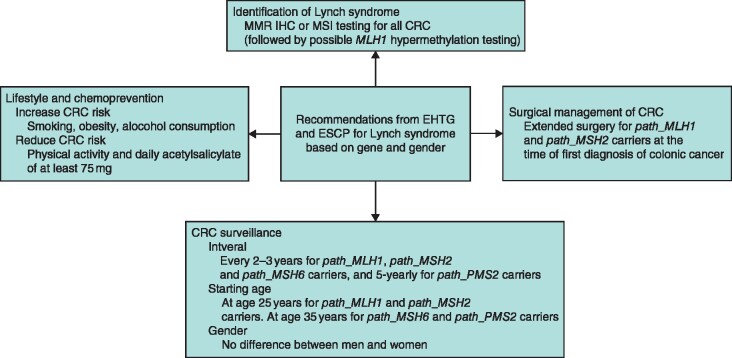
Summary of core content of the recommendations
MMR, mismatch repair; IHC, immunohistochemical; MSI, microsatellite instability; CRC, colorectal cancer; EHTG, European Hereditary Tumour Group; ESCP, European Society of Coloproctology.
Introduction
LS (OMIM #120435) is the most common dominantly inherited cancer syndrome but is often not recognized2,3. The prevalence of path_MMR carriers has been estimated to be around one in 300, that is 2·5 million people in Europe alone4.
Carriers are at increased risk of developing cancers, including colorectal, endometrial, ovarian, stomach, pancreatic, small bowel, biliary tract, urinary tract, brain and skin cancer. In LS, these cancers may occur much earlier in life than their sporadic counterparts, but older age of onset is not infrequent, and penetrance and expression vary by gene and gender from very high to immeasurable. The International Society for Gastrointestinal Hereditary Tumours (InSiGHT), through the use of its international database (http://insight‐database.org/) and expertise, categorizes MMR gene variants as being pathogenic (class 5) or likely to be pathogenic (class 4) (or as being of uncertain significance, likely not pathogenic or not pathogenic). This information can then be used to inform patient‐centred counselling in consultation with the Prospective Lynch Syndrome Database (PLSD) (http://www.plsd.eu). Potentially modifiable factors include acetylsalicylic acid (aspirin) prophylaxis and lifestyle. Typically, LS‐associated cancers have significantly better prognoses than sporadic cancers affecting the same organs, reflecting biological differences, including the marked immune responses that characterize LS cancers5. Patients with LS who are within cancer surveillance programmes benefit from a stage shift and earlier cancer diagnosis and usually survive their first cancers. Despite surveillance, those with LS can go on to develop metachronous cancers, with service planning implications6.
Carriers are identified by demonstration of a class 5 or 4 germline path_MMR variant. HNPCC refers to a family history indicating dominantly inherited colorectal cancer, which was later divided to specify several distinct, inherited, cancer syndromes that include colorectal cancer and other cancers (Fig. 2)7. Previously published guidelines8,9, for clinical management of LS were based on retrospective studies and made uniform management recommendations, regardless of which gene was involved.
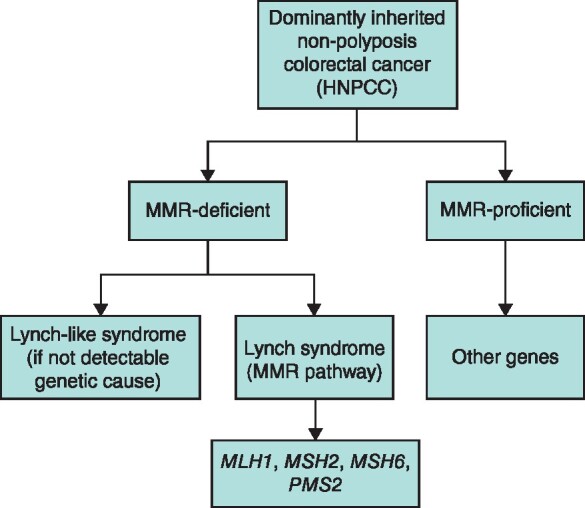
Clinical classification of hereditary non-polyposis colorectal cancer and causal genes7
HNPCC, hereditary non-polyposis colorectal cancer; MMR, mismatch repair.
Methods
Guideline group
In 2007, a group of European experts (the Mallorca Group) published guidelines for the clinical management of LS10 that were revised in 20138. The present second revision was conducted by a combined expert working group from the EHTG (former Mallorca Group) and ESCP, and was based on previously selected clinical questions. The group consisted of surgeons, clinical and molecular geneticists, pathologists, epidemiologists, gastroenterologists and a patient representative. If a particular specialty was not represented, specialists outside the group were consulted. It was decided that the update format of the manuscript would be via a continuous update process to be undertaken by the EHTG (living guidance).
Scope of updated guidelines
This update is based on the results from new prospective studies that reported the average risk of cancer in carriers by organ, by age, by gene and by gender. It covers the screening, diagnosis and management of LS, and is targeted for patients with this condition. Its aim is to gather the most up‐to‐date evidence on the management of LS. Furthermore, this guideline addresses the clinical questions raised in previous versions, and updates recommendations for the clinical management of carriers. Specifically, the guideline details the treatment and prevention of cancers based on gene and gender, and identifies areas requiring more research. This document is directed to patients of both genders and all age groups in which the diagnosis of LS is suspected or confirmed. The recommendations are directed to all patients with the condition, irrespective of severity or co‐morbidities.
Literature search
A PICO (Patients, Intervention, Comparison, Outcome) model structure was created for each area of interest, based on previously published template questions8. A systematic literature search was performed using the PubMed database and the Cochrane Database of Systematic Reviews, and manual searches of relevant articles up until November 2018. The following Medical Subject Heading (MeSH) terms were used: ‘hereditary nonpolyposis colorectal cancer’[All Fields] OR ‘Lynch syndrome’[All Fields]; 3893 articles were identified. The titles were screened and relevant articles written in English were reviewed, and the level of evidence was graded as high, moderate, low or very low, according to GRADE (Grading of Recommendations, Assessment, Development and Evaluation) criteria (http://www.gradeworkinggroup.org/) (Table S3, supporting information).
Timeline and meetings
During the working group meetings (3 meetings and several teleconferences), the outcomes of the literature search were discussed in detail. PICOs are available in AppendixS1 (supporting information) and Delphi round results in Table S4 (supporting information).
Suggestions for guidance statements emerging from the literature review were formulated and tested through Delphi model‐based voting rounds. The first Delphi round took place as an online questionnaire on SurveyMonkey® ( https://www.surveymonkey.co.uk) in week 38 of 2018. The stakeholders were identified from the membership of the EHTG to provide multidisciplinary expertise. The statements were thereby revised for a second Delphi round via live voting which took place in week 39 of 2018, among participants at the Third Annual Meeting of the EHTG in Nice, France. The statements were revised again, and a third Delphi round was conducted by SurveyMonkey® with voting in weeks 32–34 of 2019, again among multidisciplinary stakeholders identified by the EHTG. The most recent results from the PLSD studies were disclosed to all participants before voting, but were only published later11. The threshold for reaching consensus in the Delphi votes was set at 80 per cent.
The AGREE reporting checklist was used to guide the reporting of the process (AppendixS1, supporting information). An external review of the statements was undertaken before the third Delphi round, focusing mainly on the language of the statements communicating the strength of the recommendation based on the quality of evidence.
Question 1: how can the identification of Lynch syndrome be improved?
LS carcinomas of the large bowel are associated with a highly cellular, medullary or mucinous appearance, with a marked increase in the number of intratumoral and peritumoral lymphocytes, a pushing border with a low frequency of budding and low stromal content. They have a lower rate of nodal spread. Although these phenotypic features are in keeping with aberrant MMR protein expression, they are not specific for LS.
The clinical criteria for preselection of people for genetic testing (Amsterdam II12 and revised Bethesda13 criteria) are insensitive and lack specificity in identifying carriers (Table S5, supporting information); testing of incident colorectal cancer cases has been recommended for over a decade. In parallel with the present work, a consensus guideline meeting on gynaecological cancer in LS recommended screening for LS in patients with endometrial and ovarian cancer (and also BRCA1/2 screening in ovarian cancer). Furthermore, identification of carriers provides the opportunity for cascade testing of relatives, which has the benefit of identifying healthy carriers. These approaches have been shown to be cost‐effective14,15.
Laboratory screening of patients with upper urinary tract cancer to identify LS was agreed by a majority (73 per cent) but did not reach consensus.
Conclusions and recommendations
- All colorectal cancers should be tested by MMR (MLH1, MSH2, MSH6, PMS2) immunohistochemistry or MSI testing (followed by possible MLH1 hypermethylation testing) to screen for LS.
- Patients with endometrial or ovarian cancer should be screened by immunohistochemistry or DNA testing as described in the Manchester consensus statement.
Question 2: what is the optimal colorectal surveillance protocol for Lynch syndrome?
Subquestion 1: should colonoscopic surveillance be performed?
Data from largely observational studies conducted since the 1990s have supported the role of colonoscopic surveillance in patients with LS. Järvinen and colleagues16,17 reported on the outcomes of a cohort of patients with LS who underwent colonoscopic surveillance and compared them with a group who did not, and observed a 62 per cent reduction in colorectal cancer in the surveillance group. Similar observations were made in other studies18–20. Altogether, colonoscopic surveillance seems to lead to a 60–72 per cent decrease in colorectal cancer mortality. More recent data from prospective observational studies have questioned the previously reported benefits in earlier studies16,17,20 of comparative colorectal cancer incidence. Specifically, nearly half of path_MLH1 and path_MSH2 carriers develop colorectal cancer under surveillance6,21–23, and the benefits of colonoscopic surveillance are mainly to improve survival by earlier detection compared with no surveillance.
Conclusions and recommendations
- There was consensus agreement that for all path_MMR carriers colonoscopic surveillance should be performed to reduce mortality and incidence of colorectal cancer.
Subquestion 2: should chromoendoscopy/virtual chromoendoscopy be performed?
Chromoendoscopy (CE) uses contrast dyes (usually indigocarmine) to highlight the mucosal surface contours and enhance visualization. In virtual CE, filtering technology is built into the colonoscope system, which alters the white‐light image to highlight mucosal surface architecture and capillary pattern. Results with use of CE and virtual CE are summarized in Table 224–33. These studies are largely methodologically flawed, which limits the conclusions that can be drawn. CE may be equivalent to high‐quality white‐light examination with prolonged withdrawal. However, given the conflicting results of studies, and the methodological flaws of most published studies, CE may still be a helpful adjunct to be considered in colonoscopic surveillance in LS.
Conclusions and recommendations
- Chromoendoscopy is equivalent to high‐definition white‐light endoscopy in specialist centres. It may be an adjunct to be considered in the absence of high‐definition endoscopy or in centres with lower adenoma detection rates.
Subquestion 3: what is the appropriate colonoscopic surveillance interval?
In studies from the PLSD published by Møller and colleagues21, the interval between last surveillance colonoscopy and colorectal cancer was analysed. Of 145 colorectal cancers, 100 were diagnosed more 2 years after the last colonoscopy (interval after colonoscopy range 0–125 months). On the other hand, the high incidence of colorectal cancers in the PLSD despite colonoscopic surveillance was not due to the inclusion of a large cohort of Finnish path_MLH1 carriers for whom a 2–3‐year interval between colonoscopies had been recommended34. The cumulative incidence of colorectal cancer or stage at detection did not differ between 1‐yearly, 2‐yearly and 2–3‐yearly colonoscopic surveillance strategies in a study of 2747 path_MLH1, path_MSH2 and path_MSH6 carriers who were followed up for a total of 23 309 years by 16 327 colonoscopies23.
Gathering evidence suggests that carcinogenesis in path_PMS2 is predominantly via the adenomatous pathway35, and that the cancer risk is substantially lower than that for other LS genotypes, especially under colonoscopic surveillance6.
There is no reported substantial difference in lifetime incidence of colorectal cancer between that estimated by retrospective segregation analyses over three generations36–38 and that in the PLSD report6 on the effects of colonoscopy in preventing colorectal cancer as advocated by recent international guidelines (Table 3).
Studies describing the cumulative incidence of colorectal cancer in patients with Lynch syndrome
| 70‐year cumulative incidence (%) | |||||
|---|---|---|---|---|---|
| Reference | Gender | MLH1 | MSH2 | MSH6 | PMS2 |
| Bonadona et al.38 | Both | 41 | 48 | 12 | |
| Dowty et al.36 | Men | 34 | 47 | ||
| Women | 36 | 37 | |||
| ten Broeke et al.37 | Men | 13* | |||
| Women | 12* | ||||
| PLSD6 | Men | 53 | 42 | 18 | 10 |
| Women | 44 | 46 | 20 | 10 | |
*Cumulative risk at 80 years. PLSD, Prospective Lynch Syndrome Database.
Conclusions and recommendations
- For path_MLH1, path_MSH2 and path_MSH6 carriers, 2‐ or 3‐yearly colonoscopic surveillance is recommended (consensus not reached between 2 and 3 years).
- For path_PMS2 carriers, 5‐yearly surveillance may be considered.
- For patients with LS with a history of colorectal cancer and segmental or subtotal colectomy, biennial colonoscopies should be performed.
- There is no evidence at the moment to support different surveillance colonoscopy intervals for men and women.
- If bowel preparation is not entirely adequate, a repeat procedure at 1 year is recommended.
- If the bowel preparation is completely inadequate or the examination incomplete, an immediate repeat colorectal surveillance procedure should be requested (within next 6 weeks).
Subquestion 4: at what age should surveillance colonoscopy be initiated?
A number of studies have confirmed that the risk of developing colorectal cancer before the age of 25 years is very low (Table 4)6,8,21,22,37–48.
Overview of studies about age and risk of developing colorectal cancer in Lynch syndrome
| Reference | Study outcomes |
|---|---|
| de Jong et al.39 | Only two of 246 patients (0·8%) with LS developed CRC before the age of 20 years and another two between age 20 and 25 years |
|
Hendriks et al.40 Quehenberger et al.41 Hampel et al.42 Jenkins et al.43 | These studies confirmed that the risk of developing CRC before the age of 25 years is very low |
|
Vasen et al.8 Cairns et al.44 Rubenstein et al.45 | These previous guidelines recommended starting surveillance colonoscopy at age 20–25 years. |
| Jenkins et al.46 | This meta‐analysis for path_MLH1 and path_MSH2 carriers questioned whether the initiation of surveillance colonoscopy was justified before the age of 30 years |
| Giardiello et al.47 | US multisociety task force guidelines recommended starting surveillance colonoscopy at 20–25 years (or 2–5 years younger than youngest affected if aged <25 years), but to consider starting at 30 and 35 years for path_MSH6 and path_PMS2 carriers respectively |
| ten Broeke et al.37,48 |
The study described a series of 377 patients with path_PMS2 and the observed median age at first CRC was 52 (range 26–86) years. The authors also noted gender differences in CRC risk. The cumulative risk in men aged <40, 40–49, 50–59 and 60–69 years was 1·3, 4·6, 7·1 and 18·8% respectively. The corresponding cumulative risks by age in women were 0·5, 0·9, 4·7 and 10·5%. It was recommended that starting colonoscopy surveillance could be deferred until age 30 years for both genders. ten Broeke et al. also published a large series of patients with path_PMS2, and reported only a 2–3 times increased cumulative incidence of CRC under surveillance compared with the general population. This is about the same level of CRC risk as when there is a positive family history of the disease but genetic testing for LS (and other hereditary CRC syndromes) proves negative |
| Bonadona et al.38 | This nationwide French study of patients with LS supports a genotype–phenotype correlation. There were no path_PMS2 carriers in this cohort. Overall, the cumulative CRC risk by 70 years was 38% in men and 31% women. When analysed by genotype, the cumulative CRC risks were 46% for path_MLH1, 48% for path_MSH2 and 12% for path_MSH6. Median age at diagnosis of CRC also varied by genotype: 45 (range 15–90) years for path_MLH1, 44 (16–95) years for path_MSH2 and 54 (24–85) years for path_MSH6 |
| Møller et al.6,21,22 | In the 2017 PLSD report addressing incidence and survival of first cancers in patients with LS undergoing surveillance, the cumulative CRC incidence to age 70 years was 46% for path_MLH1, 35% for path_MSH2, 20% for path_MSH6 and 0% for path_PMS2. Overall, when incidence was analysed by gender, no difference was observed between men and women. The recent report (2018) from the PLSD described cancer risks and survival up to age 75 years, analysing the data both by gene and gender. The cohort included 3119 patients with 24 475 observation years. The previously described genotype‐dependent penetrance was confirmed; the cumulative CRC risk to age 75 years by genotype was: 46% for path_MLH1, 43% for path_MSH2, 15% for path_MSH6 and 0% for path_PMS2 (although there were only 124 path_PMS2 carriers in this cohort, so no firm conclusions could be drawn regarding this subgroup). Path_MSH6 has a lower risk of early‐onset cancer; the cumulative CRC risk at age 40 years was 12% for path_MLH1, 9% for path_MSH2 and 0% for path_MSH6. There were no consistent gender differences for CRC within each genotype group |
LS, Lynch syndrome; CRC, colorectal cancer; PLSD, Prospective Lynch Syndrome Database.
The risk of a path_PMS2 carrier developing cancer at young age is low, and the median age for path_PMS2‐related first colorectal cancers is 52 years47. Based on PLSD studies, path_MSH6 carriers also have a lower risk of early‐onset cancer; the cumulative colorectal cancer risk at age 40 years was 12 per cent for path_MLH1, 9 per cent for path_MSH2 and 0 per cent for path_MSH6. There is no convincing evidence to show that the age of onset is different between men and women.
Conclusions and recommendations
- For path_MLH1 or path_MSH2 carriers, surveillance colonoscopies should be initiated at the age of 25 years.
- For path_MSH6 or path_PMS2 carriers, surveillance colonoscopies should be initiated at the age of 35 years.
- Age at onset of surveillance should not be stratified by gender.
Question 3: what is the effectiveness of surveillance for other cancers?
The individual cumulative risk of cancer in any organ for the remaining lifetime of a patient with LS may be obtained by indicating their age, gender and genetic variant using http://www.plsd.eu/. There is no demonstrated benefit of surveillance for incidence or survival of gastric cancer, small bowel cancer, pancreatic cancer, urinary tract cancer, prostate cancer or breast cancer in path_MMR carriers (Table 5)6,49–56.
Studies describing cumulative risk and surveillance outcome for gastric, small bowel, pancreatic, urinary tract, prostate and breast cancer in Lynch syndrome
| Reference | Study outcomes |
|---|---|
| Gastric | |
| Møller et al.6 | There is a relative increase in incidence of 8·9 for path_MLH1 and 9·7 for path_MSH2 carriers compared with the general population |
| Park et al.49 | Geographical differences may be significant, with this report from Korea showing a higher lifetime risk |
| Capelle et al.50 | The Dutch Gastric Cancer Registry study revealed that the majority of gastric cancers in this patient population is of the intestinal type (62%) |
| Renkonen‐Sinisalo et al.51 | The study collected data on 73 mutation‐positive patients with a mean age of 49 years. In this group, an upper endoscopy for surveillance did not identify any neoplastic changes |
| Small bowel | |
| Møller et al.6 | There is a relative increase in incidence of this type of cancer of 64·7 for path_MLH1 carriers |
| ten Kate et al.52 | The study reported distribution predominantly in the duodenum and jejunum |
| Saurin et al.53 | The authors reported on 35 asymptomatic patients undergoing capsule endoscopy, which identified lesions in three patients. Of these, one had a jejunal adenocarcinoma and two had adenomas with low‐grade dysplasia |
| Haanstra et al.54 | The authors examined the effect of video capsule endoscopy in the detection of small bowel neoplasia in 200 asymptomatic patients. In this group, there were significant findings in two patients, who were diagnosed with adenocarcinoma (1 patient) and adenoma (1). An adenocarcinoma diagnosed 7 months after a negative capsule endoscopy was considered a missed lesion. Two years later, 155 of the initial 200 patients underwent a second video capsule endoscopy. Findings leading to further endoscopies with gastroduodenoscopy or balloon‐assisted endoscopy were seen in 11% of patients but none proved to be neoplasia |
| Pancreatic | |
| Møller et al.6 | The relative risk of pancreatic cancer is 7·8 for path_MLH1 carriers |
| Canto et al.55 | In this large study of screening in 354 patients at high risk of pancreatic cancer, a survival benefit was identified for patients diagnosed during screening. This study used endoscopic ultrasonography, MRI and CT for screening. However, no patients with LS were diagnosed with a tumour |
| Urinary tract | |
| Møller et al.6 | There is a relative increase in incidence of bladder cancer of 4·1 for path_MLH1 and 8·1 for path_MSH2 carriers. There is also a relative increase in incidence of ureter and kidney cancer of 3·5 for path_MLH1 and 13·7 for path_MSH2 carriers |
| Myrhøj et al.56 | The National Danish HNPCC registry assessed a strategy of screening with urinary cytology. In this study of 977 individuals, including 263 with confirmed path_MMR variants, urine cytology had a sensitivity of 29%, with a specificity of 96%. Five of 14 cancers that occurred were interval cancers not detected by screening |
| Prostate | |
| Møller et al.6 | There is a relative increase in incidence of this type of cancer of 3·2 for path_MSH2 carriers |
| IMPACT study (http://impact.icr.ac.uk/) | The study is currently recruiting carriers of path_MLH1, path_MSH2 and path_MSH6, and those who have tested negative for path_MLH1, path_MSH2 or path_MSH6 known to be present in their family. This study can be considered for patients undergoing surveillance for LS |
| Breast | |
| Møller et al.6 | In the PLSD, there is a relative incidence of breast cancer of 1·3 for path_MLH1, 1·2 for path_MSH2 and 1·4 for path_MSH6 carriers. In this cohort, the confidence intervals all include 1 and it is not possible to confirm a significant increase in breast cancer risk at this time |
LS, Lynch syndrome; HNPCC, hereditary non‐polyposis colorectal cancer; PLSD, Prospective Lynch Syndrome Database.
Conclusions and recommendations
- Consensus was not achieved for the statement ‘Surveillance for other cancers (than colorectal, endometrial and ovarian) should not be offered’.
Question 4: what is the appropriate surgical treatment for colorectal cancer?
The risk of metachronous colorectal cancer after primary colonic cancer depends on which variant a carrier has and on the extent of surgery performed in managing the primary colonic cancer (how much colon is left to be at risk). There are no good data describing the risk of a second colonic cancer by gene and treatment of first cancer. Analyses in the PLSD22 suggested that the risk of a second colorectal cancer was determined stochastically: the risk of a second cancer was not substantially different from the risk of a first cancer by age, gene and gender. Without stratifying by gene and treatment of first colonic cancer (because numbers in the study did not allow substrata for analysis), a PLSD study22 reported that the risk of metachronous colorectal cancer by 70 years (starting from 40 years) after an earlier colonic cancer and despite regular colonoscopies was 36 (95 per cent c.i. 29 to 43·8) per cent. The numbers were likely to be conservative estimates for metachronous cancer, because a substantial proportion of these patients were treated at specialized centres and will have had extended colonic surgery. Three recent meta‐analyses and several independent studies evaluated the risk of metachronous colorectal cancer after colectomy for colonic cancer (Table 6)57–65. No studies have reported the risk of a third colorectal cancer after subsequent colonic cancer. However, third metachronous colorectal cancers have been described, as has survival after these subsequent cancers22. There are no studies addressing the more invasive surgical option of extending colorectal surgery to a proctocolectomy at the occurrence of a first or metachronous colonic or rectal cancer. It is essential to evaluate the role of extended surgery prospectively and provide recommendations stratified by MMR gene in order to reduce the incidence of metachronous colorectal cancer occurring in path_MMR carriers.
Studies describing surgical treatment for colorectal cancer in Lynch syndrome
| Reference | Study outcomes |
|---|---|
| Anele et al.57 | This report included six studies involving 871 patients who met the inclusion criteria (705 had segmental colectomy and 166 extended colectomy). The weighted mean follow‐up was 7·6 years. Patients with LS were four times more likely to develop metachronous CRC after segmental colectomy than those who had extended resection, despite regular endoscopic surveillance (1–2‐yearly) |
| Heneghan et al.58 | This review included eight studies and 948 patients (780 had segmental colectomy and 168 extended colectomy) followed up for 8·9 years, but they did not exclude studies based on clinical criteria only for diagnosis of LS. The authors calculated the risk of metachronous CRC to be 3·7 times higher after segmental colectomy than extended resection. There were limitations regarding morbidity and mortality data in most of the original studies |
| Malik et al.59 | This meta‐analysis identified 1389 patients with LS and HNPCC followed up for a mean of 8·4 years, with a mean age at onset of 45·5 years. A total of 1119 patients underwent segmental colectomies with an absolute risk of metachronous CRC of 22·4% at the end of follow‐up. The 270 patients who underwent extended colectomies had a metachronous CRC risk of 4·7%. Segmental colectomy was significantly associated with an increased RR of metachronous CRC (RR 5·12, 95% c.i. 2·88 to 9·11), although no significant association with mortality was identified (RR 1·65, 0·90 to 3·02) |
| Renkonen‐Sinisalo et al.60 | The authors compared the outcomes of 242 genetically confirmed LS carriers who underwent either STC (98) or segmental colectomy (144), and were followed up for between 14·6 and 25 years. The cumulative risk of metachronous CRC after segmental colectomy was 47% compared with 7% after STC + ISA. Extended surgery also reduced the risk of subsequent abdominal surgery compared with segmental resection (10·9 versus 54·1%), but there was no difference in CRC‐specific survival. However, the majority of patients were path_MLH1 carriers. For patients undergoing STC, 10–20 cm of sigmoid was left and an ISA performed |
| Kim et al.61 | The cumulative risk of metachronous CRC was reported to be 20·4% in 10‐year follow‐up after segmental colectomy compared with 0% after extended surgery in this South‐Korean study of 106 patients with LS. No survival benefit of extended surgery was established |
| Parry et al.62 | The authors reported a decrease in metachronous CRC risk for every 10 cm of bowel removed. The cumulative risk of metachronous CRC in 322 patients undergoing segmental colectomy was 16 (95% c.i. 10 to 25)% at 10 years, 41 (30 to 52)% at 20 years and 62 (50 to 77)% at 30 years. Of the 50 patients who underwent extensive colonic resection (STC + ISA or IRA) for their first colonic cancer, none were diagnosed with metachronous CRC over 414 person‐years of follow‐up |
| Stupart et al.63 Natarajan et al.64 | Other retrospective comparative studies have reported a high incidence of metachronous CRC after segmental colectomy and a lower incidence after extended colectomy. STC with IRA or ISA decreases the risk of metachronous colonic cancer and provides easy endoscopic surveillance |
| You et al.65 | This study of 201 extended resections (STC + ISA or TC + IRA) and 321 segmental colectomies for indications other than inflammatory bowel diseases reported a median of four daily bowel movements after ISA and five after IRA, despite considerable dietary restrictions (reported by 55·6 per cent) and medication use (19·6 per cent reported daily use). STC + ISA resulted in significantly less daytime and night‐time bowel movements than TC + IRA (P = 0·002) but no significant difference in quality‐of‐life measures (P = 0·16) |
LS, Lynch syndrome; CRC, colorectal cancer; HNPCC, hereditary non‐polyposis colorectal cancer; RR, relative risk; STC, subtotal colectomy; ISA, ileosigmoidal anastomosis; IRA, ileorectal anastomosis; TC, total colectomy.
Extended surgery, either subtotal colectomy with ileosigmoidal anastomosis or total colectomy with ileorectal anastomosis, for primary colonic cancer in path_MLH1 and path_MSH2 carriers is preferable to reduce the risk of subsequent colorectal cancer, even though extended surgery has not been shown to improve overall survival. There is no substantial evidence to support extended surgery for path_MSH6 and path_PMS2 carriers. All surgical decision‐making should be personalized, based on the patient's age, gender, and expected functional outcome and priorities.
Subquestion 1: should extended surgery for Lynch syndrome‐associated colonic cancer be recommended?
A largely retrospective body of evidence supports the extension of surgical resection in path_MLH1 and path_MSH2 carriers, but the risk of metachronous colorectal cancer in path_MSH6 and path_PMS2 carriers is not high enough to warrant an extended approach (Table 6).
Conclusions and recommendations
- For a path_MLH1 or path_MSH2 carrier with a first colonic cancer, extended surgery with ileosigmoidal/ileorectal anastomosis is preferable to standard resection to reduce the risk of metachronous colorectal cancer.
- For a path_MSH6 or path_PMS2 pathogenic variant carrier with a first colonic cancer, standard/segmental colonic resection should be offered.
- For a path_MMR carrier with a metachronous colonic cancer, the surgical treatment can be extended surgery with ileorectal/ileosigmoidal anastomosis.
- A decision on extended surgery for colorectal cancer should not be based on deficient MMR immunohistochemistry (loss of MLH1, MSH2, MSH6 or PMS2) and BRAF staining/MLH1 hypermethylation from the preoperative endoscopic biopsy only.
Subquestion 2: how should surgery for rectal cancer in Lynch syndrome be performed?
Studies have reported metachronous cancer after rectal cancer in carriers66,67. Because the cumulative risk of a subsequent colonic cancer developing during surveillance is significant, extended surgery may be a personal preference, considering the higher degree of surgical morbidity associated with the procedure. Quality of life of patients with an ileoanal pouch may be comparable to that of patients with familial adenomatous polyposis rather than those with inflammatory bowel disease (IBD), because the worse overall outcome in the latter group is due to the underlying inflammatory condition. There is clear evidence that surgeons performing a high volume of procedures in high‐volume units (over 10 per year) achieve lower pouch failure rates as well as better pouch salvage than those with a lower throughput of these procedures68,69. Preferred surgical options by gene are shown in Table 7.
Surgical options for colorectal cancer in path_MMR carriers
| Path_MLH1 | Path_MSH2 | Path_MSH6 | Path_PMS2 | Additional risk factors | |
|---|---|---|---|---|---|
| Primary colonic cancer of a known LS pathogenic variant carrier | Subtotal colectomy with ileosigmoidal (ileorectal) anastomosis | Subtotal colectomy with ileosigmoidal (ileorectal) anastomosis | Segmental colectomy (right, extended right or left colectomy) | Segmental colectomy (right, extended right or left colectomy) |
Adenoma formation in a colonic segment other than the segment affected by colonic cancer Extended surgery such as colectomy with ileosigmoidal or ileorectal anastomosis. For young patients, consider more extensive surgery |
| Metachronous colonic cancer in a known LS pathogenic variant carrier who has undergone previous segmental colectomy | Subtotal colectomy with ileorectal anastomosis | Subtotal colectomy with ileorectal anastomosis | Subtotal colectomy with ileorectal anastomosis | Subtotal colectomy with ileorectal anastomosis | |
| Primary rectal cancer in a known LS pathogenic variant carrier | Anterior resection/APR | Anterior resection/APR | Anterior resection/APR | Anterior resection/APR | |
| Rectal cancer after previous colonic cancer surgery in a known LS pathogenic variant carrier | Proctectomy/proctocolectomy with ileoanal anastomosis with pouch or APR with permanent ileostomy | Proctectomy/proctocolectomy with ileoanal anastomosis with pouch or APR with permanent ileostomy | Proctectomy/proctocolectomy with ileoanal anastomosis with pouch or APR with permanent ileostomy |
LS, Lynch syndrome; APR, abdominoperineal resection.
Conclusions and recommendations
- For a path_MMR carrier, the surgical treatment of a primary rectal cancer (occurring as the first colorectal cancer) should be standard resection (anterior resection or abdominoperineal resection).
- In a young path_MMR carrier with a synchronous colorectal neoplasm or a personal preference, extended surgery can be considered.
- Ileoanal pouch surgery (in agreement with European CanCer Organisation guidelines for pouch surgery in ulcerative colitis) should be performed in highly specialized colorectal surgical units.
Subquestion 3: should prophylactic bowel surgery be performed?
It is acknowledged that, even with the more favourable stage at diagnosis in patients under surveillance, there is a 9 per cent overall mortality rate among patients with LS in the 10 years after diagnosis of colorectal cancer. There is no documented procedure to identify and separate carriers at higher risk of colorectal cancer than the average by using age, gene and gender, nor those who might be at risk of not surviving a future colorectal cancer. There is no evidence base to support prophylactic colorectal surgery in path_MMR carriers.
In a study70 of patients with high‐grade dysplasia in endoscopic biopsies and a polyp that was not amenable to endoscopic removal, 22 of 165 polyps (13·3 per cent) had an invasive cancer on final pathology. In another study at the Mayo Clinic71, 133 of 750 unresectable polyps (17·7 per cent) harboured a malignancy, of which 23 per cent were lymph node‐positive. Although these studies were conducted without knowledge of the MMR status of the tumours, they indicate that high‐grade dysplasia on biopsy is a strong predictor of tumours harbouring invasive malignancy.
In patients with LS and concurrent IBD, it is unclear whether colorectal cancer risks are sufficiently increased for prophylactic colectomy to be indicated. In a small series72 of 12 patients with LS and concurrent IBD, four developed colorectal cancer in an early age. However, the series did not demonstrate a sufficiently increased risk of colorectal cancer to recommend prophylactic surgery.
Conclusions and recommendations
- For endoscopically non‐removable polyps with advanced histology, an oncological approach is recommended, as for gene‐specific treatment for carcinoma.
- Prophylactic colorectal surgery in the absence of neoplastic lesions in the colorectum is not recommended for path_MMR carriers based on their pathogenic variant‐related risk only.
Question 5: what is the influence of lifestyle factors on the development of adenoma or colorectal cancer in Lynch syndrome?
The majority of studies showed positive associations between BMI and smoking and colorectal cancer, whereas some studies reported that alcohol consumption was positively associated with colorectal cancer. One study reported an inverse association between physical activity and colorectal cancer in path_MMR carriers (Table 8)73–89. No lifestyle factor has been demonstrated to increase the risk of cancer specifically for one gender, or for carriers of pathogenic variants in a specific gene.
Association studies between BMI, smoking, alcohol consumption, physical activity and colorectal cancer in Lynch syndrome
| Reference | Study outcomes |
|---|---|
|
Diergaarde et al.73 Botma et al.74 Campbell et al75 Movahedi et al.76 Win et al.77 | These studies reported on the association between BMI and colorectal tumours in LS. A high BMI was associated with an increased risk of colorectal tumours in three publications74,76,77 another75 indicated an association in the same direction, and one73 did not show an association |
|
Diergaarde et al.73 Kamiza et al.78 Watson et al.79 Winkels et al.80 Dashti et al.81 | In analyses of alcohol consumption and colorectal tumour risk in LS, three studies73,78,79 did not observe an association, one80 demonstrated a possible increased risk, and one81 reported a significant increase in risk of colorectal tumours when alcohol consumption was high |
|
Kamiza et al.78 | The influence of physical activity on colorectal tumour risk has been investigated in only one study, which showed that being physically active is significantly associated with a decreased colorectal tumour risk in those with LS |
|
Brand et al.82 Diergaarde et al.73 Pande et al.83 Watson et al.79 Winkels et al.80 | The risk of colorectal tumours is significantly increased by smoking in LS |
|
Diergaarde et al.73 Kamiza et al.78 Botma et al.74 Voskuil et al.84 Burn et al.85 Mathers et al.86 Jung et al.87 Chau et al.88 Heine‐Bröring et al.89 | Different aspects of diet, such as dietary patterns74, and consumption of meat73,78,84, vegetables73,78, fruit73,78, fish73, dairy products73, dietary fibre73,85,86, dietary B vitamins87, dietary supplements88,89, tea73 and coffee73 have been investigated in relation to colorectal tumour risk in people with LS. None of these dietary factors, however, were evaluated in more than three publications |
LS, Lynch syndrome.
Conclusions and recommendations
- Path_MMR carriers should be advised that smoking and obesity increase the risk of colorectal cancer.
- Path_MMR carriers should be advised that alcohol consumption increases the risk of colorectal cancer.
- Path_MMR carriers should be advised that physical activity reduces the risk of colorectal cancer.
Question 6: what is the role of acetylsalicylic acid (aspirin) in the management of Lynch syndrome?
An RCT76,85,90 showed that 600 mg acetylsalicylic acid daily for 2–4 years was well tolerated and reduced colorectal cancer incidence after 5 years following initiation of the treatment. A recently published study91 has shown that the benefit of prevention with acetylsalicylic acid persists into the second decade. Observational data in the general population suggest that lower doses may also be effective92,93. For bodyweight above average (70 kg), a higher dose than currently in clinical use for other indications may be required94.
Conclusions and recommendations
- Path_MMR carriers should be advised that daily acetylsalicylic acid intake will reduce colorectal cancer risk.
- The recommended acetylsalicylic acid dose should be a minimum of 75–100 mg daily. This dose should be increased for people with above‐average body mass.
Final conclusion
The recommendations from the EHTG and ESCP for identification of patients with LS, colorectal surveillance, surgical management of colorectal cancer, lifestyle and chemoprevention in LS that reached a consensus (at least 80 per cent) are presented here. The joint statement also endorsed the Manchester International Consensus Group recommendations for the management of gynaecological cancers in LS.
Supplementary Material
Acknowledgements
Development of the guideline was supported by an educational grant from Promega (USA). EHTG is a charitable company registered in Scotland (registration number SC048407). ESCP is a charitable organization registered in Scotland (registration number SC205553). A grant from the ESCP guideline committee was awarded for this guideline development. The authors thank J. Kleijnen for valuable advice and help in streamlining the PICOs in the external review.
T.T.S. is supported by grants from the Emil Aaltonen Foundation, and Sigrid Juselius Foundation. D.G.E and E.J.C. are supported by the National Institute for Health Research (NIHR) Manchester Biomedical Research Centre (IS‐BRC‐1215–20007). N.R. was funded as a Medical Research Council Doctoral Research Fellow (MR/M018431/1). P.Q. is an NIHR senior investigator and supported by Yorkshire Cancer Research L386 and L394. J.R.S. was supported by Health and Care Research Wales via a grant to Wales Gene Park. None of the funding bodies influenced the content of the recommendation. T.T.S. is a Chief Executive Officer and co‐owner of Healthfund Finland, outside the submitted work. D.G.E. reports consultancy from AstraZeneca, outside the submitted work.
Disclosure: The authors declare no other conflict of interest.
Supporting information
Additional supporting information can be found online in the Supporting Information section at the end of the article.
References
Associated Data
Supplementary Materials
References
- Crosbie EJ, Ryan NAJ, Arends MJ, Bosse T, Burn J, Cornes JM. et al . The Manchester International Consensus Group recommendations for the management of gynecological cancers in Lynch syndrome. Genet Med 2019; 21: 2390–2400.
- Lynch HT, Snyder CL, Shaw TG, Heinen CD, Hitchins MP. Milestones of Lynch syndrome: 1895–2015. Nat Rev Cancer 2015; 15: 181–194.
- Lynch HT, Lynch PM, Lanspa SJ, Snyder CL, Lynch JF, Boland CR. Review of the Lynch syndrome: history, molecular genetics, screening, differential diagnosis, and medicolegal ramifications. Clin Genet 2009; 76: 1–18.
- Haraldsdottir S, Rafnar T, Frankel WL, Einarsdottir S, Sigurdsson A, Hampel H. et al . Comprehensive population‐wide analysis of Lynch syndrome in Iceland reveals founder mutations in MSH6 and PMS2 . Nat Commun 2017; 8: 1–11.
- Llosa NJ, Cruise M, Tam A, Wicks EC, Hechenbleikner EM, Taube JM. et al . The vigorous immune microenvironment of microsatellite instable colon cancer is balanced by multiple counter‐inhibitory checkpoints. Cancer Discov 2015; 5: 43–51.
- Møller P, Seppälä TT, Bernstein I, Holinski‐Feder E, Sala P, Evans DG. et al . Cancer risk and survival in path‐MMR carriers by gene and gender up to 75 years of age: a report from the Prospective Lynch Syndrome Database. Gut 2018; 67: 1306–1316.
- Valle L. Recent discoveries in the genetics of familial colorectal cancer and polyposis. Clin Gastroenterol Hepatol 2019; 15: 809–819.
- Vasen HFA, Blanco I, Aktan‐Collan K, Gopie JP, Alonso A, Aretz S. et al . Revised guidelines for the clinical management of Lynch syndrome (HNPCC): recommendations by a group of European experts. Gut 2013; 62: 812–823.
- Syngal S, Brand RE, Church JM, Giardiello FM, Hampel HL, Burt RW. ACG clinical guideline: genetic testing and management of hereditary gastrointestinal cancer syndromes. Am J Gastroenterol 2015; 110: 223–262.
- Vasen HFA, Möslein G, Alonso A, Bernstein I, Bertario L, Blanco I. et al . Guidelines for the clinical management of Lynch syndrome (hereditary non‐polyposis cancer). J Med Genet 2007; 44: 353–362.
- Dominguez‐Valentin M, Sampson JR, Seppälä TT, ten Broeke SW, Plazzer JP, Nakken S. et al . Cancer risks by gene, age, and gender in 6350 carriers of pathogenic mismatch repair variants: findings from the Prospective Lynch Syndrome Database. Genet Med 2020; 22: 15–25.
- Vasen HF, Watson P, Mecklin JP, Lynch HT. New clinical criteria for hereditary nonpolyposis colorectal cancer (HNPCC, Lynch syndrome) proposed by the International Collaborative group on HNPCC. Gastroenterology 1999; 116: 1453–1456.
- Umar A, Boland CR, Terdiman JP, Syngal S, Chapelle A de la, Rüschoff J. et al . Revised Bethesda guidelines for hereditary nonpolyposis colorectal cancer (Lynch syndrome) and microsatellite instability. J Natl Cancer Inst 2004; 96: 261–268.
- Snowsill T, Coelho H, Huxley N, Jones‐Hughes T, Briscoe S, Frayling IM. et al . Molecular testing for Lynch syndrome in people with colorectal cancer: systematic reviews and economic evaluation. Health Technol Assess Rockv 2017; 21: 1–238.
- Pujol P, Lyonnet DS, Frebourg T, Blin J, Picot MC, Lasset C. et al . Lack of referral for genetic counseling and testing in BRCA1/2 and Lynch syndromes: a nationwide study based on 240 134 consultations and 134 652 genetic tests. Breast Cancer Res Treat 2013; 141: 135–144.
- Järvinen HJ, Mecklin JP, Sistonen P. Screening reduces colorectal cancer rate in families with hereditary nonpolyposis colorectal cancer. Gastroenterology 1995; 108: 1405–1411.
- Järvinen HJ, Aarnio M, Mustonen H, Aktan‐Collan K, Aaltonen LA, Peltomäki P. et al . Controlled 15‐year trial on screening for colorectal cancer in families with hereditary nonpolyposis colorectal cancer. Gastroenterology 2000; 118: 829–834.
- Newton K, Green K, Lalloo F, Evans DG, Hill J. Colonoscopy screening compliance and outcomes in patients with Lynch syndrome. Colorectal Dis 2015; 17: 38–46.
- Stuckless S, Green JS, Morgenstern M, Kennedy C, Green RC, Woods MO. et al . Impact of colonoscopic screening in male and female Lynch syndrome carriers with an MSH2 mutation. Clin Genet 2012; 82: 439–445.
- Dove‐Edwin I, Sasieni P, Adams J, Thomas HJW. Prevention of colorectal cancer by colonoscopic surveillance in individuals with a family history of colorectal cancer: 16 year, prospective, follow‐up study. BMJ 2005; 331: 1047–1049.
- Møller P, Seppälä T, Bernstein I, Holinski‐Feder E, Sala P, Evans DGG. et al . Cancer incidence and survival in Lynch syndrome patients receiving colonoscopic and gynaecological surveillance: first report from the prospective Lynch syndrome database. Gut 2017; 66: 464–472.
- Møller P, Seppälä T, Bernstein I, Holinski‐Feder E, Sala P, Evans DG. et al . Incidence of and survival after subsequent cancers in carriers of pathogenic MMR variants with previous cancer: a report from the prospective Lynch syndrome database. Gut 2017; 66: 1657–1664.
- Engel C, Vasen HF, Seppälä T, Aretz S, Bigirwamungu‐Bargeman M, Boer SY de. et al . No difference in colorectal cancer incidence or stage at detection by colonoscopy among 3 countries with different Lynch syndrome surveillance policies. Gastroenterology 2018; 155: 1400–1409.e2.
- Brown SR, Baraza W, Din S, Riley S. Chromoscopy versus conventional endoscopy for the detection of polyps in the colon and rectum. Cochrane Database Syst Rev 2016; (4)CD006439.
- Kamiński MF, Hassan C, Bisschops R, Pohl J, Pellisé M, Dekker E. et al . Advanced imaging for detection and differentiation of colorectal neoplasia: European Society of Gastrointestinal Endoscopy (ESGE) guideline. Endoscopy 2014; 46: 435–449.
- Lecomte T, Cellier C, Meatchi T, Barbier JP, Cugnenc PH, Jian R. et al . Chromoendoscopic colonoscopy for detecting preneoplastic lesions in hereditary nonpolyposis colorectal cancer syndrome. Clin Gastroenterol Hepatol 2005; 3: 897–902.
- Stoffel EM, Turgeon DK, Stockwell DH, Zhao L, Normolle DP, Tuck MK. et al . Missed adenomas during colonoscopic surveillance in individuals with Lynch syndrome (hereditary nonpolyposis colorectal cancer). Cancer Prev Res 2008; 1: 470–475.
- Rahmi G, Lecomte T, Malka D, Maniere T, Le Rhun M, Guimbaud R. et al . Impact of chromoscopy on adenoma detection in patients with Lynch syndrome: a prospective, multicenter, blinded, tandem colonoscopy study. Am J Gastroenterol 2015; 110: 288–298.
- Rijn JC van, Reitsma JB, Stoker J, Bossuyt PM, Van Deventer SJ, Dekker E. Polyp miss rate determined by tandem colonoscopy: a systematic review. Am J Gastroenterol 2006; 101: 343–350.
- East JE, Suzuki N, Stavrinidis M, Guenther T, Thomas HJW, Saunders BP. Narrow band imaging for colonoscopic surveillance in hereditary non‐polyposis colorectal cancer. Gut 2008; 57: 65–70.
- Bisschops R, Tejpar S, Willekens H, De Hertogh G, Van Cutsem E. Virtual chromoendoscopy (I‐SCAN) detects more polyps in patients with Lynch syndrome: a randomized controlled crossover trial. Endoscopy 2017; 49: 342–350.
- Hüneburg R, Lammert F, Rabe C, Rahner N, Kahl P, Büttner R. et al . Chromocolonoscopy detects more adenomas than white light colonoscopy or narrow band imaging colonoscopy in hereditary nonpolyposis colorectal cancer screening. Endoscopy 2009; 41: 316–322.
- Rondagh EJA, Gulikers S, Gómez‐García EB, Vanlingen Y, Detisch Y, Winkens B. et al . Nonpolypoid colorectal neoplasms: a challenge in endoscopic surveillance of patients with Lynch syndrome. Endoscopy 2013; 45: 257–264.
- Seppälä T, Pylvänäinen K, Evans DG, Järvinen H, Renkonen‐Sinisalo L, Bernstein I. et al . Colorectal cancer incidence in path_MLH1 carriers subjected to different follow‐up protocols: a prospective Lynch syndrome database report. Hered Cancer Clin Pract 2017; 15: 18.
- Broeke SW ten, Bavel TC van, Jansen AML, Gómez‐García E, Hes FJ, Hest LP van. et al . Molecular background of colorectal tumors from patients with Lynch syndrome associated with germline variants in PMS2 . Gastroenterology 2018; 155: 844–851.
- Dowty JG, Win AK, Buchanan DD, Lindor NM, Macrae FA, Clendenning M. et al . Cancer risks for MLH1 and MSH2 mutation carriers. Hum Mutat 2013; 34: 490–497.
- Broeke SW ten, Klift HMV, Tops CMJ, Aretz S, Bernstein I, Buchanan DD. et al . Cancer risks for PMS2 ‐associated Lynch syndrome. J Clin Oncol 2018; 36: 2961–2968.
- Bonadona V, Bonaïti B, Olschwang S, Grandjouan S, Huiart L, Longy M. et al . Cancer risks associated with germline mutations in MLH1 , MSH2 , and MSH6 genes in Lynch syndrome. JAMA 2011; 305: 2304–2310.
- Jong AE de, Nagengast FM, Kleibeuker JH, Meeberg PC van de, Wijk HJ van, Cats A. et al . What is the appropriate screening protocol in Lynch syndrome? Fam Cancer 2006; 5: 373–378.
- Hendriks YMC, Wagner A, Morreau H, Menko F, Stormorken A, Quehenberger F. et al . Cancer risk in hereditary nonpolyposis colorectal cancer due to MSH6 mutations: impact on counseling and surveillance. Gastroenterology 2004; 127: 17–25.
- Quehenberger F, Vasen HFA, Van Houwelingen HC. Risk of colorectal and endometrial cancer for carriers of mutations of the hMLH1 and hMSH2 gene: correction for ascertainment. J Med Genet 2005; 42: 491–496.
- Hampel H, Frankel W, Panescu J, Lockman J, Sotamaa K, Fix D. et al . Screening for Lynch syndrome (hereditary nonpolyposis colorectal cancer) among endometrial cancer patients. Cancer Res 2006; 66: 7810–7817.
- Jenkins MA, Baglietto L, Dowty JG, Van Vliet CM, Smith L, Mead LJ. et al . Cancer risks for mismatch repair gene mutation carriers: a population‐based early onset case‐family study. Clin Gastroenterol Hepatol 2006; 4: 489–498.
- Cairns SR, Scholefield JH, Steele RJ, Dunlop MG, Thomas HJW, Evans GD. et al . Guidelines for colorectal cancer screening and surveillance in moderate and high risk groups (update from 2002). Gut 2010; 59: 666–689.
- Rubenstein JH, Enns R, Heidelbaugh J, Barkun A, Adams MA, Dorn SD. et al . American Gastroenterological Association Institute Guideline on the diagnosis and management of Lynch syndrome. Gastroenterology 2015; 149: 777–782.
- Jenkins MA, Dowty JG, Ait Ouakrim D, Mathews JD, Hopper JL, Drouet Y. et al . Short‐term risk of colorectal cancer in individuals with Lynch syndrome: a meta‐analysis. J Clin Oncol 2015; 33: 326–331.
- Giardiello FM, Allen JI, Axilbund JE, Boland CR, Burke CA, Burt RW. et al . Guidelines on genetic evaluation and management of Lynch syndrome: a consensus statement by the US multi‐society task force on colorectal cancer. Am J Gastroenterol 2014; 109: 1159–1179.
- Broeke SW ten, Brohet RM, Tops CM, Klift HM van der, Velthuizen ME, Bernstein I. et al . Lynch syndrome caused by germline PMS2 mutations: delineating the cancer risk. J Clin Oncol 2015; 33: 319–325.
- Park YJ, Shin KH, Park JG. Risk of gastric cancer in hereditary nonpolyposis colorectal cancer in Korea. Clin Cancer Res 2000; 6: 2994–2998.
- Capelle LG, Van Grieken NCT, Lingsma HF, Steyerberg EW, Klokman WJ, Bruno MJ. et al . Risk and epidemiological time trends of gastric cancer in Lynch syndrome carriers in the Netherlands. Gastroenterology 2010; 138: 487–492.
- Renkonen‐Sinisalo L, Sipponen P, Aarnio M, Julkunen R, Aaltonen LA, Sarna S. et al . No support for endoscopic surveillance for gastric cancer in hereditary non‐polyposis colorectal cancer. Scand J Gastroenterol 2002; 37: 574–577.
- Ten Kate GL, Kleibeuker JH, Nagengast FM, Craanen M, Cats A, Menko FH. et al . Is surveillance of the small bowel indicated for Lynch syndrome families? Gut 2007; 56: 1198–1201.
- Saurin JC, Pilleul F, Soussan EB, Manire T, Dhalluin PN, Gaudric M. et al . Small‐bowel capsule endoscopy diagnoses early and advanced neoplasms in asymptomatic patients with Lynch syndrome. Endoscopy 2010; 42: 1057–1062.
- Haanstra J, Al‐Toma A, Dekker E, Vanhoutvin S, Nagengast F, Mathus‐Vliegen E. et al . Incidence of small bowel neoplasia in Lynch syndrome assessed by video capsule endoscopy. Endosc Int Open 2017; 05: E622–E626.
- Canto MI, Almario JA, Schulick RD, Yeo CJ, Klein A, Blackford A. et al . Risk of neoplastic progression in individuals at high risk for pancreatic cancer undergoing long‐term surveillance. Gastroenterology 2018; 155: 740–751.e2.
- Myrhøj T, Andersen MB, Bernstein I. Screening for urinary tract cancer with urine cytology in Lynch syndrome and familial colorectal cancer. Fam Cancer 2008; 7: 303–307.
- Anele CC, Adegbola SO, Askari A, Rajendran A, Clark SK, Latchford A. et al . Risk of metachronous colorectal cancer following colectomy in Lynch syndrome: a systematic review and meta‐analysis. Colorectal Dis 2017; 19: 528–536.
- Heneghan HM, Martin ST, Winter DC. Segmental vs extended colectomy in the management of hereditary nonpolyposis colorectal cancer: a systematic review and meta‐analysis. Colorectal Dis 2015; 17: 382–389.
- Malik SS, Lythgoe MP, McPhail M, Monahan KJ. Metachronous colorectal cancer following segmental or extended colectomy in Lynch syndrome: a systematic review and meta‐analysis. Fam Cancer 2018; 17: 557–564.
- Renkonen‐Sinisalo L, Seppälä TTTT, Järvinen HJHJ, Mecklin JPJ‐P. Subtotal colectomy for colon cancer reduces the need for subsequent surgery in Lynch syndrome. Dis Colon Rectum 2017; 60: 792–799.
- Kim TJ, Kim ER, Hong SN, Kim YH, Huh JW, Park YA. et al . Survival outcome and risk of metachronous colorectal cancer after surgery in Lynch syndrome. Ann Surg Oncol 2017; 24: 1085–1092.
- Parry S, Win AK, Parry B, Macrae FA, Gurrin LC, Church JM. et al . Metachronous colorectal cancer risk for mismatch repair gene mutation carriers: the advantage of more extensive colon surgery. Gut 2011; 60: 950–957.
- Stupart DA, Goldberg PA, Baigrie RJ, Algar U, Ramesar R. Surgery for colonic cancer in HNPCC: total vs segmental colectomy. Colorectal Dis 2011; 13: 1395–1399.
- Natarajan N, Watson P, Silva‐Lopez E, Lynch HT. Comparison of extended colectomy and limited resection in patients with Lynch syndrome. Dis Colon Rectum 2010; 53: 77–82.
- You YN, Chua HK, Nelson H, Hassan I, Barnes SA, Harrington J. Segmental vs . extended colectomy: measurable differences in morbidity, function, and quality of life. Dis Colon Rectum 2008; 51: 1036–1043.
- Kalady MF, Lipman J, McGannon E, Church JM. Risk of colonic neoplasia after proctectomy for rectal cancer in hereditary nonpolyposis colorectal cancer. Ann Surg 2012; 255: 1121–1125.
- Win AK, Parry S, Parry B, Kalady MF, Macrae FA, Ahnen DJ. et al . Risk of metachronous colon cancer following surgery for rectal cancer in mismatch repair gene mutation carriers. Ann Surg Oncol 2013; 20: 1829–1836.
- Burns EM, Bottle A, Aylin P, Clark SK, Tekkis PP, Darzi A. et al . Volume analysis of outcome following restorative proctocolectomy. Br J Surg 2011; 98: 408–417.
- Raval MJ, Schnitzler M, O'Connor BI, Cohen Z, McLeod RS. Improved outcome due to increased experience and individualized management of leaks after ileal pouch–anal anastomosis. Ann Surg 2007; 246: 763–770.
- Loungnarath R, Mutch MG, Birnbaum EH, Read TE, Fleshman JW. Laparoscopic colectomy using cancer principles is appropriate for colonoscopically unresectable adenomas of the colon. Dis Colon Rectum 2010; 53: 1017–1022.
- Bertelson NL. Colectomy for endoscopically unresectable polyps: how often is it cancer. Dis Colon Rectum 2012; 55: 1111–1116.
- McNamara KL, Aronson MD, Cohen Z. Is there a role for prophylactic colectomy in Lynch syndrome patients with inflammatory bowel disease? Int J Colorectal Dis 2016; 31: 9–13.
- Diergaarde B, Braam H, Vasen HF, Nagengast FM, Muijen GNP van, Kok FJ. et al . Environmental factors and colorectal tumor risk in individuals with hereditary nonpolyposis colorectal cancer. Clin Gastroenterol Hepatol 2007; 5: 736–742.e1.
- Botma A, Nagengast FM, Braem MGM, Hendriks JCM, Kleibeuker JH, Vasen HFA. et al . Body mass index increases risk of colorectal adenomas in men with Lynch syndrome: the GEOLynch cohort study. J Clin Oncol 2010; 28: 4346–4353.
- Campbell PT, Jacobs ET, Ulrich CM, Figueiredo JC, Poynter JN, McLaughlin JR. et al . Case–control study of overweight, obesity, and colorectal cancer risk, overall and by tumor microsatellite instability status. J Natl Cancer Inst 2010; 102: 391–400.
- Movahedi M, Bishop DT, Macrae F, Mecklin JP, Moeslein G, Olschwang S. et al . Obesity, aspirin, and risk of colorectal cancer in carriers of hereditary colorectal cancer: a prospective investigation in the CAPP2 study. J Clin Oncol 2015; 33: 3591–3597.
- Win AK, Dowty JG, English DR, Campbell PT, Young JP, Winship I. et al . Body mass index in early adulthood and colorectal cancer risk for carriers and non‐carriers of germline mutations in DNA mismatch repair genes. Br J Cancer 2011; 105: 162–169.
- Kamiza AB, Hsieh LL, Tang R, Chien HT, Lai CH, Chiu LL. et al . Risk factors associated with colorectal cancer in a subset of patients with mutations in MLH1 and MSH2 in Taiwan fulfilling the Amsterdam II criteria for Lynch syndrome. PLoS One 2015; 10: 1–14.
- Watson P, Ashwathnarayan R, Lynch HT, Roy HK. Tobacco use and increased colorectal cancer risk in patients with hereditary nonpolyposis colorectal cancer (Lynch syndrome). Arch Intern Med 2004; 164: 2429–2431.
- Winkels RM, Botma A, Van Duijnhoven FJB, Nagengast FM, Kleibeuker JH, Vasen HFA. et al . Smoking increases the risk for colorectal adenomas in patients with Lynch syndrome. Gastroenterology 2012; 142: 241–247.
- Dashti SG, Buchanan DD, Jayasekara H, Ouakrim DA, Clendenning M, Rosty C. et al . Alcohol consumption and the risk of colorectal cancer for mismatch repair gene mutation carriers. Cancer Epidemiol Biomarkers Prev 2017; 26: 366–375.
- Brand RM, Jones DD, Lynch HT, Brand RE, Watson P, Ashwathnayaran R. et al . Risk of colon cancer in hereditary non‐polyposis colorectal cancer patients as predicted by fuzzy modeling: influence of smoking. World J Gastroenterol 2006; 12: 4485–4491.
- Pande M, Lynch PM, Hopper JL, Jenkins MA, Gallinger S, Haile RW. et al . Smoking and colorectal cancer in Lynch syndrome: results from the Colon Cancer Family Registry and the University of Texas M.D. Anderson Cancer Center. Clin Cancer Res 2010; 16: 1331–1339.
- Voskuil D, Kampman E, Grubben MJA, Kok F, Nagengast F, Vasen HF. et al . Meat consumption and meat preparation in relation to colorectal adenomas among sporadic and HNPCC family patients in the Netherlands. Eur J Cancer 2002; 38: 2300–2308.
- Burn J, Gerdes AM, MacRae F, Mecklin JP, Moeslein G, Olschwang S. et al . Long‐term effect of aspirin on cancer risk in carriers of hereditary colorectal cancer: an analysis from the CAPP2 randomised controlled trial. Lancet 2011; 378: 2081–2087.
- Mathers JC, Movahedi M, Macrae F, Mecklin JP, Moeslein G, Olschwang S. et al . Long‐term effect of resistant starch on cancer risk in carriers of hereditary colorectal cancer: an analysis from the CAPP2 randomised controlled trial. Lancet Oncol 2012; 13: 1242–1249.
- Jung AY, Duijnhoven FJB van, Nagengast FM, Botma A, Heine‐Bröring RC, Kleibeuker JH. et al . Dietary B vitamin and methionine intake and MTHFR C677T genotype on risk of colorectal tumors in Lynch syndrome: the GEOLynch cohort study. Cancer Causes Control 2014; 25: 1119–1129.
- Chau R, Dashti SG, Ait Ouakrim D, Buchanan DD, Clendenning M, Rosty C. et al . Multivitamin, calcium and folic acid supplements and the risk of colorectal cancer in Lynch syndrome. Int J Epidemiol 2016; 45: 940–953.
- Heine‐Bröring RC, Winkels RM, Botma A, Duijnhoven FJB van, Jung AY, Kleibeuker JH. et al . Dietary supplement use and colorectal adenoma risk in individuals with Lynch syndrome: the GEOLynch Cohort Study. PLoS One 2013; 8: 1–8.
- Burn J, Bishop DT, Mecklin JP, Macrae F, Möslein G, Olschwang S. et al . Effect of aspirin or resistant starch on colorectal neoplasia in the Lynch syndrome. N Engl J Med 2008; 359: 2567–2578.
- Burn J, Sheth H, Elliott F, Reed L, Macrae F, Mecklin JP. et al .; CAPP2 Investigators. Cancer prevention with aspirin in hereditary colorectal cancer (Lynch syndrome), 10‐year follow‐up and registry‐based 20‐year data in the CAPP2 study: a double‐blind, randomised, placebo‐controlled trial. Lancet 2020; 395: 1855–1863.
- Algra AM, Rothwell PM. Effects of regular aspirin on long‐term cancer incidence and metastasis: a systematic comparison of evidence from observational studies versus randomised trials. Lancet Oncol 2012; 13: 518–527.
- Cook NR, Lee IM, Zhang SM, Moorthy MV, Buring JE. Alternate‐day, low‐dose aspirin and cancer risk: long‐term observational follow‐up of a randomized trial. Ann Intern Med 2013; 159: 77–85.
- Rothwell PM, Cook NR, Gaziano JM, Price JF, Belch JFF, Roncaglioni MC. et al . Effects of aspirin on risks of vascular events and cancer according to bodyweight and dose: analysis of individual patient data from randomised trials. Lancet 2018; 392: 387–399.
Conditions covered
Reproduced for free educational use under the licence shown above. WhiteCoat Pro is not affiliated with or endorsed by the authors, the publisher or the issuing organisation. Always check the original document for the current version.