Summary
Tuberculous meningitis (TBM) is the most severe form of tuberculosis, causing death or disability in around half of those affected. There are no up-to-date international guidelines defining its optimal management. Therefore, the Tuberculous Meningitis International Research Consortium conducted a systematic review of available evidence to address key management questions and develop practice guidance. The consortium includes representatives from India, Indonesia, South Africa, Uganda, Vietnam, Australia, Netherlands, United Kingdom, and United States. Questions were developed using the PICO (Population, Intervention, Comparator, Outcome) format for TBM diagnosis, anti-tuberculosis chemotherapy, adjunctive anti-inflammatory therapy, and neurocritical/neurosurgical care. A GRADE (Grading of Recommendations, Assessment, Development and Evaluations) approach was used to assess certainty (quality) of evidence and determine the direction and strength of recommendations for each PICO question. We provide evidence-based recommendations for the optimal treatment and diagnosis of TBM, alongside expert opinion. We expose substantial knowledge and evidence gaps, thereby highlighting current research priorities.
Introduction
An estimated 10·8 million people develop tuberculosis (TB) globally each year,(1) of whom 2-5% have tuberculous meningitis (TBM).(2–4) Young children and immunosuppressed individuals, including those living with HIV, are at a particularly high risk of the disease and the associated poor outcomes.(5)
TBM develops following dissemination of Mycobacterium tuberculosis from the lungs to the brain. Its clinical course is usually insidious, with typical features of headache, neck stiffness and fever, developing over days to weeks. In untreated cases, neurological deficits develop, consciousness declines and death results.(5) Even with the best available treatment, 20-50% of patients die.(6–10) Early diagnosis and treatment, before the onset of coma, substantially reduces death and disability,(11) yet the best diagnostics and most effective treatments are not well defined. We therefore conducted a systematic review of the available evidence to address a series of predefined, critical clinical questions, to produce an authoritative international practice guideline for the management of TBM.
Rationale for the guideline
No international clinical practice guideline exists for TBM. Previous national guidelines by the United Kingdom British Infection Society for central nervous system (CNS) TB in adults and children, published in 2009, have not been updated.(12) TB treatment guidelines from the World Health Organization (WHO)(13–15) and jointly from the American Thoracic Society (ATS), Centers for Disease Control and Prevention (CDC), and Infectious Diseases Society of America (IDSA)(16,17) include limited recommendations on CNS TB management. An up-to-date, evidence-based practice guideline is required to help physicians globally provide the best care to adults and children with TBM.
Guideline scope
We provide guidance for the diagnosis and management of TBM in children and adults, including people living with HIV (PLWH). We provide limited review of other CNS TB complications, including isolated brain tuberculomas, spinal cord TB, and TB brain abscesses. We sought to make recommendations using the best available evidence, providing an assessment of the strength and certainty of our recommendations. However, the recommendations are to guide and do not mandate treatment approaches. Clinicians should continue to exercise their own judgement based upon the individual characteristics of their patients.
Target audience
The guideline is written for healthcare workers responsible for TBM management anywhere in the world. We recognise that not all diagnostic tests, treatments, and management strategies are available in all settings, and decisions must be individualised by the treating clinician according to available resources.
Methods
Guideline inception
The Tuberculous Meningitis International Research Consortium identified the need for a TBM practice guideline in October 2020. A writing group was convened from within the multidisciplinary and global Consortium to define its scope, target audience, and methods.
Four working groups addressed key questions concerning diagnosis, anti-TB chemotherapy, adjunctive therapy, and neurocritical/neurosurgical care. Individuals were assigned to working groups (4-6 members/group) based on expertise and experience, ensuring adult and paediatric expertise within each group. A Guideline Steering Group provided oversight. Working groups were supported by a librarian and methodologist.
Questions
Key questions were developed using the PICO (Population, Intervention, Comparator, Outcome) format. Final questions, with recommendations, are shown in boxes 1-4.
Search strategy and selection criteria
Literature searches were conducted for each PICO question using keywords and controlled vocabulary. Ovid Medline, Embase, Cochrane CENTRAL, Global Health and Global Index Medicus were searched from inception until 24th July 2023, followed by a final screening for new literature on 11th March 2025 (appendix p34). Search strategies for Medline are provided in appendix pp26-32. A total of 35,143 records were retrieved, with 7380 records screened for relevance after duplicate removal. Non-English language articles and conference abstracts were excluded.
Study selection
For diagnostic questions, we only included test accuracy studies. For anti-TB chemotherapy, only data from phase II/III randomised trials using standard WHO-recommended therapy as the comparator were considered for adults. Pharmacokinetic (PK) studies not reporting a mortality endpoint were excluded. An up-to-date systematic review and meta-analysis of anti-TB chemotherapy in children directly informed recommendations;(18) a literature review was not repeated. For optimal antiretroviral therapy (ART) timing, only randomised controlled trials (RCTs) were included. For neurocritical/neurosurgical care, a ‘standard WHO therapy’ comparator included only studies after 1995, when streptomycin was phased out as a first-line drug (ensuring recommendations were relevant to current treatment).
For all questions, abstracts were independently assessed by two reviewers from working groups and relevant abstracts were shortlisted for full text review. When the reviewers did not agree on abstract inclusion, consensus was reached by discussion. Full texts of included studies were retrieved and independently assessed for eligibility by two reviewers. Data extracted from eligible studies was tabulated and quality assessed. Full text data extraction was performed by one group member, with data from a random sample of 10% of studies cross-checked by another group member.
Certainty of evidence
A GRADE (Grading of Recommendations, Assessment, Development and Evaluations)(19) approach was used to assess certainty (quality) of evidence and determine the direction and strength of recommendations. Data for PICO questions were summarised and presented in summary of findings tables (appendix pp3-18 & 19-25). The following domains were assessed: risk of bias (using a standard approach to applying signalling questions), indirectness, inconsistency, imprecision, and other considerations (including publication bias). Risk of bias assessment was performed using appropriate tools (e.g., Quality Assessment of Diagnostic Accuracy Studies 2 [QUADAS-2] for diagnostic studies, Revised Cochrane Risk-of-Bias tool for Randomized Controlled Trials [RoB2] for RCTs).(20,21) Certainty assessment was performed by one individual from the respective working group, with certainty downgrading/upgrading performed in line with the GRADE approach.(22)
For each PICO question, ‘certainty of evidence’ (high, moderate, weak, very weak) and ‘strength of recommendation’ (strong or weak, for or against) were stated.(19) Justifications for recommendation strengths are given in accompanying narrative. Draft recommendations were developed and approved in guideline group meetings. Wider consultation with global TBM experts (~120 people) occurred during Tuberculous Meningitis International Research Consortium Meetings (Oxford, UK, September 2023, and Bali, Indonesia, November 2024). An evaluation of patient values and preferences was not performed.
Limitations
Only English language articles were included; studies from high-burden countries not published in English were not included. Quality assessment was performed by an individual researcher from each working group (rather than two independent researchers).
Good practice points
Recognising the need to provide practical guidance, even when evidence is limited or absent, we also provide expert-opinion-based ‘good practice points’ and figures (figures 1&2) summarising suggested diagnostic and therapeutic approaches.
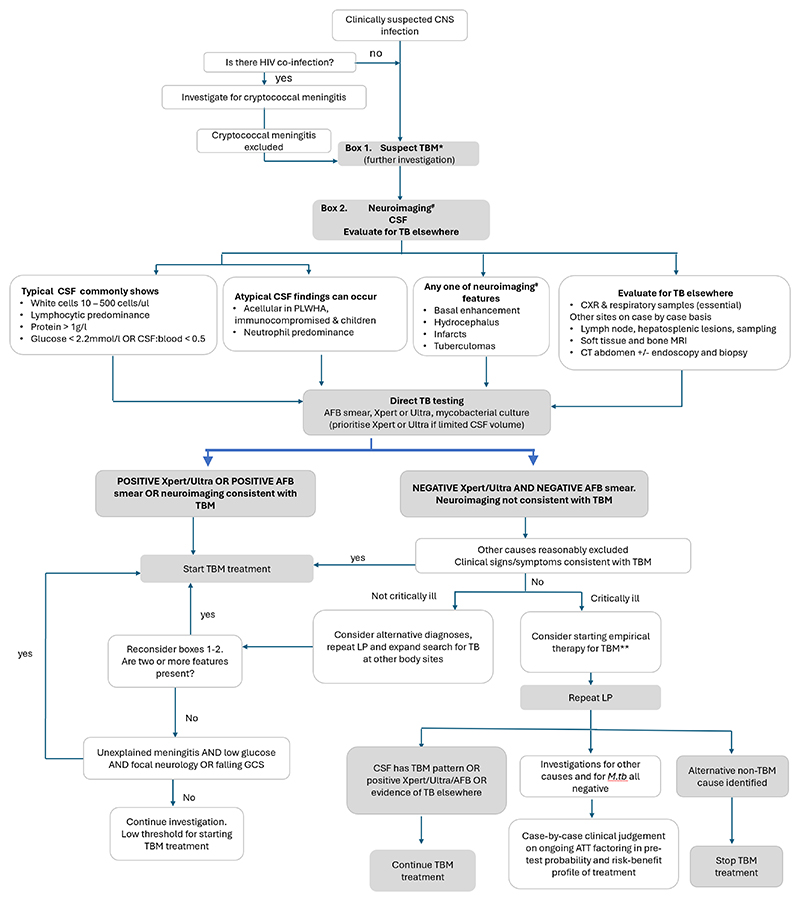
Boxes shaded in grey represent evidence-based recommendations. Boxes without shading represent consensus recommendations drawn from collective expert opinion and expertisen. In PLWHA, cryptococcal meningitis can present similarly to TBM and should be excluded in the first instance as CrAg testing is highly sensitive.(129) Large volumes of CSF are recommended. Diagnostic test(s) performed will depend on local availability, however multiple TB testing where available should be performed. Where rapid diagnostic testing or neuroimaging is consistent, ATT for TBM should be commenced. Whilst mycobacterial culture does not return rapid results, this remains an important diagnostic test to perform. Where rapid diagnostic testing is negative and neuroimaging is not suggestive of TBM, a decision to start treatment should be made on degree of clinical suspicion, repeated evaluations, neurological deterioration and active exclusion of other possible causes.
Top: Diagnosis. Box 1. Suspect TBM* where risk factors, symptoms, and signs, are suggestive. *Risk factors other than HIV include immunosuppression, malnutrition, travel or residence in TB endemic region, young age, contact with infectious TB in the last 1-2 years. Compatible symptoms and signs include >5 days of fever with any of: headache, vomiting, neck stiffness, poor appetite or poor weight gain (young children), cough, cranial nerve palsy. Box 2. Mass lesions and raised intracranial pressure may develop as part of CNS tuberculosis (tuberculoma or tuberculous abscess) or from an alternative diagnosis (e.g., brain tumour or bacterial abscess); as such in patients being evaluated for TBM there may be contraindications to lumbar puncture due to the risk of cerebral herniation. Neuroimaging# should be performed before lumbar puncture (to exclude the risk of herniation) if this is possible, and lumbar puncture only performed when it is safe to do so. Obtaining neuroimaging before lumbar puncture may delay treatment initiation,(130) therefore clinical discretion should be used on a case-by-case basis. Modality of neuroimaging# depends on availability. CT is often accessible and, using contrast, can detect hydrocephalus, basal exudates, large infarcts and tuberculomas. MRI is more sensitive at detecting small and evolving infarcts particularly in the brainstem. Bottom: Treatment initiation. **Differentiating TBM from other meningitides in high incidence TB settings can be challenging. Strongly consider starting empirical therapy in conjunction with treatment for alternative causes in the critically unwell. Repeating CSF analysis with TB testing may provide valuable guidance when deciding between TBM or other CNS infection. In the absence of a perfect test to diagnose TBM, clinical judgement on whether to initiate or continue anti-TB treatment should consider all aspects of the case including epidemiological, clinical, laboratory, and imaging features where this is available. Specialist input should be sought. AFB=acid-fast bacilli. ATT=anti-tuberculosis chemotherapy. CNS=central nervous system. CSF=cerebrospinal fluid, HIV=human immunodeficiency virus. LP=lumbar puncture. M.tb=Mycobacterium tuberculosis. OP=opening pressure. PLWHA=people living with HIV/AIDS. TBM=tuberculous meningitis.
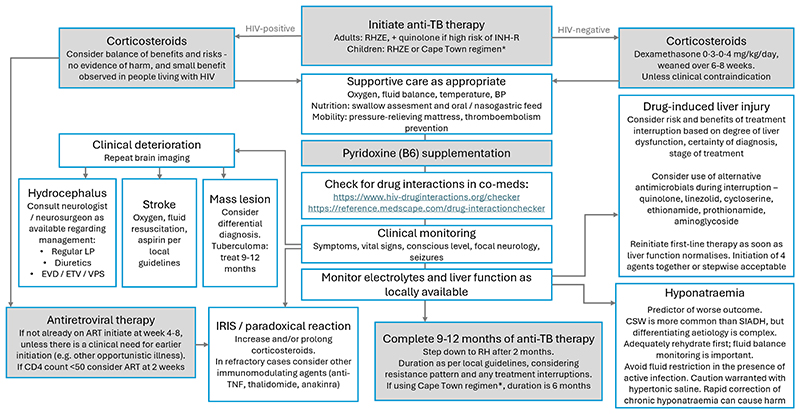
Boxes shaded in grey represent evidence-based recommendations. Boxes without shading represent consensus recommendations drawn from collective expert opinion and expertise. *The Cape Town regimen is also WHO-recommended for the treatment of drug-susceptible TBM in children and is a 6-month duration with elevated dosages of isoniazid 15-20mg/kg/day, rifampicin 22·5-30mg/kg/day and pyrazinamide 35-45mg/kg/day, and the substitution of ethambutol with ethionamide 17·5-22·5mg/kg/day. ART=antiretroviral therapy. BP=blood pressure. CSW=cerebral salt-wasting syndrome. EVD=external ventricular drain. ETV=endoscopic third ventriculostomy. INH-R=isoniazid resistance. IRIS=immune reconstitution inflammatory syndrome. LP=lumbar puncture. SIADH=syndrome of inappropriate antidiuretic hormone secretion. TNF=tumour necrosis factor. VPS=ventriculoperitoneal shunt.
Recommendations
Diagnosis of TBM
Recommendations are shown in box 1, with evidence synthesis in appendix pp3-13.
A uniform case definition was created in 2010 as a research tool for TBM classification, defining definite, probable, possible and not TBM.(23) Developed as a standardised approach to classifying TBM diagnosis in research, it is now used as a standard against which diagnostic tests are assessed.
Rationale and context for recommendations
1. How accurate are cerebrospinal fluid (CSF) microscopy and biochemistry to diagnose TBM?
We found no studies directly addressing this question. The TBM lumbar CSF profile typically includes a moderate lymphocytic pleocytosis, elevated protein, low glucose (<50% plasma concentration) and moderately elevated lactate (5-10mmol/l).(24) However, none of these parameters is specific enough individually, or in combination, for definitive diagnosis. However, CSF analysis is an essential part of the TBM diagnostic workup, providing supporting evidence for TBM diagnosis(28) and an opportunity to detect M. tuberculosis or identify other causes of meningoencephalitis.
2. How accurate are microbiological and molecular tests to diagnose TBM?
The challenge in detecting M. tuberculosis within CSF is the very low bacterial numbers, limiting the sensitivity of all currently available tests. Technician skill, large CSF volumes and optimal processing improve diagnostic yields.(25–27)
In most settings, CSF Ziehl-Neelsen (ZN) smear is insensitive (<30%), and provides little advantage over Xpert MTB/RIF (Xpert) or Xpert MTB/RIF Ultra (Ultra) (GeneXpert, Cepheid Sunnyvale, CA) (appendix pp3-4).(27) Xpert and Ultra are PCR-based tests that provide rapid results and detect mutations associated with rifampicin resistance. Ultra’s lower limit of detection enhances its sensitivity making it the test of choice, when available.(28) Both Xpert and Ultra demonstrated high specificity (appendix pp5-8), although neither test can rule out TBM. These tests should, when possible, be combined with mycobacterial culture, enabling subsequent extended drug susceptibility tests (appendix p9). The accuracy of Xpert and Ultra to detect rifampicin resistance reduces when bacterial numbers are very low.(29)
Alere-Lipoarabinomannan (LAM) (Abbott Determine TB-LAM antigen, Lake Bluff, USA) identifies M. tuberculosis cell wall components by lateral flow. There is insufficient evidence to recommend for or against using Alere-LAM on CSF (appendix pp10-11).
3. How accurate is adenosine deaminase (ADA) to diagnose TBM?
ADA accuracy assessment is limited by variable assays with uncertain positive test cut-offs, and lack of gold standard comparators (appendix pp12-13). Elevated CSF ADA concentrations are not specific for TBM. Whilst evidence certainty was very low, ADA measurement is relatively inexpensive, and elevated concentrations may prompt utilisation of better tests (e.g. Ultra). Measurement of CSF ADA should not replace Xpert, Ultra, or culture.
4. How accurate is neuroimaging to diagnose TBM?
We found no studies directly assessing this question. However, brain imaging, with CT or MRI, enables assessment of the incidence and evolution of the common TBM complications (hydrocephalus, tuberculomas, infarctions) before and after the start of TBM treatment.(30) For these purposes, baseline brain imaging is recommended.
Good practice points
CSF volume
We recommend sampling ≥6mLs CSF for dedicated M. tuberculosis testing.(25) Larger CSF volumes are a strong predictor of positive ZN stain, M. tuberculosis culture, and Xpert.(26,31) CSF should be centrifuged at 3000g for 20 minutes, with the cell pellet subject to mycobacterial tests.(25,31,32)
Children and PLWH
Our recommendations apply to all age groups and PLWH. Only one study evaluated Ultra in children, reporting 50% sensitivity,(33) lower than adult studies (~65%), probably reflecting lower CSF volumes from children. Sensitivities of ZN stain, mycobacterial culture, Xpert and Ultra are higher in PLWH, probably due to higher bacillary loads.(34–36)
Diagnostic approach and empirical therapy
No single negative test can rule out TBM. Combining CSF ZN smear, Xpert/Ultra, mycobacterial culture, can increase diagnostic yields.(34,36) Repeated testing of CSF may increase diagnostic yields. Consistent neuroimaging features, e.g. hydrocephalus, basal exudates, infarcts or tuberculomas, increases the probability of TBM,(30,37,38) as does M. tuberculosis identification outside the CNS. Testing of sputum for M. tuberculosis is recommended given pulmonary TB is present in ~50% of cases of TBM.(9,10) Nevertheless, given the limited sensitivity of available tests and the fatal consequences of delayed treatment, many patients (30-50%) must start treatment empirically,(6,9,10,39) based on clinical suspicion alone. A diagnostic approach to TBM, based on evidence and expert opinion, is presented in figure 1.
Anti-TB chemotherapy
Recommendations are shown in box 2, with evidence synthesis in appendix 14-18.
Anti-TB drug regimens for TBM treatment are based on those developed for pulmonary TB and do not account for the need to achieve therapeutic concentrations within the CNS.(40) TBM caused by bacteria resistant to critical first-line drugs (rifampicin and isoniazid) is an increasing therapeutic challenge, with few data describing the CNS activity and effectiveness of drugs recently approved and highly effective for multi-drug resistant pulmonary TB treatment.(41–44) Recent animal and clinical studies utilising PET imaging with radiolabelled antibiotics has provided insights on CSF and brain distribution, and activity of these drugs.(45–48)
Rationale and context for recommendations
1. Does increasing the rifampicin dosing reduce mortality in adults with TBM vs. standard 10mg/kg/day dosing?
Standard 10mg/kg/day rifampicin results in very low CSF concentrations/exposures.(9,49) Rifampicin was undetectable in CSF in two-thirds of patients with TBM in two studies using the standard dose.(7,50) Higher rifampicin doses/exposures increase bacterial killing in pulmonary TB,(51) and 35mg/kg/day has been safely used in adults and children with pulmonary TB and TBM.(52–55)
Four phase II and one phase III trial have investigated higher rifampicin doses for TBM (appendix pp14-15). Across these five studies, three studies did not have mortality as their primary outcomes or utilised high-dose rifampicin with other interventions (linezolid and aspirin).(42,50,56) The duration (2-8 weeks) and doses (15-35mg/kg/day) of rifampicin varied, but higher rifampicin doses were not associated with reduced TBM mortality (odds ratio 0·91, 95% confidence interval [CI] 0·56-1·46). However, these data are dominated by a large (817 adults) phase III trial investigating 15mg/kg/day rifampicin, which may not have resulted in sufficiently high CSF exposures.(9,49) We therefore examined the benefit of rifampicin >20mg/kg/day, including lower dose intravenous administration that achieved equivalent exposures. Data were limited and a mortality benefit was not observed, although >20mg/kg/day was safe.
Two active phase III trials are investigating 35mg/kg/day rifampicin in adults with TBM. Later in 2025, the HARVEST trial (ISRCTN15668391) will report results, and the INTENSE-TBM trial (NCT04145258) will report results in 2026. The results of these trials are likely to provide definitive data to address this PICO question.
2. Does an adjunctive fluoroquinolone or linezolid reduce mortality in adults from TBM?
Five RCTs have evaluated the addition of fluoroquinolones to standard rifampicin-based regimens for TBM (appendix p16). Three studied levofloxacin, one moxifloxacin, and one levofloxacin, ciprofloxacin and gatifloxacin. Taken together, the addition of a fluoroquinolone to the regimen was not associated with significantly reduced mortality (odds ratio 0·86 95% CI 0·51-1·45). However, post-hoc analysis of the 2016 Vietnam trial(9) found rifampicin 15mg/kg/day with levofloxacin (as the fifth drug) reduced mortality in adults with TBM caused by isoniazid resistant bacteria (hazard ratio 0·34, 95% CI 0·15-0·76, P=0·01).(57)
The WHO endorsed linezolid for multi-drug resistant (MDR) pulmonary TB treatment in 2019.(14) Data investigating its use in TBM treatment are limited to three small phase II trials (appendix p17),(42,58,59) which did not establish its benefit in presumed drug-sensitive TBM. Linezolid may, however, have a role in treating MDR-TBM, given its favourable CNS PK and bactericidal activity.(60)
3. Does higher dosing, or alternative administration routes, of other TB drugs reduce mortality in adults from TBM?
Only one study has addressed this question: a phase II trial of higher-dose intravenous isoniazid (500mg/day) and ethambutol (2g/day) with rifampicin and pyrazinamide in 54 adults (appendix p18).(61) Pharmacokinetic analysis of the 2016 Vietnam trial found a strong association between high CSF isoniazid concentrations, slow acetylator status, and reduced case-fatality.(49) A 6-month regimen with high doses of rifampicin, isoniazid, pyrazinamide (RHZ) and ethionamide has produced excellent outcomes in South African children (see PICO question 5), but has not been studied in adults.
Intrathecal administration, usually of aminoglycosides, were used in the early years of anti-TB chemotherapy,(62) but became uncommon once RHZ became available. It has some recent proponents,(63,64) although there are no comparative trials and data are insufficient to make a recommendation.
4. Is treatment duration less than 12 months effective in TBM in adults?
No trials comparing <12 months with ≥12 months anti-TB chemotherapy were identified. In 2016, a meta-analysis of 19 observational studies concluded that in all cohorts most deaths occurred in the first six months; and relapse was uncommon in all participants irrespective of the regimen. No inferences regarding optimal treatment duration could be made.(65) The WHO currently recommend treating adult TBM with 12-months of anti-TB drugs; there is no evidence supporting a different recommendation. Additionally, there is no substantive evidence to support longer durations of anti-TB chemotherapy for TBM (than for pulmonary TB) in terms of better outcomes.
5. What is the optimal treatment for childhood TBM?
Due to the non-linear effect of weight on clearance, young children (particularly <2 years) achieve lower drug exposures when dosed at the same mg/kg dosage as older children, adolescents and adults.(66) Rifampicin up to 35mg/kg/day is safe in children, and in one study, doses of up to 65-70mg/kg rifampicin were needed to reach the target exposure in children.(53) Additionally, a small phase II RCT of children with TBM reported better neurocognitive outcomes in those receiving regimens containing high-dose (30mg/kg/day) rifampicin.(67) For more than 30 years, children with TBM in South Africa have been treated with 6 months of higher doses of isoniazid, rifampicin, pyrazinamide and ethionamide, with excellent outcomes.(68) A recent systematic review informed the 2022 WHO child and adolescent TB guidelines;(18) no clinical trials were identified but 7 observational studies provided evidence, graded as low quality. In children and adolescents ≤19 years with drug-susceptible TBM, WHO recently recommended that a 6-month regimen (isoniazid 15-20mg/kg/day, rifampicin 22·5-30mg/kg/day and pyrazinamide 35-45mg/kg/day, and the substitution of ethambutol with ethionamide 17·5-22·5mg/kg/day) can be used instead of the 12-month standard regimen.(69)
Results of the SURE trial (ISRCTN40829906),(70) a RCT comparing a 6-month intensive regimen to the 12-month standard for childhood TBM, will be available by the end of 2025.
Good practice points
Drug-resistant TBM
Mortality from TBM caused by bacteria resistant to rifampicin and isoniazid (MDR TBM) exceeds 70%.(57,71) Poor outcomes are driven by delayed detection of resistance and initiation of second-line anti-TB treatment, compounded by the uncertain effectiveness of second-line drugs in TBM. There are no RCTs informing guidance.
Early rifampicin resistance detection is critical to outcomes. Therefore, Xpert or Ultra testing of CSF and other specimens, if extra-neural TB is suspected, are strongly encouraged in all patients with TBM. Clinical deterioration after the start of anti-TB treatment is an unreliable indicator of MDR TBM as it is more commonly caused by hydrocephalus, infarcts, or other inflammatory complications (e.g. tuberculomas).
Without trials, the selection of second-line drugs is based upon their predicted activity within the CNS (appendix p19). CSF pharmacokinetic data assist that selection, although CSF concentrations of some drugs do not correlate well with brain concentrations. For example, rifampicin, delamanid, pretomanid and bedaquiline achieve much higher concentrations in brain than CSF.(45–47,72) Employing therapeutic drug monitoring to address low exposure in plasma/serum may help to optimise CNS concentration.(73)
The BPaL regimen is highly effective for MDR pulmonary TB,(74) but it has not been evaluated in patients with MDR TBM. In animal models of TBM, the BPaL regimen is inferior to the standard TB regimen,(45) with no additive effective of bedaquiline.(48) Excellent activity was however noted in animal studies with PaZ-based regimens such as PaLZ.(48) Whether bedaquiline achieves sufficient CNS exposure to be effective is uncertain. However, ≥50% of patients with TBM have concurrent pulmonary TB,(9) for which bedaquiline will be highly effective.
Adverse drug effects
Pyrazinamide, isoniazid and rifampicin can all cause drug-induced liver injury (DILI), the commonest reason for treatment interruption and drug substitution. However, unlike in pulmonary TB, stopping anti-TB drugs is an independent risk factor for death from TBM.(75–77) Therefore, clinicians should weigh carefully the risks of discontinuation of anti-TB therapy with the severity of DILI.
Little evidence exists to guide clinicians, although the ACT HIV(10,77) and LAST ACT(76) (NCT03100786) TBM trials randomised participants who developed DILI to three strategies: replace RHZ with a fluoroquinolone and an aminoglycoside; withdraw pyrazinamide and monitor transaminases; or continue all drugs unless transaminases rise >10x normal. Results are anticipated by the end of 2025.
Reintroduction of first-line drugs can be considered once liver function normalises, either stepwise or all at once, at a full dose or an escalating dose. There is insufficient evidence to support one approach over another, or the order of the drugs to be reintroduced.(78)
Drug-drug interactions are an essential consideration in the treatment of TB. Rifampicin induces the hepatic metabolism of a wide variety of drugs, including ART. The most up-to-date information on drug interactions can be found at https://www.hiv-druginteractions.org/checker.
Adjunctive therapy
Recommendations are shown in box 3, with evidence synthesis in appendix pp21-24.
Outcomes from TBM are strongly associated with dysregulated inflammatory responses.(79) However, these responses vary substantially between individuals. For example, PLWH and TBM have higher concentrations of inflammatory markers but lower numbers of leucocytes, compared to TBM patients without HIV.(39,80)
Adjunctive corticosteroids have been given to control TBM-associated inflammation ever since anti-TB drugs became available to treat TBM.(81) The challenge, however, has been recognising the heterogeneity in inflammatory response and identifying those who benefit most from corticosteroids or, more recently, better targeted adjunctive therapies.
Rationale and context for recommendations
1. Should corticosteroids be used as an adjunctive therapy in patients with TBM?
Corticosteroids are recommended by WHO and ATS/CDC/IDSA for everyone with TBM, regardless of severity.(16,82) The results of two large (n=1065) and seven smaller (n=585) RCTs, support these and our recommendations (appendix pp21-22). Corticosteroids reduced case-fatality, especially in children and adults without HIV.(83) There is no signal for a change in disability amongst survivors in these groups.
In PLWH and TBM, the benefits of corticosteroids are uncertain. One large RCT, published 3 months after the updated literature search (23/7/2023), was included given its relevance.(10) 520 adults with HIV-associated TBM were enrolled; dexamethasone was associated with a non-significant survival benefit (hazard ratio 0·85; 95% CI 0·66-1·10). Disability and the incidence of immune reconstitution inflammatory syndrome (IRIS) were not reduced by dexamethasone. Despite most participants being profoundly immune-suppressed (52% CD4 <50 cells/mm3), dexamethasone did not increase adverse events.
In the absence of an effective alternative adjunctive therapy for HIV-associated TBM, and the safety and potential effectiveness of corticosteroids, we recommend their use on a case-by-case basis in PLWH.
2. What is the optimal timing of antiretroviral therapy in CNS TB?
Clinical trials in PLWH with pulmonary TB have demonstrated clear mortality benefit for patients with CD4 counts <50/mm3 who start ART within 2 weeks of starting anti-TB treatment, albeit with increased risk of IRIS.(84–86) One RCT has been conducted in PLWH with TBM (median CD4 count 41cells/mm3) comparing ART initiation within 7 days of anti-TB treatment or at 2 months. No difference in 9-month survival between the arms was found (appendix p23).(87) This finding was similar across all CD4 counts. More grade 4 laboratory events were observed in the immediate ART group, but no increase in neurological events.
These limited data inform our weak recommendation to defer ART for 4-8 weeks after starting TB treatment. This is in agreement with WHO and other guidelines.(88–91) A range has been given based on expert opinion and clinicians should decide to start ART based on individual patient factors, considering CD4 count (if available), other opportunistic infections, neuroimaging and TBM-IRIS risk factors (CSF ZN/culture positivity, CSF neutrophil pleocytosis).(92)
3. What other adjunctive therapies can be considered for the management of TBM?
Several small phase II studies in adults and children suggest aspirin, added to corticosteroids, may reduce the incidence of brain infarcts and death (appendix p24). However, the trials are too small and heterogenous to be definitive and a recommendation to use aspirin routinely cannot be given. The SURE (ISRCTN40829906) and INTENSE-TBM (NCT04145258) trials, investigating adjunctive aspirin in children and adults respectively, will provide high-quality data from the end of 2025.
Observational studies in South African children have suggested adjunctive thalidomide (2-5mg/kg/day) was safe and effective in treating TB mass lesions and optochiasmatic arachnoiditis.(93,94) A trial of higher dose thalidomide (24mg/kg/day) was terminated early due to adverse effects and mortality in the thalidomide arm.(95) No additional trials have been reported. Teratogenicity and other adverse events have limited thalidomide’s use as an adjunctive agent.
Case series have suggested biological agents targeting TNF-α (e.g. infliximab, adalimumab) can help treat tuberculomas and optochiasmatic arachnoiditis.(96,97) A retrospective cohort study in India reported adjunctive infliximab (10mg/kg 1-3 doses, 4 weeks apart) was safe and effective in treating severe inflammatory complications of TBM.(98) The active TIMPANI trial (NCT05590455) is investigating adjunctive adalimumab in adults with TBM and HIV.
Good practice points
Paradoxical reactions and IRIS
Adjunctive anti-inflammatory therapies (e.g. corticosteroids) are usually given with anti-TB drugs at the start of treatment. However, in ~20% of patients with TBM (>30% PLWH), inflammatory intracerebral complications occur. These typically arise after 20-60 days of treatment, but can occur many months later. Often called ‘paradoxical reactions’, they occur despite effective anti-TB treatment. In the context of PLWH starting ART, they can meet the criteria for IRIS,(99) although the clinical and imaging characteristic are similar, regardless of HIV status.
The management of these inflammatory complications has not been subject to trials. Expert opinion recommends using high-dose corticosteroids initially (e.g. dexamethasone 0·4mg/kg/day), tapering slowly according to symptom resolution. If corticosteroids do not control symptoms, then small case-series/case reports have described the use of anti-TNF biologics (e.g. infliximab),(98) thalidomide,(100) or anakinra.(101,102)
Adjuvant interferon-gamma treatment has been described in refractory CNS tuberculosis,(103) and cyclophosphamide treatment described in CNS vasculitis.(104,105) Data are too limited to make recommendations concerning their use (appendix p35).
Neurocritical and neurosurgical care
Recommendations are shown in box 4, with evidence synthesis in appendix p25.
TBM causes critical illness with unique neurocritical and neurosurgical considerations. Raised intracranial pressure (ICP) can fatally compress brain tissue and cause ischaemia. Cerebral infarction is common (>65%) and predictive of poor outcomes.(106) Key management concerns relate to controlling raised ICP, whether from oedema, hydrocephalus, or mass lesions (tuberculomas/TB abscess), and ameliorating cerebral ischaemia from raised ICP and vasculitis.(107)
Rationale and context for recommendations
1. Should active management (medical and/or surgical) or standard of care be used in individuals with TBM and hydrocephalus/raised ICP?
Hydrocephalus occurs in 50-90% of patients. Management varies from monitoring without intervention, to medical (regular lumbar punctures and/or diuretics) and neurosurgical (lumbar or external ventricular drains [EVD], endoscopic third ventriculostomy [ETV] or ventriculoperitoneal shunts [VPS]) intervention.(106,108–111) No studies have directly compared these approaches. Lack of standardised definitions and management approaches preclude evidence-based recommendations.
2. Should a VPS or ETV be used for the surgical management of hydrocephalus in patients with TBM?
Two single-centre RCTs have compared VPS with ETV.(112,113) Whilst both studies demonstrated the benefit of surgical intervention, mortality and success rates were similar between the interventions (appendix p25). These procedures should be considered on a case-by-case basis; recommending one procedure over the other cannot be made based on the available data.
3. Should surgical management of tuberculomas with or without TBM occur at time of diagnosis or after medical treatment failure? 4. Should surgical management of TB abscesses with or without TBM occur at time of diagnosis or after medical treatment failure?
No studies directly address these two PICO questions. Surgery can be necessary, but no studies have compared the timing of surgery for tuberculomas or TB abscesses. There was heterogeneity in diagnosis, surgical techniques (biopsy vs. debulking vs. full resection), lesion location, duration of follow-up, and assessment of resolution or treatment failure. Evidence-based recommendations cannot be made. Consortium members have reviewed the management of intracranial TB mass lesions elsewhere.(114)
5. Should the management of hyponatremia in patients with TBM be based on aetiology?
Hyponatremia can cause cerebral oedema, raised ICP and infarction.(107,115–117) Studies suggest it is more commonly caused by cerebral salt wasting (CSW) than syndrome of inappropriate antidiuretic hormone secretion (SIADH), although their discrimination is difficult and diagnostic criteria vary.(117,118) Whether outcomes are improved by management tailored to cause is uncertain. There are insufficient data to make recommendations concerning optimal management of TBM-associated hyponatraemia.
6. Should all patients with TBM be assessed for clinical and sub-clinical seizures?
Seizures can occur due to raised ICP, tuberculomas and ischaemia, and can increase cerebral oxygen consumption increasing the risk of a metabolic crisis and infarction.(119,120) The pooled incidence of EEG-confirmed seizures was 25% from five descriptive studies; they are more common in children than adults.(121–125) Seizures are associated with increased mortality and morbidity.(122,126) We found no studies directly addressing the PICO question. Therefore, we were unable to provide recommendations.
Good practice points
Supportive care and checklists
A comprehensive assessment proforma and an accompanying ‘priorities’ checklist for patients with TBM were proposed in 2019 by Consortium members.(127) The proforma outlines what should be asked, checked, or tested at initial evaluation and daily inpatient review to assist supportive clinical care for patients. The checklist offers a useful and easy reminder of important issues to review during a time-critical period of acute patient deterioration. A global survey demonstrated many centres (>90%) have the resources to apply these approaches.(127,128)
Figure 2. provides an evidence-based and expert opinion overview of TBM treatment.
Supplementary Material
Acknowledgements
Hung Tran Thai (biostatistics, Oxford University Clinical Research Unit, Ho Chi Minh City) provided statistical support for PICO 2 of the diagnostics section.
Footnotes
Conflicts of interest statement
AGD was supported by a Wellcome Clinical PhD Fellowship (award number 175479) and Crick Clinical Post Doctoral Fellowship (via Meningitis Now) during the duration of this project. The funders had no influence on the content of the work. AF declares a Wellcome Trust Discovery Grant and South African NRF SARChI Chair Neurosciences, unrelated to this publication, and roles as President-elect, International Society for Pediatric Neurosurgery, and President, Society of Neurosurgeons of South Africa. AvL declares funding from NIH NIAID (R01AI145781 and R01AI165721). DM declares funding from the UK MRC, and US NIH. FCC received funding from the NIH (R21TW011035). FVC declares institutional grants from Wellcome, Janssen and Viiv, and membership of the DSMB for the SaDAPT trial and DOLPHIN3, and TSC membership for ILANA. JES declares a NIH R21 grant (1R21NS134516-01) for investigating cerebrovascular flow in TBM. NCB declares funding from NIH (NINDS K23 NS110470 and NIAID R01 AI170158). RBR declares funding from NIHR (NIHR Academic Clinical Lectureship (CL-2018-20-001), and being a named inventor for Prostanoid receptor modulators to treat Non-Tuberculous Mycobacterial Infections (WO2024/069179A1). RJW declares institutional grants from Wellcome, Cancer Research UK, Medical Research Council, National Institutes of Health, and NIHR, and support for attending meetings and/or travel from Wellcome (refund of institution) and the Bill and Melinda Gates Foundation (refund of personal costs). RvC declares DSMB membership for two RCTs focused on TB meningitis (no payments received). SKJ declares an institutional grant from U.S. National Institutes of Health. The other authors declared no conflicts of interest.
Author contributions
All authors approved the final manuscript. Working group membership signifies a role in article review, data extraction, and sub-group recommendation formulation. In addition to group membership, Contributor Role Taxonomy (CRediT) roles are provided in brackets. AGD: co-led adjunctive therapy group (data curation, formal analysis, investigation, writing – original draft, writing – review & editing). AF: neurocritical and neurosurgical care group, steering group (supervision, writing – review & editing). AvL: adjunctive therapy group (data curation, formal analysis, investigation, writing – review & editing). AM: adjunctive therapy group (data curation, formal analysis, investigation). CMU: anti-TB chemotherapy group (data curation, formal analysis, investigation, writing – review & editing). DG: steering group (supervision). DM: steering group (supervision). ER: methodology support (methodology, resources, writing – review & editing). EWT: co-led neurocritical and neurosurgical care group (data curation, formal analysis, investigation, writing – original draft, writing – review & editing). FCC: anti-TB chemotherapy group (data curation, formal analysis, investigation, writing – original draft, writing – review & editing). FVC: co-led anti-TB chemotherapy group (data curation, formal analysis, investigation, visualization, writing – original draft, writing – review & editing). GS: neurocritical and neurosurgical care group (data curation, formal analysis, investigation). GET: steering group (conceptualization, methodology, supervision, writing – original draft, writing – review & editing). JCA: anti-TB chemotherapy group (data curation, formal analysis, investigation, writing – review & editing). JD: led project, co-led diagnosis group (conceptualization, data curation, formal analysis, investigation, methodology, project administration, visualization, writing – original draft, writing – review & editing). JH: co-led diagnosis group (data curation, formal analysis, investigation, visualization,, writing – original draft, writing – review & editing). JES: adjunctive therapy group (data curation, formal analysis, investigation,, writing – original draft, writing – review & editing). JAS: co-led anti-TB chemotherapy group (data curation, formal analysis, investigation, writing – review & editing). KED: anti-TB chemotherapy group, steering group (data curation, formal analysis, investigation, supervision). NCB: diagnosis group (data curation, formal analysis, investigation, visualization, writing – original draft, writing – review & editing). REA: anti-TB chemotherapy group (data curation, formal analysis, investigation, writing – review & editing). RBR: diagnosis group (data curation, formal analysis, investigation, writing – review & editing). RS: co-led adjunctive therapy group (data curation, formal analysis, investigation, writing – original draft, writing – review & editing). RvC: steering group (supervision, writing – review & editing). RvT: adjunctive therapy group (data curation, formal analysis, investigation). RJW: steering group (conceptualization, supervision, writing – review & editing). STA: adjunctive therapy group (data curation, formal analysis, investigation, writing – review & editing). SD: diagnosis group (data curation, formal analysis, investigation, writing – review & editing). SKJ: anti-TB chemotherapy group (data curation, formal analysis, investigation, writing – original draft, writing – review & editing). SP: library support, design of searches (data curation, resources). UKM: steering group (supervision, writing – review & editing). UKR: co-led neurocritical and neurosurgical care group (data curation, formal analysis, investigation, writing – original draft, writing – review & editing). VS: diagnosis group (data curation, formal analysis, investigation).
References
Associated Data
Supplementary Materials
References
- Geneva: World Health Organization. Global tuberculosis report 2024. 2024. [accessed Nov 13, 2024]. https://www.who.int/publications/i/item/9789240101531 .
- Huynh J, Donovan J, Phu NH, Nghia HDT, Thuong NTT, Thwaites GE. Tuberculous meningitis: progress and remaining questions. Lancet Neurol. 2022;21:450–64. doi: 10.1016/S1474-4422(21)00435-X.
- Seddon JA, Tugume L, Solomons R, et al. The current global situation for tuberculous meningitis: epidemiology, diagnostics, treatment and outcomes. Wellcome Open Res. 2019;4 doi: 10.12688/wellcomeopenres.15535.1.
- Dodd PJ, Osman M, Cresswell FV, et al. The global burden of tuberculous meningitis in adults: A modelling study. PLOS Global Public Health. 2021;1:e0000069. doi: 10.1371/journal.pgph.0000069.
- Wilkinson RJ, Rohlwink U, Misra UK, et al. Tuberculous meningitis. Nat Rev Neurol. 2017;13:581–98. doi: 10.1038/nrneurol.2017.120.
- Marais S, Pepper DJ, Schutz C, Wilkinson RJ, Meintjes G. Presentation and Outcome of Tuberculous Meningitis in a High HIV Prevalence Setting. PLoS One. 2011;6:e20077. doi: 10.1371/journal.pone.0020077.
- Ruslami R, Ganiem AR, Dian S, et al. Intensified regimen containing rifampicin and moxifloxacin for tuberculous meningitis: an open-label, randomised controlled phase 2 trial. Lancet Infect Dis. 2013;13:27–35. doi: 10.1016/S1473-3099(12)70264-5.
- Chiang SS, Khan FA, Milstein MB, et al. Treatment outcomes of childhood tuberculous meningitis: a systematic review and meta-analysis. Lancet Infect Dis. 2014;14:947–57. doi: 10.1016/S1473-3099(14)70852-7.
- Heemskerk AD, Bang ND, Mai NTH, et al. Intensified Antituberculosis Therapy in Adults with Tuberculous Meningitis. N Engl J Med. 2016;374:124–34. doi: 10.1056/NEJMoa1507062.
- Donovan J, Bang ND, Imran D, et al. Adjunctive Dexamethasone for Tuberculous Meningitis in HIV-Positive Adults. N Engl J Med. 2023;389:1357–67. doi: 10.1056/NEJMoa2216218.
- Thao LTP, Heemskerk AD, Geskus RB, et al. Prognostic Models for 9-Month Mortality in Tuberculous Meningitis. Clin Infect Dis. 2018;66:523–32. doi: 10.1093/cid/cix849.
- Thwaites G, Fisher M, Hemingway C, et al. British Infection Society guidelines for the diagnosis and treatment of tuberculosis of the central nervous system in adults and children. J Infect. 2009;59:167–87. doi: 10.1016/j.jinf.2009.06.011.
- World Health Organization. Module 3, Diagnosis: rapid diagnostics for tuberculosis detection. 3rd ed. 2024. WHO consolidated guidelines on tuberculosis.
- World Health Organization. Module 4, Treatment: drug-resistant tuberculosis treatment. 2020. WHO consolidated guidelines on tuberculosis.
- World Health Organization. Module 5, Management of tuberculosis in children and adolescents. 2022. WHO consolidated guidelines on tuberculosis.
- Nahid P, Dorman SE, Alipanah N, et al. Official American Thoracic Society/Centers for Disease Control and Prevention/Infectious Diseases Society of America Clinical Practice Guidelines: Treatment of Drug-Susceptible Tuberculosis. Clin Infect Dis. 2016;63:e147–95. doi: 10.1093/cid/ciw376.
- Nahid P, Mase SR, Migliori GB, et al. Treatment of drug-resistant tuberculosis an official ATS/CDC/ERS/IDSA clinical practice guideline. Am J Respir Crit Care Med. 2019;200:E93–142. doi: 10.1164/rccm.201909-1874ST.
- Sulis G, Tavaziva G, Gore G, et al. Comparative Effectiveness of Regimens for Drug-Susceptible Tuberculous Meningitis in Children and Adolescents: A Systematic Review and Aggregate-Level Data Meta-Analysis. Open Forum Infect Dis. 2022;9 doi: 10.1093/ofid/ofac108.
- Schünemann H, Brożek J, Guyatt G, Oxman A, editors. GRADE handbook for grading quality of evidence and strength of recommendations. The GRADE Working Group; 2013. Updated October 2013.
- Whiting PF, Rutjes AWS, Westwood ME, et al. QUADAS-2: a revised tool for the quality assessment of diagnostic accuracy studies. Ann Intern Med. 2011;155:529–36. doi: 10.7326/0003-4819-155-8-201110180-00009.
- Sterne JAC, Savović J, Page MJ, et al. RoB 2: a revised tool for assessing risk of bias in randomised trials. BMJ. 2019;366 doi: 10.1136/bmj.l4898.
- Balshem H, Helfand M, Schünemann HJ, et al. GRADE guidelines: 3. Rating the quality of evidence. J Clin Epidemiol. 2011;64:401–6. doi: 10.1016/j.jclinepi.2010.07.015.
- Marais S, Thwaites G, Schoeman JF, et al. Tuberculous meningitis: a uniform case definition for use in clinical research. Lancet Infect Dis. 2010;10:803–12. doi: 10.1016/S1473-3099(10)70138-9.
- Poplin V, Boulware DR, Bahr NC. Methods for rapid diagnosis of meningitis etiology in adults. Biomark Med. 2020;14:459–79. doi: 10.2217/bmm-2019-0333.
- Bahr NC, Tugume L, Rajasingham R, et al. Improved diagnostic sensitivity for tuberculous meningitis with Xpert® MTB/RIF of centrifuged CSF. Int J Tuberc Lung Dis. 2015;19:1209–15. doi: 10.5588/ijtld.15.0253.
- Heemskerk AD, Donovan J, Thu DDA, et al. Improving the microbiological diagnosis of tuberculous meningitis: A prospective, international, multicentre comparison of conventional and modified Ziehl–Neelsen stain, GeneXpert, and culture of cerebrospinal fluid. J Infect. 2018;77:509–515. doi: 10.1016/j.jinf.2018.09.003.
- Stadelman AM, Ssebambulidde K, Buller A, et al. Cerebrospinal fluid AFB smear in adults with tuberculous meningitis: A systematic review and diagnostic test accuracy meta-analysis. Tuberculosis (Edinb) 2022;135:102230. doi: 10.1016/j.tube.2022.102230.
- Donovan J, Cresswell FV, Thuong NTT, et al. Xpert MTB/RIF Ultra for the Diagnosis of Tuberculous Meningitis: A Small Step Forward. Clin Infect Dis. 2020;71:2002–5. doi: 10.1093/cid/ciaa473.
- Wang J, Zhang X, Huo F, et al. Analysis of Xpert MTB/RIF results in retested patients with very low initial bacterial loads: A retrospective study in China. J Infect Public Health. 2023;16:911–6. doi: 10.1016/j.jiph.2023.04.004.
- Dian S, Hermawan R, van Laarhoven A, et al. Brain MRI findings in relation to clinical characteristics and outcome of tuberculous meningitis. PLoS One. 2020;15 doi: 10.1371/journal.pone.0241974.
- Thwaites GE, Chau T, Farrar JJ. Improving the Bacteriological Diagnosis of Tuberculous Meningitis. J Clin Microbiol. 2004;42:378–9. doi: 10.1128/JCM.42.1.378-379.2004.
- Stewart SM. The bacteriological diagnosis of tuberculous meningitis. J Clin Pathol. 1953;6:241–2. doi: 10.1136/jcp.6.3.241.
- Pradhan NN, Paradkar MS, Kagal A, et al. Performance of Xpert® MTB/RIF and Xpert® Ultra for the diagnosis of tuberculous meningitis in children. Int J Tuberc Lung Dis. 2022;26:317–25. doi: 10.5588/ijtld.21.0388.
- Bahr NC, Nuwagira E, Evans EE, et al. Diagnostic accuracy of Xpert MTB/RIF Ultra for tuberculous meningitis in HIV-infected adults: a prospective cohort study. Lancet Infect Dis. 2018;18:68–75. doi: 10.1016/S1473-3099(17)30474-7.
- Cresswell FV, Tugume L, Bahr NC, et al. Xpert MTB/RIF Ultra for the diagnosis of HIV-associated tuberculous meningitis: a prospective validation study. Lancet Infect Dis. 2020;20:308–317. doi: 10.1016/S1473-3099(19)30550-X.
- Donovan J, Thu DDA, Phu NH, et al. Xpert MTB/RIF Ultra versus Xpert MTB/RIF for the diagnosis of tuberculous meningitis: a prospective, randomised, diagnostic accuracy study. Lancet Infect Dis. 2020;20:299–307. doi: 10.1016/S1473-3099(19)30649-8.
- Soni N, Kumar S, Shimle A, Ora M, Bathla G, Mishra P. Cerebrovascular complications in tuberculous meningitis-A magnetic resonance imaging study in 90 patients from a tertiary care hospital. Neuroradiol J. 2020;33:3–16. doi: 10.1177/1971400919881188.
- Theron S, Andronikou S, Grobbelaar M, Steyn F, Mapukata A, du Plessis J. Localized basal meningeal enhancement in tuberculous meningitis. Pediatr Radiol. 2006;36:1182–5. doi: 10.1007/s00247-006-0312-1.
- van Laarhoven A, Dian S, Ruesen C, et al. Clinical Parameters, Routine Inflammatory Markers, and LTA4H Genotype as Predictors of Mortality Among 608 Patients With Tuberculous Meningitis in Indonesia. J Infect Dis. 2017;215:1029–39. doi: 10.1093/infdis/jix051.
- Jain SK, Tobin DM, Tucker EW, et al. Tuberculous meningitis: a roadmap for advancing basic and translational research. Nat Immunol. 2018;19:521–5. doi: 10.1038/s41590-018-0119-x.
- Upton CM, Steele CI, Maartens G, Diacon AH, Wiesner L, Dooley KE. Pharmacokinetics of bedaquiline in cerebrospinal fluid (CSF) in patients with pulmonary tuberculosis (TB) J Antimicrob Chemother. 2022;77:1720–4. doi: 10.1093/jac/dkac067.
- Davis AG, Wasserman S, Stek C, et al. A Phase 2A Trial of the Safety and Tolerability of Increased Dose Rifampicin and Adjunctive Linezolid, With or Without Aspirin, for Human Immunodeficiency Virus-Associated Tuberculous Meningitis: The LASER-TBM Trial. Clin Infect Dis. 2023;76:1412–22. doi: 10.1093/cid/ciac932.
- Sahib A, Bhatia R, Srivastava MVP, et al. Escalate: Linezolid as an add on treatment in the intensive phase of tubercular meningitis. A randomized controlled pilot trial. Tuberculosis (Edinb) 2023;142 doi: 10.1016/j.tube.2023.102351.
- Wasserman S, Donovan J, Kestelyn E, et al. Advancing the chemotherapy of tuberculous meningitis: a consensus view. Lancet Infect Dis. 2025;25 doi: 10.1016/S1473-3099(24)00512-7.
- Mota F, Ruiz-Bedoya CA, Tucker EW, et al. Dynamic 18F-Pretomanid PET imaging in animal models of TB meningitis and human studies. Nat Commun. 2022;13 doi: 10.1038/s41467-022-35730-3.
- Ruiz-Bedoya CA, Mota F, Tucker EW, et al. High-dose rifampin improves bactericidal activity without increased intracerebral inflammation in animal models of tuberculous meningitis. J Clin Invest. 2022;132 doi: 10.1172/JCI155851.
- Tucker EW, Guglieri-Lopez B, Ordonez AA, et al. Noninvasive 11C-rifampin positron emission tomography reveals drug biodistribution in tuberculous meningitis. Sci Transl Med. 2018;10 doi: 10.1126/scitranslmed.aau0965.
- Chen X, Arun B, Nino-Meza OJ, et al. Dynamic PET reveals compartmentalized brain and lung tissue antibiotic exposures of tuberculosis drugs. Nat Commun. 2024;15 doi: 10.1038/s41467-024-50989-4.
- Ding J, Thuy Thuong Thuong N, Van Pham T, et al. Pharmacokinetics and Pharmacodynamics of Intensive Antituberculosis Treatment of Tuberculous Meningitis. Clin Pharmacol Ther. 2020;107:1023–33. doi: 10.1002/cpt.1783.
- Cresswell FV, Meya DB, Kagimu E, et al. High-Dose Oral and Intravenous Rifampicin for the Treatment of Tuberculous Meningitis in Predominantly Human Immunodeficiency Virus (HIV)-Positive Ugandan Adults: A Phase II Open-Label Randomized Controlled Trial. Clin Infect Dis. 2021;73:876–84. doi: 10.1093/cid/ciab162.
- Te Brake LHM, de Jager V, Narunsky K, et al. Increased bactericidal activity but dose-limiting intolerability at 50 mg·kg-1 rifampicin. Eur Respir J. 2021;58 doi: 10.1183/13993003.00955-2020.
- Boeree MJ, Heinrich N, Aarnoutse R, et al. High-dose rifampicin, moxifloxacin, and SQ109 for treating tuberculosis: a multi-arm, multi-stage randomised controlled trial. Lancet Infect Dis. 2017;17:39–49. doi: 10.1016/S1473-3099(16)30274-2.
- Garcia-Prats AJ, Svensson EM, Winckler J, et al. Pharmacokinetics and safety of high-dose rifampicin in children with TB: the Opti-Rif trial. J Antimicrob Chemother. 2021;76:3237–46. doi: 10.1093/jac/dkab336.
- Ordonez AA, Wang H, Magombedze G, et al. Dynamic imaging in patients with tuberculosis reveals heterogeneous drug exposures in pulmonary lesions. Nat Med. 2020;26:529–34. doi: 10.1038/s41591-020-0770-2.
- Svensson EM, DIan S, Brake Te, et al. Model-Based Meta-analysis of Rifampicin Exposure and Mortality in Indonesian Tuberculous Meningitis Trials. Clin Infect Dis. 2020;71:1817–23. doi: 10.1093/cid/ciz1071.
- Dian S, Yunivita V, Ganiem AR, et al. Double-Blind, Randomized, Placebo-Controlled Phase II Dose-Finding Study To Evaluate High-Dose Rifampin for Tuberculous Meningitis. Antimicrob Agents Chemother. 2018;62 doi: 10.1128/AAC.01014-18.
- Heemskerk AD, Nguyen MTH, Dang HTM, et al. Clinical Outcomes of Patients With Drug-Resistant Tuberculous Meningitis Treated With an Intensified Antituberculosis Regimen. Clin Infect Dis. 2017;65:20–8. doi: 10.1093/cid/cix230.
- Sahib A, Bhatia R, Srivastava MVP, et al. Escalate: Linezolid as an add on treatment in the intensive phase of tubercular meningitis. A randomized controlled pilot trial. Tuberculosis (Edinb) 2023;142 doi: 10.1016/j.tube.2023.102351.
- Chow FC, Kafeero P, Nakimbugwe M, et al. Safety and Tolerability of a Short Course of Linezolid for the Treatment of Predominantly Moderate to Severe Tuberculous Meningitis in Adults with HIV. J Infect Dis. 2025 doi: 10.1093/infdis/jiaf089. published online Feb 17.
- Abdelgawad N, Wasserman S, Abdelwahab MT, et al. Linezolid Population Pharmacokinetic Model in Plasma and Cerebrospinal Fluid Among Patients With Tuberculosis Meningitis. J Infect Dis. 2024;229:1200–8. doi: 10.1093/infdis/jiad413.
- Butov D, Feshchenko Y, Kuzhko M, et al. Effectiveness of Intravenous Isoniazid and Ethambutol Administration in Patients with Tuberculosis Meningoencephalitis and HIV Infection. Tuberc Respir Dis (Seoul) 2020;83:1–8. doi: 10.4046/trd.2019.0021.
- Freiman I, Geefhuysen J. Evaluation of intrathecal therapy with streptomycin and hydrocortisone in tuberculous meningitis. J Pediatr. 1970;76:895–901. doi: 10.1016/s0022-3476(70)80372-9.
- Li K, Wang L, Wen L, Wang J, Li M. Intrathecal therapy for tuberculous meningitis: propensity-matched cohort study. Neurol Sci. 2022;43:2693–8. doi: 10.1007/s10072-021-05690-5.
- Gao Y, Su J, Ma Y, et al. Efficacy and safety of intrathecal dexamethasone combined with isoniazid in the treatment of tuberculous meningitis: a meta-analysis. BMC Neurol. 2024;24 doi: 10.1186/s12883-024-03701-4.
- Jullien S, Ryan H, Modi M, Bhatia R. Six months therapy for tuberculous meningitis. Cochrane Database Syst Rev. 2016;9 doi: 10.1002/14651858.CD012091.pub2.
- Chabala C, Turkova A, Hesseling AC, et al. Pharmacokinetics of First-Line Drugs in Children With Tuberculosis, Using World Health Organization-Recommended Weight Band Doses and Formulations. Clin Infect Dis. 2022;74:1767–75. doi: 10.1093/cid/ciab725.
- Paradkar MS, Devaleenal DB, Mvalo T, et al. Randomized Clinical Trial of High-Dose Rifampicin With or Without Levofloxacin Versus Standard of Care for Pediatric Tuberculous Meningitis: The TBM-KIDS Trial. Clin Infect Dis. 2022;75:1594–601. doi: 10.1093/cid/ciac208.
- van Toorn R, Schaaf HS, Laubscher JA, van Elsland SL, Donald PR, Schoeman JF. Short intensified treatment in children with drug-susceptible tuberculous meningitis. Pediatr Infect Dis J. 2014;33:248–52. doi: 10.1097/INF.0000000000000065.
- World Health Organization. Module 5, Management of tuberculosis in children and adolescents. 2022. WHO operational handbook on tuberculosis.
- Huynh J, Chabala C, Sharma S, et al. Effectiveness and safety of shortened intensive treatment for children with tuberculous meningitis (SURE): a protocol for a phase 3 randomised controlled trial evaluating 6 months of antituberculosis therapy and 8 weeks of aspirin in Asian and African children with tuberculous meningitis. BMJ Open. 2025;15:e088543. doi: 10.1136/bmjopen-2024-088543.
- Evans EE, Avaliani T, Gujabidze M, et al. Long term outcomes of patients with tuberculous meningitis: The impact of drug resistance. PLoS One. 2022;17 doi: 10.1371/journal.pone.0270201.
- Tucker EW, Pieterse L, Zimmerman MD, et al. Delamanid Central Nervous System Pharmacokinetics in Tuberculous Meningitis in Rabbits and Humans. Antimicrob Agents Chemother. 2019;63 doi: 10.1128/AAC.00913-19.
- Alffenaar JWC, Stocker SL, Forsman LD, et al. Clinical standards for the dosing and management of TB drugs. Int J Tuberc Lung Dis. 2022;26:483–99. doi: 10.5588/ijtld.22.0188.
- Conradie F, Diacon AH, Ngubane N, et al. Treatment of Highly Drug-Resistant Pulmonary Tuberculosis. N Engl J Med. 2020;382:893–902. doi: 10.1056/NEJMoa1901814.
- Thwaites GE, Bang ND, Dung NH, et al. Dexamethasone for the Treatment of Tuberculous Meningitis in Adolescents and Adults. N Engl J Med. 2004;351:1741–51. doi: 10.1056/NEJMoa040573.
- Donovan J, Phu NH, Thao LTP, et al. Adjunctive dexamethasone for the treatment of HIV-uninfected adults with tuberculous meningitis stratified by Leukotriene A4 hydrolase genotype (LAST ACT): Study protocol for a randomised double blind placebo controlled non-inferiority trial. Wellcome Open Res. 2018;3:32. doi: 10.12688/wellcomeopenres.14007.1.
- Donovan J, Phu NH, Mai NTH, et al. Adjunctive dexamethasone for the treatment of HIV-infected adults with tuberculous meningitis (ACT HIV): Study protocol for a randomised controlled trial. Wellcome Open Res. 2018;3:31. doi: 10.12688/wellcomeopenres.14006.2.
- Sharma SK, Singla R, Sarda P, et al. Safety of 3 different reintroduction regimens of antituberculosis drugs after development of antituberculosis treatment-induced hepatotoxicity. Clin Infect Dis. 2010;50:833–9. doi: 10.1086/650576.
- Hai HT, Thanh Hoang Nhat L, Tram TTB, et al. Whole blood transcriptional profiles and the pathogenesis of tuberculous meningitis. Elife. 2024;13 doi: 10.7554/eLife.92344.
- Thuong NTT, Heemskerk D, Tram TTB, et al. Leukotriene A4 Hydrolase Genotype and HIV Infection Influence Intracerebral Inflammation and Survival From Tuberculous Meningitis. J Infect Dis. 2017;215:1020–8. doi: 10.1093/infdis/jix050.
- Shane SJ, Clowater RA, Riley C. The treatment of tuberculous meningitis with cortisone and streptomycin. Can Med Assoc J. 1952;67:13–5.
- World Health Organization. Module 4, Treatment - Drug-susceptible tuberculosis treatment. 2022. [accessed Nov 21, 2024]. WHO consolidated guidelines on tuberculosis. https://www.ncbi.nlm.nih.gov/books/NBK581329/
- Prasad K, Singh MB, Ryan H. Corticosteroids for managing tuberculous meningitis. Cochrane Database Syst Rev. 2016 doi: 10.1002/14651858.CD002244.pub4. published online April 28.
- Abdool Karim SS, Naidoo K, Grobler A, et al. Integration of antiretroviral therapy with tuberculosis treatment. N Engl J Med. 2011;365:1492–501. doi: 10.1056/NEJMoa1014181.
- Blanc F-X, Sok T, Laureillard D, et al. Earlier versus later start of antiretroviral therapy in HIV-infected adults with tuberculosis. N Engl J Med. 2011;365:1471–81. doi: 10.1056/NEJMoa1013911.
- Havlir DV, Kendall MA, Ive P, et al. Timing of antiretroviral therapy for HIV-1 infection and tuberculosis. N Engl J Med. 2011;365:1482–91. doi: 10.1056/NEJMoa1013607.
- Torok ME, Yen NTB, Chau TTH, et al. Timing of Initiation of Antiretroviral Therapy in Human Immunodeficiency Virus (HIV)-Associated Tuberculous Meningitis. Clin Infect Dis. 2011;52:1374–83. doi: 10.1093/cid/cir230.
- European AIDS Clinical Society. When to start ART in Persons with Opportunistic Infections — EACS Guidelines. 2023. [accessed Jan 20, 2025]. https://eacs.sanfordguide.com/eacs-part1/eacs-section4/ois/opportunistic-infections .
- U.S. Centers for Disease Control and Prevention. TB Treatment for Persons with HIV | TB | CDC. 2023. [accessed Jan 20, 2025]. https://www.cdc.gov/tb/topic/treatment/tbhiv.htm .
- World Health Organization. Module 6, Tuberculosis and comorbidities. 2024. [accessed Jan 20, 2025]. WHO consolidated guidelines on tuberculosis. https://www.who.int/publications/i/item/9789240087002 .
- Bracchi M, van Halsema C, Post F, et al. British HIV Association guidelines for the management of tuberculosis in adults living with HIV 2019. HIV Med. 2019:s2–83. doi: 10.1111/hiv.12748.
- Marais S, Meintjes G, Pepper DJ, et al. Frequency, Severity, and Prediction of Tuberculous Meningitis Immune Reconstitution Inflammatory Syndrome. Clin Infect Dis. 2013;56:450–60. doi: 10.1093/cid/cis899.
- Schoeman JF, Fieggen G, Seller N, Mendelson M, Hartzenberg B. Intractable Intracranial Tuberculous Infection Responsive to Thalidomide: Report of Four Cases. J Child Neurol. 2006;21:301–8. doi: 10.1177/08830738060210040801.
- Van Toorn R, Solomons RS, Seddon JA, Schoeman JF. Thalidomide Use for Complicated Central Nervous System Tuberculosis in Children: Insights From an Observational Cohort. Clin Infect Dis. 2021;72:e136–45. doi: 10.1093/cid/ciaa1826.
- Schoeman JF, Springer P, van Rensburg AJ, et al. Adjunctive thalidomide therapy for childhood tuberculous meningitis: results of a randomized study. J Child Neurol. 2004;19:250–7. doi: 10.1177/088307380401900402.
- Abo YN, Curtis N, Osowicki J, et al. Infliximab for Paradoxical Reactions in Pediatric Central Nervous System Tuberculosis. J Pediatric Infect Dis Soc. 2021;10:1087–91. doi: 10.1093/jpids/piab094.
- Marais BJ, Cheong E, Fernando S, et al. Use of Infliximab to Treat Paradoxical Tuberculous Meningitis Reactions. Open Forum Infect Dis. 2021;8 doi: 10.1093/ofid/ofaa604.
- Manesh A, Gautam P, Kumar SSD, et al. Effectiveness of Adjunctive High-Dose Infliximab Therapy to Improve Disability-Free Survival Among Patients With Severe Central Nervous System Tuberculosis: A Matched Retrospective Cohort Study. Clin Infect Dis. 2023;77:1460–7. doi: 10.1093/cid/ciad401.
- Meintjes G, Lawn SD, Scano F, et al. Tuberculosis-associated immune reconstitution inflammatory syndrome: case definitions for use in resource-limited settings. Lancet Infect Dis. 2008;8:516–23. doi: 10.1016/S1473-3099(08)70184-1.
- van Toorn R, Zaharie SD, Seddon JA, et al. The use of thalidomide to treat children with tuberculosis meningitis: A review. Tuberculosis (Edinb) 2021;130 doi: 10.1016/j.tube.2021.102125.
- Keeley AJ, Parkash V, Tunbridge A, et al. Anakinra in the treatment of protracted paradoxical inflammatory reactions in HIV-associated tuberculosis in the United Kingdom: a report of two cases. Int J STD AIDS. 2020;31:808–12. doi: 10.1177/0956462420915394.
- van Arkel C, Boeree M, Magis-Escurra C, et al. Interleukin-1 receptor antagonist anakinra as treatment for paradoxical responses in HIV-negative tuberculosis patients: A case series. Med (N Y) 2022;3:603–611.:e2. doi: 10.1016/j.medj.2022.07.001.
- Lee JY, Yim JJ, Yoon BW. Adjuvant interferon-γ treatment in two cases of refractory tuberculosis of the brain. Clin Neurol Neurosurg. 2012;114:732–4. doi: 10.1016/j.clineuro.2011.12.013.
- Gonzalez-Duarte A, Higuera-Calleja J, Flores F, Davila-Maldonado L, Cantú-Brito C. Cyclophosphamide treatment for unrelenting CNS vasculitis secondary to tuberculous meningitis. Neurology. 2012;78:1277–8. doi: 10.1212/WNL.0b013e318250d84a.
- Celotti A, Vianello F, Sattin A, Malipiero G, Faggin R, Cattelan A. Cyclophosphamide immunomodulation of TB-associated cerebral vasculitis. Infect Dis (Lond) 2018;50:779–82. doi: 10.1080/23744235.2018.1467038.
- Rohlwink UK, Kilborn T, Wieselthaler N, Banderker E, Zwane E, Figaji AA. Imaging Features of the Brain, Cerebral Vessels and Spine in Pediatric Tuberculous Meningitis With Associated Hydrocephalus. Pediatr Infect Dis J. 2016;35:e301–10. doi: 10.1097/INF.0000000000001236.
- Donovan J, Figaji A, Imran D, Phu NH, Rohlwink U, Thwaites GE. The neurocritical care of tuberculous meningitis. Lancet Neurol. 2019;18:771–83. doi: 10.1016/S1474-4422(19)30154-1.
- Modi M, Sharma K, Prabhakar S, et al. Clinical and radiological predictors of outcome in tubercular meningitis: A prospective study of 209 patients. Clin Neurol Neurosurg. 2017;161:29–34. doi: 10.1016/j.clineuro.2017.08.006.
- Raut T, Garg RK, Jain A, et al. Hydrocephalus in tuberculous meningitis: Incidence, its predictive factors and impact on the prognosis. J Infect. 2013;66:330–7. doi: 10.1016/j.jinf.2012.12.009.
- Farinha NJ, Razali KA, Holzel H, Morgan G, Novelli VM. Tuberculosis of the central nervous system in children: a 20-year survey. J Infect. 2000;41:61–8. doi: 10.1053/jinf.2000.0692.
- Schoeman JF, Van Zyl LE, Laubscher JA, Donald PR. Serial CT scanning in childhood tuberculous meningitis: prognostic features in 198 cases. J Child Neurol. 1995;10:320–9. doi: 10.1177/088307389501000417.
- Aranha A, Choudhary A, Bhaskar S, Gupta LN. A Randomized Study Comparing Endoscopic Third Ventriculostomy versus Ventriculoperitoneal Shunt in the Management of Hydrocephalus Due to Tuberculous Meningitis. Asian J Neurosurg. 2018;13:1140–7. doi: 10.4103/ajns.AJNS_107_18.
- Goyal P, Srivastava C, Ojha BK, et al. A randomized study of ventriculoperitoneal shunt versus endoscopic third ventriculostomy for the management of tubercular meningitis with hydrocephalus. ChNS. 2014;30:851–7. doi: 10.1007/s00381-014-2371-1.
- Marais S, Van Toorn R, Chow FC, et al. Management of intracranial tuberculous mass lesions: how long should we treat for? Wellcome Open Res. 2020;4:158. doi: 10.12688/wellcomeopenres.15501.3. 2020 4:158.
- Spasovski G, Vanholder R, Allolio B, et al. Clinical practice guideline on diagnosis and treatment of hyponatraemia. Eur J Endocrinol. 2014;170:G1–47. doi: 10.1530/EJE-13-1020.
- Misra UK, Kalita J, Kumar M, Neyaz Z. Hypovolemia due to cerebral salt wasting may contribute to stroke in tuberculous meningitis. QJM. 2018;111:455–60. doi: 10.1093/qjmed/hcy072.
- Misra UK, Kalita J, Bhoi SK, Singh RK. A study of hyponatremia in tuberculous meningitis. J Neurol Sci. 2016;367:152–7. doi: 10.1016/j.jns.2016.06.004.
- Inamdar P, Masavkar S, Shanbag P. Hyponatremia in children with tuberculous meningitis: A hospital-based cohort study. J Pediatr Neurosci. 2016;11:182. doi: 10.4103/1817-1745.193376.
- Burneo JG, Fang J, Saposnik G. Impact of seizures on morbidity and mortality after stroke: a Canadian multi-centre cohort study. Eur J Neurol. 2010;17:52–8. doi: 10.1111/j.1468-1331.2009.02739.x.
- Brancusi F, Farrar J, Heemskerk D. Tuberculous meningitis in adults: a review of a decade of developments focusing on prognostic factors for outcome. Future Microbiol. 2012;7:1101–16. doi: 10.2217/fmb.12.86.
- Misra UK, Kumar M, Kalita J. Seizures in tuberculous meningitis. Epilepsy Res. 2018;148:90–5. doi: 10.1016/j.eplepsyres.2018.10.005.
- Song X, Wen L, Li M, Yu X, Wang L, Li K. New-onset seizures in adults with tuberculous meningitis during long-term follow-up: Characteristics, functional outcomes and risk factors. Int J Infect Dis. 2020;93:258–63. doi: 10.1016/j.ijid.2020.02.007.
- Misra UK, Kalita J, Roy AK, Mandal SK, Srivastava M. Role of clinical, radiological, and neurophysiological changes in predicting the outcome of tuberculous meningitis: a multivariable analysis. J Neurol Neurosurg Psychiatry. 2000;68:300–3. doi: 10.1136/jnnp.68.3.300.
- Li K, Tang H, Yang Y, et al. Clinical features, long-term clinical outcomes, and prognostic factors of tuberculous meningitis in West China: a multivariate analysis of 154 adults. Expert Rev Anti Infect Ther. 2017;15:629–35. doi: 10.1080/14787210.2017.1309974.
- Kalita J, Misra UK. EEG changes in tuberculous meningitis: A clinicoradiological correlation. Electroencephalogr Clin Neurophysiol. 1998;107:39–43. doi: 10.1016/s0013-4694(98)00016-9.
- Misra UK, Kumar M, Kalita J. Seizures in tuberculous meningitis. Epilepsy Res. 2018;148:90–5. doi: 10.1016/j.eplepsyres.2018.10.005.
- Donovan J, Rohlwink UK, Tucker EW, Hiep NTT, Thwaites GE, Figaji AA. Checklists to guide the supportive and critical care of tuberculous meningitis. Wellcome Open Res. 2019;4:163. doi: 10.12688/wellcomeopenres.15512.2.
- Tucker EW, Marais S, Seddon JA, et al. International Survey Reveals Opportunities to Improve Tuberculous Meningitis Management and the Need for Standardized Guidelines. Open Forum Infect Dis. 2020;7 doi: 10.1093/ofid/ofaa445.
- Temfack E, Rim JJB, Spijker R, et al. Cryptococcal Antigen in Serum and Cerebrospinal Fluid for Detecting Cryptococcal Meningitis in Adults Living With Human Immunodeficiency Virus: Systematic Review and Meta-Analysis of Diagnostic Test Accuracy Studies. Clin Infect Dis. 2021;72:1268–78. doi: 10.1093/cid/ciaa1243.
- Milburn J, Williams CG, Lechiile K, et al. Computed Tomography of the Head Before Lumbar Puncture in Adults With Suspected Meningitis in High-HIV Prevalence Settings. Open Forum Infect Dis. 2024;11 doi: 10.1093/ofid/ofae565.
Conditions covered
Reproduced for free educational use under the licence shown above. WhiteCoat Pro is not affiliated with or endorsed by the authors, the publisher or the issuing organisation. Always check the original document for the current version.